The Call of Duty movie is being framed around what combat demands from the people who fight. According to Variety, its director says the adaptation will explore the “cost of war and having to be a warrior.” That gives viewers a meaningful idea of its intended priorities: the human burden behind the action.
It also sets a demanding standard. A movie can acknowledge suffering while still treating every battle as an opportunity for applause. For this adaptation, the crucial question is whether consequences will change its characters’ decisions, relationships, and understanding of duty.
This is spoiler-free commentary on the director’s stated approach, not a review of the finished film. Those remarks establish an ambition; they do not establish particular scenes, character arcs, dialogue, or an ending. The most useful response is to examine what fulfilling that ambition would require.
A statement of intent, with a real dramatic challenge
The director’s other headline-making declaration—“These are not comic books or cartoon characters”—suggests a desire to emphasize human complexity. But the comparison is less revealing than the commitment underneath it. Animation and comic-book adaptations can explore grief, responsibility, and moral compromise. A military setting does not automatically make a story more mature.
My view is that seriousness comes from how a film handles a choice once the excitement of making it has passed. Does the decision close off possibilities? Does someone else carry its consequences? Can the protagonist explain it without the film quietly endorsing that explanation?
Those questions give the announcement substance beyond its forceful wording. They also preserve the distinction between a promising direction and an achieved result—the same distinction that guides our look at the expectations surrounding Compassionate Release. A project’s framing can invite worthwhile criticism before there is enough evidence for a verdict.
The soldier must be more than an effective fighter
A character-centered approach would begin with a distinction between capability and identity. Being good at a dangerous job tells us something about a person. It does not tell us everything worth knowing.
For the Call of Duty movie, the interesting dramatic territory lies in the relationship between competence and dependence. A soldier might be decisive within a clear command structure yet uncertain when obligations conflict. Loyalty might provide stability while making disagreement harder. These are potential avenues for characterization, not descriptions of the film’s unconfirmed plot.
The test is whether individual values become visible through behavior. Who receives patience? Whose fear gets dismissed? What does someone notice when nobody is issuing instructions? Such details can distinguish people more effectively than a speech explaining that they have suffered.
They can also prevent trauma from becoming a shortcut to depth. A troubled expression may suggest a history, but character development requires movement: something remembered, avoided, or misunderstood must affect what happens next. Otherwise, the burden remains an accessory attached to an otherwise invulnerable action figure.
Action needs consequences that survive the next cut
A film about war’s cost can still deliver gripping action. Suspense and spectacle are not inherently incompatible with reflection. The difficulty is maintaining the relationship between the immediate thrill and the larger meaning of what the audience has witnessed.
Editing is central to that relationship. Cutting straight from danger to a fresh objective can make consequences feel temporary. Staying with the aftermath creates room for a different experience: uncertainty about what was accomplished, recognition of who is missing, or an uncomfortable gap between completing an assignment and understanding it.
Sound can help establish that perspective, too. A change in the soundscape may redirect attention from the scale of an event to an individual’s experience. But technique only carries emotional weight when the story remembers what it has emphasized. A moment of distress that never alters a relationship or later choice risks becoming decorative solemnity.
For viewers, one practical measure is continuity. After a major action sequence, ask what has changed besides the location and the number of surviving characters. If trust, confidence, or the meaning of the mission has shifted, the action is doing dramatic work.
Whose cost does the camera count?
The director’s emphasis on the warrior offers an identifiable point of view. It also raises a necessary question about the limits of that perspective. A soldier’s burden can anchor a war film without becoming the only suffering the film considers meaningful.
A story does not need to follow every person affected by a conflict. It does need to make deliberate choices about who receives attention. Civilians shown only as people to rescue, for example, have a different dramatic status from civilians allowed their own judgments, priorities, and reactions.
The distinction matters because sympathy for a protagonist can become an automatic justification for everything around that protagonist. The stronger approach would allow respect for courage to coexist with scrutiny of decisions and their effects. Empathy should deepen the questions a film asks.

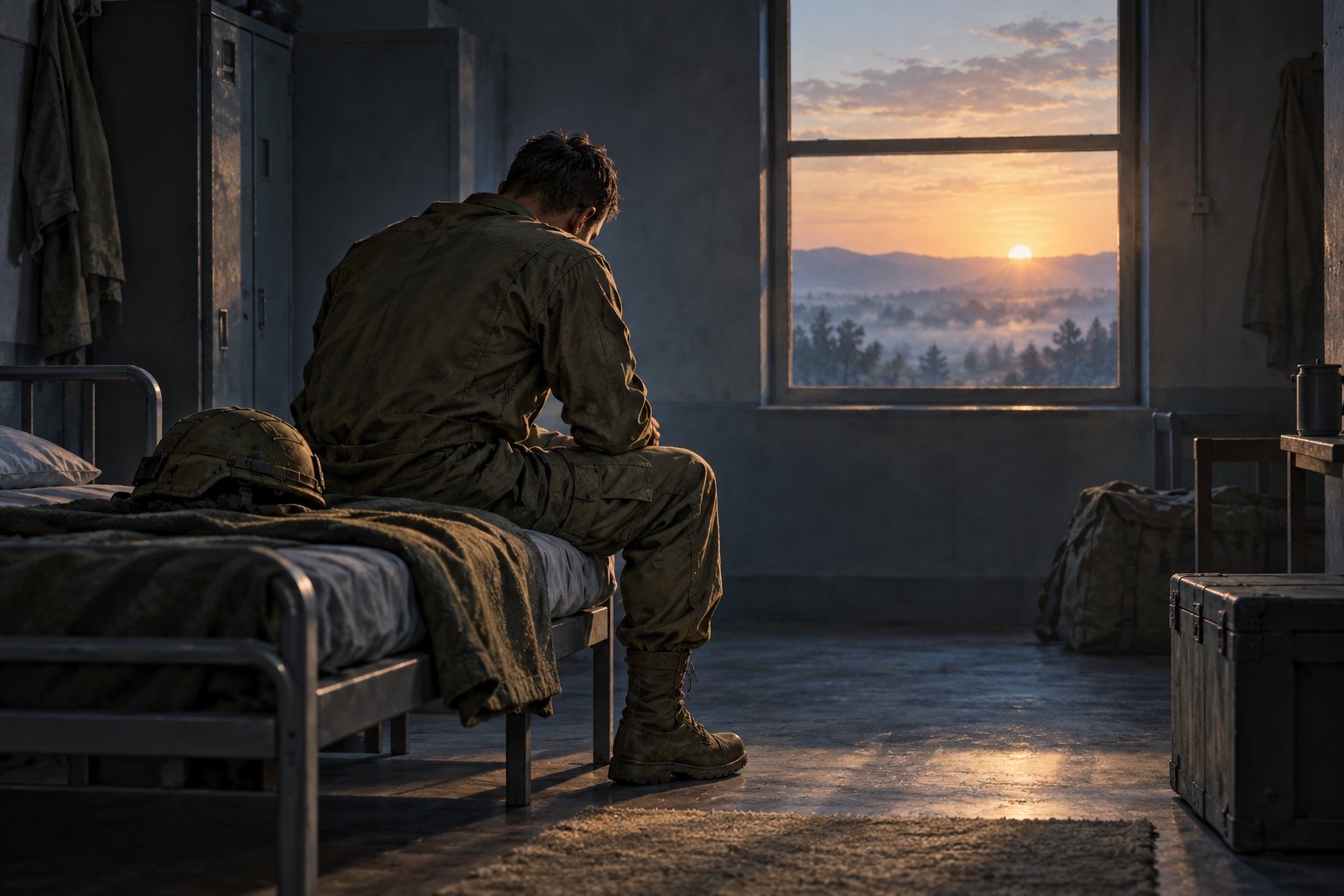
Consequences can extend into ordinary spaces as well. An interrupted routine or a relationship that no longer works as it once did can communicate something an expansive battle scene cannot. The illustration here represents that broader idea; it does not depict a confirmed scene from the adaptation.
Vulnerability can make the spectacle more powerful
There is a useful critical principle behind our character-focused reading of Shelley Duvall in The Shining: understanding danger through a vulnerable person changes how an audience experiences it. The relevance here is perspective, rather than any claim that these films share a story.
For Call of Duty, vulnerability need not mean helplessness. A highly capable character can still have incomplete information, competing responsibilities, or limited control over an outcome. Those limits make judgment meaningful. If every instinct is correct and every difficult decision receives immediate vindication, the film leaves little room to explore the burden its director describes.
Nor must emotional credibility eliminate humor or camaraderie. Characters need enough life beyond suffering for viewers to understand what danger threatens. Their attachments, habits, and disagreements would give loss a specific meaning rather than a generalized mood.
The deeper question inside duty
The most compelling possibility in the director’s remarks concerns obligation. Duty can describe an order, a commitment to another person, or a conviction about what must be protected. Those meanings may overlap, but drama emerges when they pull in different directions.
My standard for this adaptation would therefore be whether its characters must interpret duty, rather than merely invoke it. A film earns that theme when doing the assigned job and living with the result become connected dramatic problems.
The announcement offers a worthwhile ambition, with no guarantee of its fulfillment. If Call of Duty makes its characters’ burdens shape the story all the way through, its action could acquire lasting emotional force. The decisive measure will be what victory asks them to carry afterward.
Original content by this site's editorial team. Published: October 31, 2026 at 20:08:49 PDT (Los Angeles time)