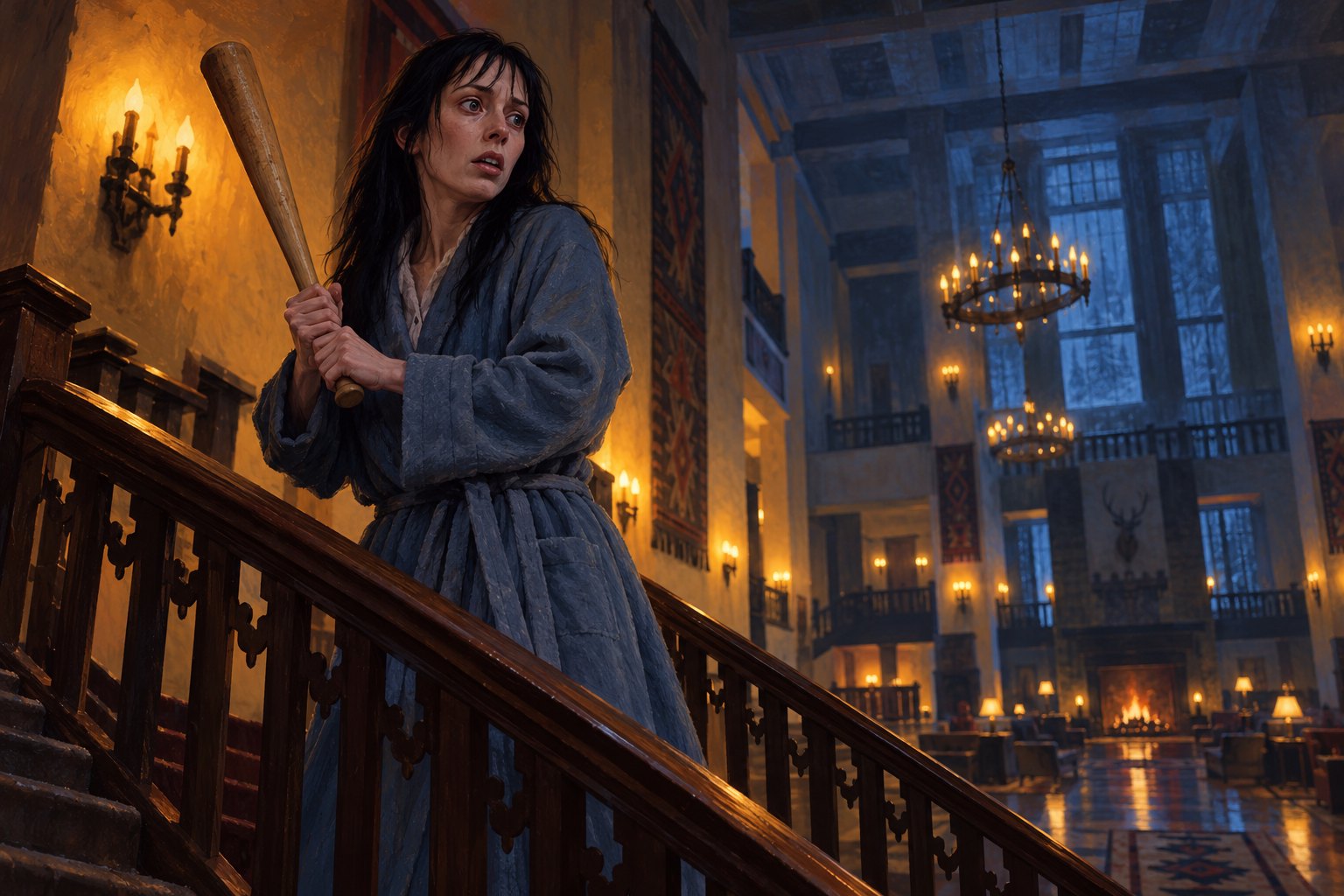
Shelley Duvall makes The Shining frightening because she gives its violence a human consequence. Jack Nicholson’s Jack Torrance commands attention with his sneers, sudden changes of tone, and terrifying appetite for domination. Duvall’s Wendy makes us feel what it costs to share a room with him. Her performance turns the Overlook Hotel from an extraordinary haunted building into a place where a mother must keep making decisions while desperately afraid.
For me, that is the crucial achievement of Stanley Kubrick’s 1980 film. Nicholson supplies the spectacle of a man becoming monstrous; Duvall supplies the emotional pressure that makes the spectacle hurt. Watch Wendy closely, and an apparent story about a father’s unraveling becomes an equally compelling story about a woman learning that protecting her family means resisting her husband.
Spoiler warning: This review discusses the entire film, including its ending.
Wendy’s ordinary behavior establishes the danger
Jack takes the winter caretaker job at the isolated Overlook, bringing Wendy and their son, Danny. The arrangement promises space for his writing and a fresh start for the family. Yet the film establishes a history of harm before the hotel’s supernatural forces fully assert themselves: Jack has previously injured Danny.
Duvall’s early performance matters because Wendy does not enter the story behaving as though she is already inside a horror movie. She tries to sustain conversation, maintain routines, and make their circumstances workable. Her friendliness can look awkward beside Nicholson’s guarded hostility. That imbalance is expressive. She keeps offering connection to someone who increasingly treats connection as an imposition.
There is a painful difference between what Wendy hopes a conversation will accomplish and what Jack wants from it. She approaches him as a partner; he increasingly hears an interruption. Duvall makes those small failures accumulate. Long before she carries a weapon, her tentative delivery suggests someone measuring the emotional temperature before taking another step.
This does not make Wendy foolish. It makes the film uncomfortable in a recognizable way. A relationship does not become legible all at once, especially when acknowledging its danger would require dismantling the life built around it.
Jack turns responsibility into an excuse for control
Nicholson’s performance is expansive, sometimes almost vaudevillian. His exaggerated politeness can become a threat before his voice rises. That theatrical quality is particularly effective opposite Duvall, whose reactions remain grounded in the immediate question of what Jack might do next.
As Wendy becomes concerned about Danny, Jack invokes his work and obligations to the hotel. The language of responsibility becomes a means of dismissing the people to whom he has the clearest responsibilities. He presents their needs as an assault on his importance.
The Overlook’s appeal to him can be read through that resentment. Its grand spaces and spectral social world offer the recognition he believes his family withholds. Wendy asks him to respond to a frightened child. The hotel offers him a stage.
That tension gives the supernatural story its moral shape. The ghosts do not make Jack’s behavior emotionally incomprehensible. They magnify his willingness to treat other people as obstacles. A related question runs through our analysis of power and persecution in The Devils: how does violence become easier when its perpetrators give it a respectable justification?
The manuscript makes Wendy’s isolation visible
When Wendy discovers that Jack’s manuscript repeats “All work and no play makes Jack a dull boy,” the revelation destroys more than her confidence in his writing. The pages expose the emptiness behind the activity around which the household has organized itself.
The phrase is banal; its repetition is horrifying. Page after page suggests that time has passed without the progress Wendy imagined. The work that supposedly required her absence has become evidence of a reality from which she was excluded.
Duvall gives this discovery room to register. Wendy is reading, checking, and trying to understand. That process makes the scene more frightening than an instantaneous scream would. We experience the interval between finding something wrong and comprehending how wrong it is.
The typewriter also changes meaning. An ordinary instrument of work becomes the center of a threatening private world. Kubrick needs no new monster for this revelation. He needs Wendy to look at what has been sitting in front of her.
On the staircase, fear becomes action
The staircase confrontation is the strongest argument against treating Wendy as merely a screaming victim. Holding a baseball bat, she retreats as Jack advances. Her movements are uncertain, her voice strained. Yet she continues to preserve distance between them.
Duvall does not turn self-defense into a sudden display of polished competence. Wendy is trying to stop someone she knows, while still struggling with the fact that stopping him has become necessary. The hesitation belongs to the situation.
When she strikes Jack and subsequently locks him in the pantry, her fear has not disappeared. Her behavior has changed. That distinction is the performance’s central insight: terror and effective action can exist in the same body.
Notice how differently the actors use space. Nicholson presses forward as though the scene belongs to him. Duvall works backward, negotiating the next foothold and the next second. His performance asserts control; hers measures the effort required to escape it.
The bathroom scene refuses the comfort of an iconic quote
“Here’s Johnny!” is easily detached from the film as a punch line. Within the bathroom attack, however, Jack’s showmanship is grotesque because Wendy is on the other side of the broken door. His enjoyment and her desperation occupy the same sequence.
Wendy gets Danny through the window but cannot follow him. That physical limitation is devastatingly simple. She can create an escape route for her child without being able to use it herself. The scene transforms protection into a concrete action with an immediate personal cost.
Duvall keeps the danger bodily: breath, trembling, the effort of holding a knife, the shrinking margin between defense and injury. Her reactions give Jack’s performance resistance and consequence. Without that counterweight, his grandstanding could become too entertaining.
This emphasis on care under pressure also connects with our reading of compassion in The Exorcist. Horror gains emotional force when helping another person requires remaining present inside something unbearable.
Danny survives by changing the pattern
Danny’s escape through the snowy hedge maze extends the film’s concern with observation. He retraces his footprints and conceals his route, frustrating Jack’s pursuit. Force is defeated by attention to the environment.

Wendy and Danny ultimately escape in the snowcat brought by Dick Hallorann, whose attempt to help costs him his life. Their survival therefore depends on several kinds of action: Hallorann’s intervention, Wendy’s defense, and Danny’s ingenuity. The ending does not award safety to a single invulnerable hero.
Wendy’s endurance is especially affecting because the film offers no moment in which survival makes her serene. Escape is an achievement, not proof that the experience has left her untouched.
The final photograph—and the details worth revisiting
The closing photograph places Jack among the Overlook’s revelers in 1921. Its precise supernatural explanation remains open. What is unmistakable is the contrast: Wendy and Danny move away from the hotel, while Jack appears absorbed into its past.
On another viewing, watch the smaller patterns rather than hunting for a single secret solution. The model maze anticipates the landscape of the final pursuit. “REDRUM” becomes intelligible through its reflection. Jack’s manuscript turns repetition into a trap. These are visible connections, not evidence that every object conceals a code.
My reading is that The Shining makes repetition the language of its evil: familiar grievances, renewed violence, and a past that keeps claiming the present. Wendy’s resistance interrupts that movement. Duvall makes the interruption exhausting, frightened, and convincing. Nicholson gives the nightmare its grin; she gives survival its weight.
Original content by this site's editorial team. Published: October 31, 2026 at 15:57:55 PDT (Los Angeles time)