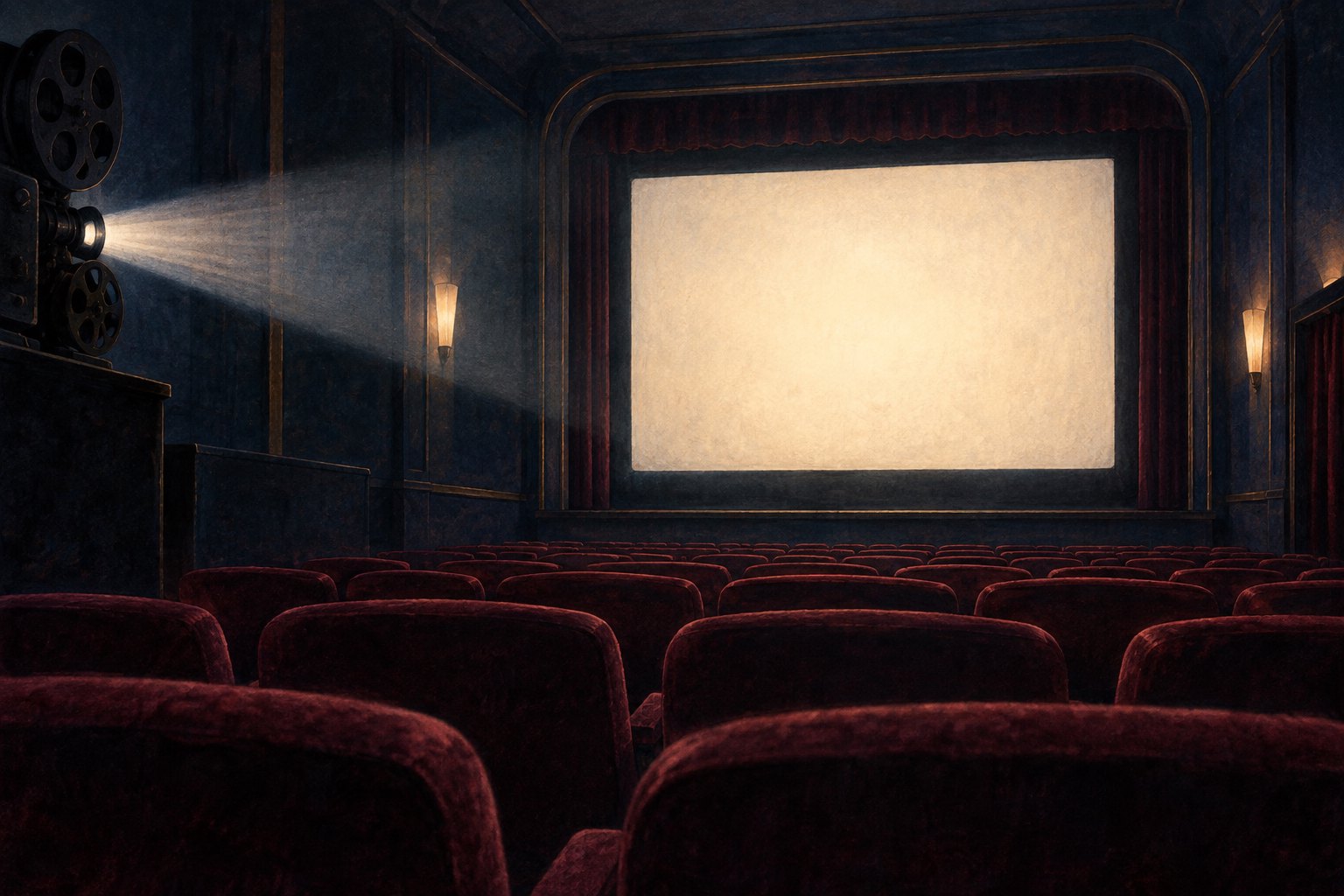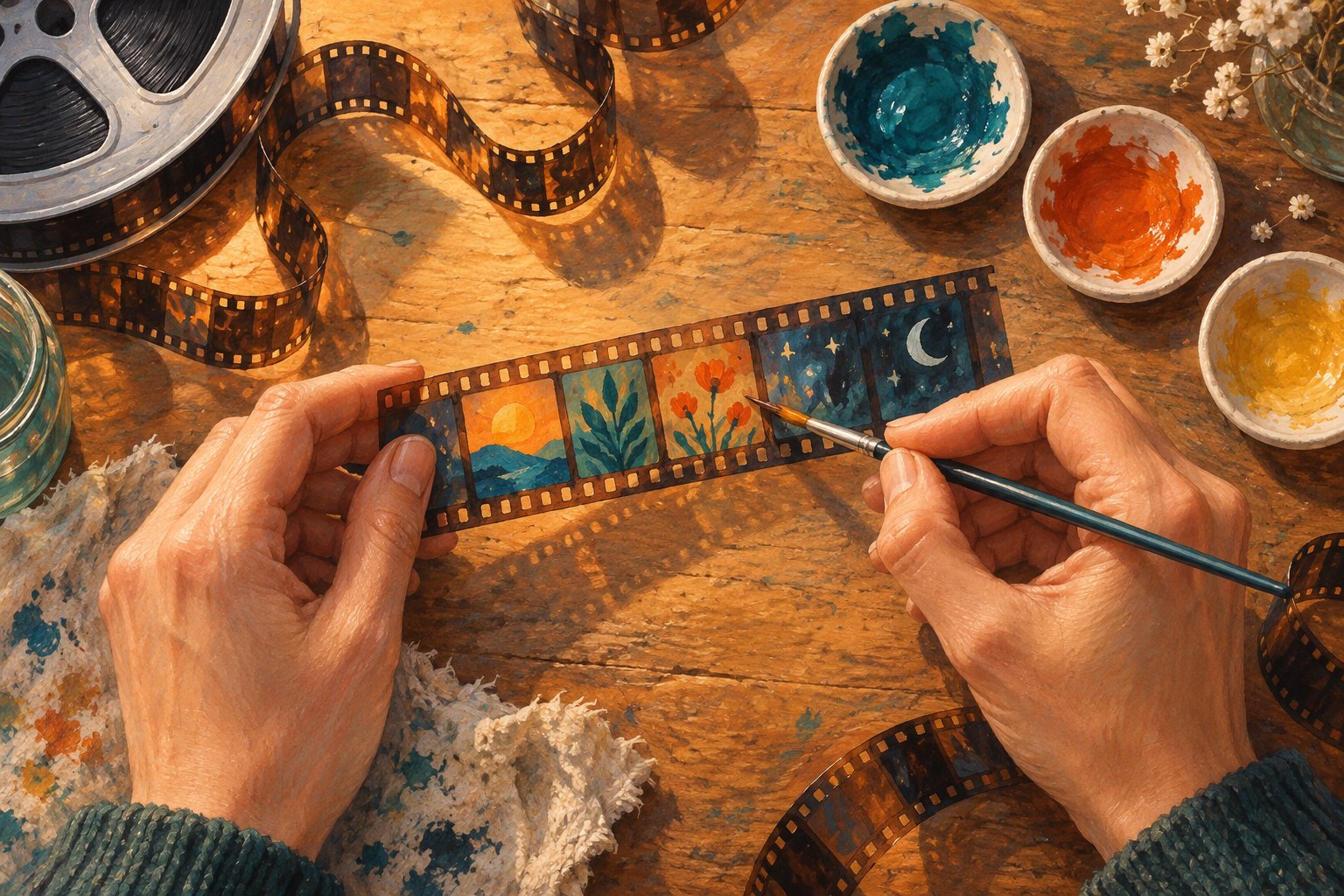
An Austin club is giving old film a new purpose: people can draw, paint, and scratch on it to create art. As described in KUT’s reporting, the attraction is wonderfully physical. Film becomes something to handle and alter, bringing the material behind moving images within reach of the person who usually watches them.
The playful “strip” wording gets attention. The creative premise deserves more. For anyone interested in movie reviews and film analysis, this activity opens a useful question: how much of our response to an image comes from its subject, and how much comes from its color, texture, and movement?
My view is that the strongest appeal lies in that shift of attention. Working on a filmstrip can make visual decisions feel concrete. A line has a direction. A patch of paint occupies space. A scratch interrupts what was already there. Those small choices offer a practical way to think about how movies guide our eyes.
What the Austin Activity Actually Offers
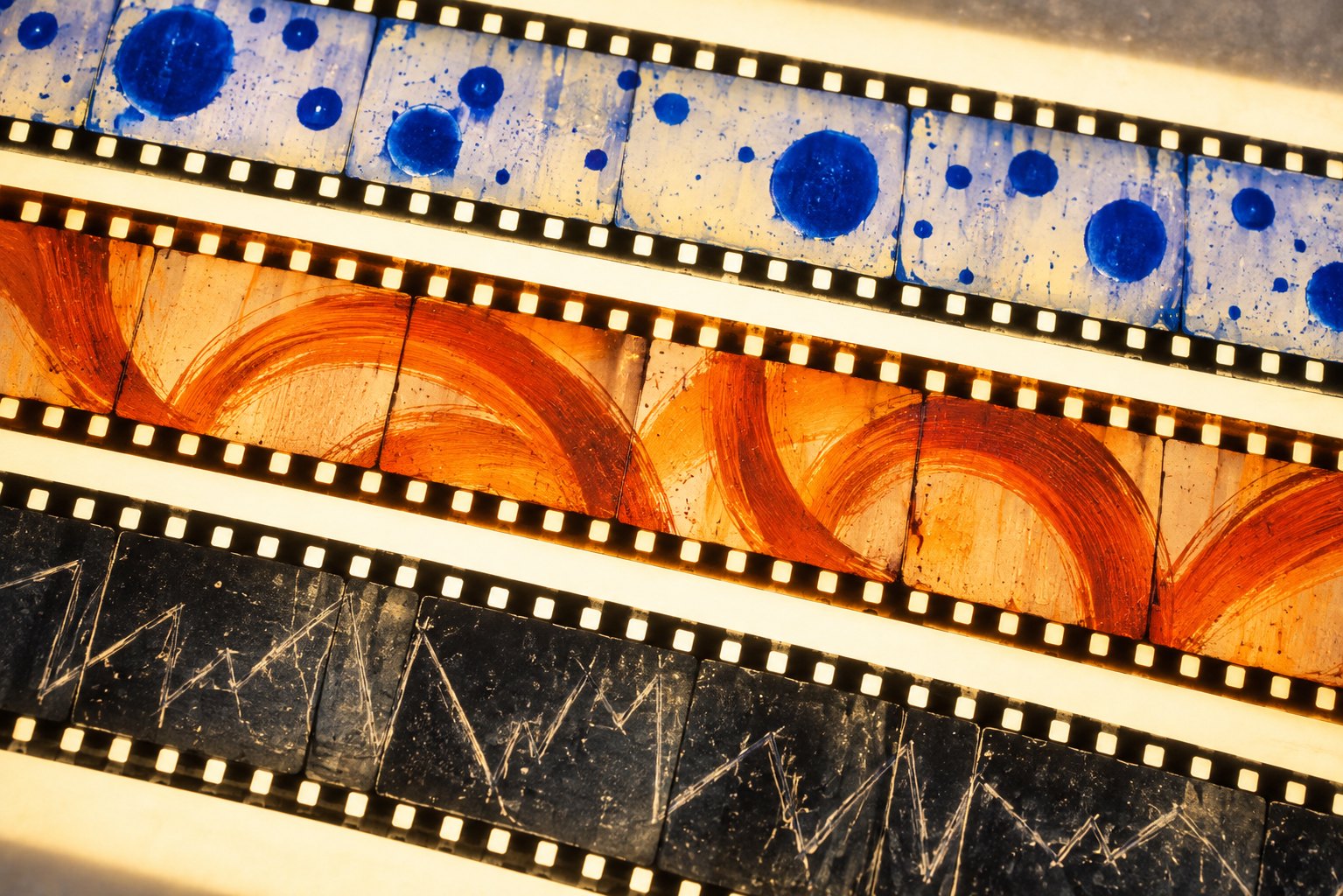
The central idea is straightforward: old film becomes a surface for drawing, painting, and scratching. These are three different ways of changing an existing material. Drawing introduces marks; painting can build areas of color; scratching removes or disrupts part of a surface.
That description establishes the activity’s appeal, but it does not establish the quality of any finished work. An invitation to experiment is something we can discuss on its own terms. Individual pieces deserve judgments based on what they actually do.
The distinction matters here because this is an arts activity rather than a named narrative feature. There is no established plot to recap, character arc to evaluate, or movie dialogue to quote. The useful critical approach is to consider the creative possibilities of the process while keeping imagined examples separate from accounts of what participants have made.
Drawing, Painting, and Scratching Make Different Arguments
A drawn line directs attention
Imagine adding a small circle to an existing image. Even without knowing what the image contains, the circle creates a point of emphasis. Put it near the edge and the composition may feel pulled sideways. Put it at the center and it may become the first thing a viewer notices.
This hypothetical exercise has an immediate connection to watching movies. A frame distributes attention through placement, contrast, and empty space. Drawing onto film lets someone intervene in that distribution instead of simply accepting it.
Paint changes the balance of an image
A painted area can become the dominant feature of a composition. Consider a translucent wash that leaves something visible underneath, then imagine a dense patch that obscures it. The difference invites two distinct readings: looking through a color and confronting a barrier.
Neither effect automatically carries a fixed emotion. Red does not always mean anger, and blue does not always mean sadness. What matters is the relationship between the color, the surrounding image, and the viewer’s expectations. The most interesting experiment would test that relationship rather than rely on a ready-made color code.
A scratch makes the surface noticeable
Scratching brings the material itself into the foreground. Where drawing and painting add something, a scratch can make an absence visible. It also introduces a gesture that may appear delicate, restless, abrupt, or forceful depending on its shape and context.
Those descriptions are interpretations, not reliable evidence of the maker’s emotional state. A jagged mark could be carefully planned. A smooth stroke could be accidental. Good criticism describes the effect before guessing at the intention.
How a Small Mark Can Suggest a Larger Rhythm
A single altered image asks where we look. A sequence introduces another question: when does something change? If handmade images are presented in succession, repetition and variation become tools for shaping the experience.
Imagine a dot appearing in approximately the same place across several images, then shifting toward an edge. The change could read as movement. Imagine that dot disappearing altogether. Its absence could become the sequence’s most noticeable event. These are illustrative possibilities, not descriptions of a particular Austin participant’s work or a confirmed screening format.
For a movie watcher, the broader lesson concerns expectation. Repetition establishes something we begin to anticipate. A break in that pattern gains force because of what preceded it. The same critical question applies to a scene that repeatedly returns to one person’s face: what happens when the film finally holds on someone else?
Our commentary on why listening and reaction shots deserve attention approaches that question through performance. Handmade marks offer another entry point into the way a film allocates our attention.
Looking for Emotion Without Inventing a Story
Character-based criticism often begins with desire: what does this person want, and what stands in the way? Abstract imagery invites a different starting point. We can ask what persists, what changes, and which element seems to organize the image.
A recurring shape might become something the eye follows. Another mark might interrupt it. That relationship can suggest tension without establishing a literal conflict between characters. Calling one shape a hero and another a villain would add a story the work may never support.
The more useful response is specific: a dense cluster made the frame feel crowded; an open area gave the eye somewhere to rest; an interruption made a repeated pattern newly noticeable. Such observations explain an experience while leaving room for another viewer to respond differently.
That discipline also runs through our discussion of separating interpretation from evidence in film conversations. An imaginative reading becomes stronger when readers can see what prompted it.
A Simple Framework for Your Own Experiment
If you try working on film, a small creative constraint can make the results easier to understand. These suggestions are general exercises, not a description of the Austin club’s curriculum:
- Choose one kind of mark. Begin with dots, curves, or short lines so that differences remain easy to notice.
- Change one feature. Explore size, spacing, or density before changing everything together.
- Leave some material visible. Give yourself a way to compare your intervention with the surface beneath it.
- Describe the result plainly. Identify where your eye goes and what creates that pull before assigning a theme.
For practical participation details, confirm arrangements with the organizer, including which materials are suitable and how finished pieces will be handled or viewed. The creative concept alone does not establish those particulars.
The Deeper Appeal: Film Becomes Touchable
What interests me most about Austin’s activity is the change in the viewer’s relationship to film. A material associated with finished images becomes available for another decision. Someone can respond to it with a line, a wash of color, or an interruption.
Oldness does not guarantee artistic value, and handmade texture does not excuse an uninteresting result. The work still needs to reward attention. But the invitation itself is valuable: it makes composition something a person can test with their hands.
That experience can travel back into ordinary moviegoing. A viewer may become more attentive to an obstructed face, a repeated color, or a sudden change in visual rhythm. Austin’s film-art activity offers a modest, compelling starting point for that awareness: take a surface, make a choice, and look closely at what changed.
Original content by this site's editorial team. Published: September 14, 2026 at 20:13:40 PDT (Los Angeles time)