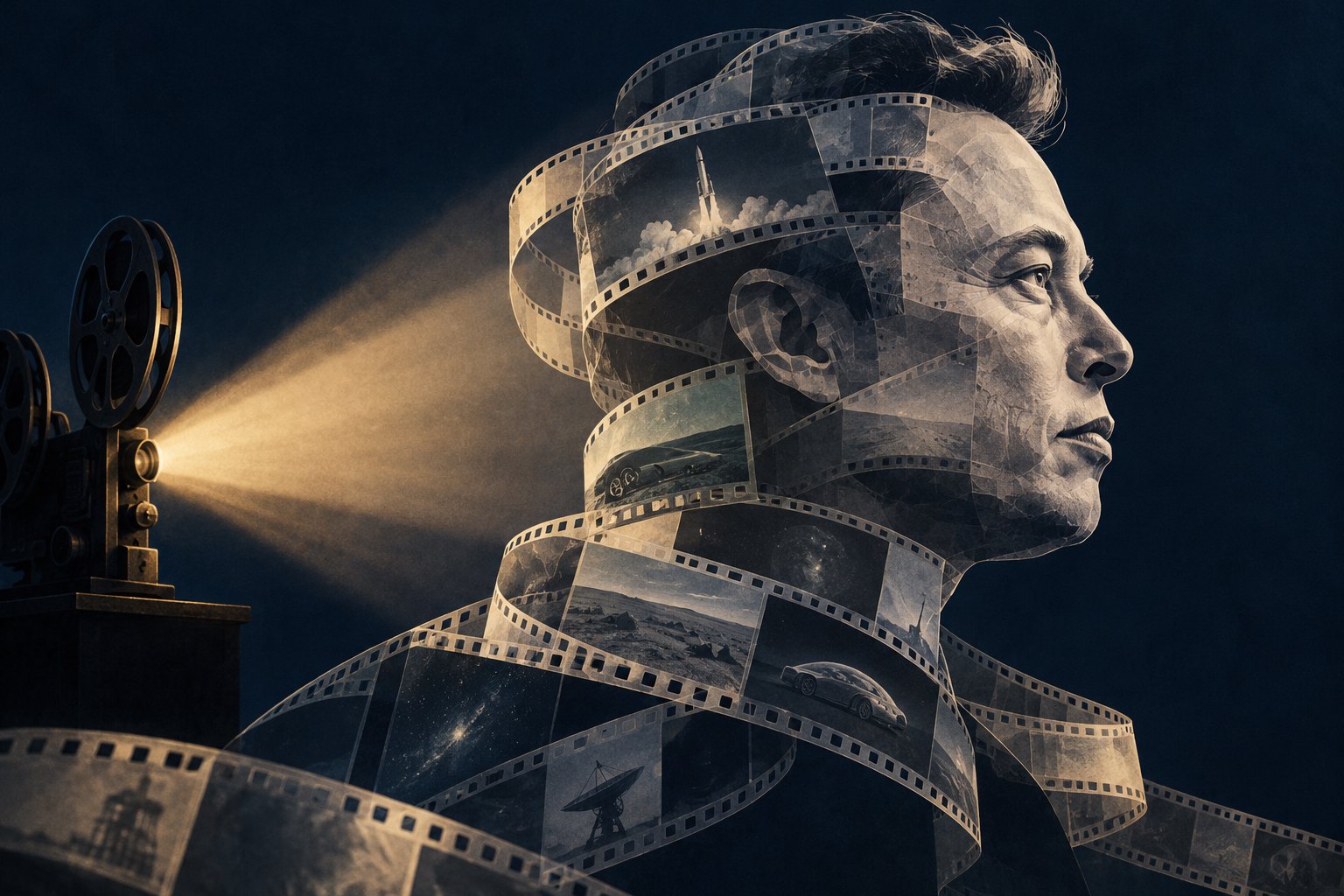
Alex Gibney’s Musk puts an unusually large demand on its audience: four hours of attention to one already familiar public figure. The New York Times frames its conversation with Gibney around why that length was necessary. For viewers deciding what to make of the undertaking, the central question is what those hours allow a documentary to explain.
The strongest critical case for that duration is the space it can give to context, competing perspectives, and consequences. That is an argument about documentary form, however, rather than a verified account of Gibney’s specific explanation. A director’s reasons for making a long film and the audience’s reasons for finding it worthwhile still need to meet on screen.
This is spoiler-free commentary on the film’s runtime and the demands of documentary portraiture, rather than a screening review. It does not assign the film unverified scenes, dialogue, or character arcs.
What four hours can contribute to a portrait
A short portrait has to make rapid decisions about significance. One incident may stand for a personality; one interview may establish a conflict; one transition may carry years of change. Such compression can produce clarity. It can also make a complicated life appear to follow a cleaner trajectory than the evidence supports.
An extended documentary has room to revisit those first impressions. A statement encountered early can acquire a different meaning when placed beside later conduct. An apparently decisive account can be complicated by another witness. A choice that initially seems inevitable can emerge as one of several possibilities.
For a film centered on Musk, that capacity matters because recognition can easily masquerade as understanding. Knowing a face, a reputation, or a collection of public statements does not automatically explain the relationships among them. A documentary’s contribution lies in establishing those relationships carefully enough that viewers can evaluate them.
My view is that this provides a credible artistic argument for four hours. It also sets a demanding standard: the additional material should change the viewer’s understanding. Simply supplying another example of an already established trait offers a weaker justification.
Musk as a documentary subject, rather than a ready-made character
Character analysis works differently in nonfiction. A fictional protagonist’s behavior can be interpreted within a deliberately constructed story. A documentary subject exists beyond the frame, and the filmmaker’s selection never encompasses the entire person. Editing creates a portrait without making that portrait exhaustive.
Approaching Musk through its central figure therefore requires attention to the difference between self-presentation, observable action, and interpretation. What someone says about a decision establishes how they describe it. Establishing the decision’s consequences requires additional evidence. Inferring an underlying motive demands greater caution still.
Those distinctions become especially valuable when a subject provokes strong expectations. Viewers may arrive prepared to admire, distrust, or dismiss him. A substantial film should give those viewers something more demanding to do than recognize the version they already carry.
The same concern about reputation preceding the work appears in our commentary on how early labels shape movie expectations. Here, the label attaches to a real person as well as a film. The challenge is to keep familiarity from doing the work that evidence should perform.
The surrounding voices determine the portrait’s depth
One practical way to assess a long documentary is to watch what happens when its central subject stops speaking. Do other participants introduce experiences and priorities of their own? Does their testimony complicate the narrative? Or does every voice serve the same predetermined description?
A person discussing a powerful figure may have a different understanding of the stakes than that figure does. What looks like an ambitious decision from one position may look like uncertainty from another. The documentary earns depth when it makes those differences intelligible and establishes the basis for each account.
This is where additional running time can have its greatest value. Giving someone time to explain what they knew, what they did, and what they could not know makes their testimony easier to assess. A brief, emphatic quotation may be memorable while leaving those essential questions unanswered.
For Musk, the useful character-centered question is consequently broader than whether the film makes its subject compelling. It is whether the people around that subject can emerge as individuals whose experiences matter in their own right. That is a standard to apply while watching, not a claim about which participants appear.

Accumulation needs an argument
Four hours can accommodate a great deal of material. Organization determines how much of it becomes understanding. Chronology establishes sequence, but sequence alone cannot establish causation. Putting two statements beside each other may reveal a contradiction; it may also conceal a change in circumstances that explains the difference.
The viewer should therefore be able to distinguish what the film documents from what its arrangement invites them to infer. Dates, context, and the limits of a witness’s knowledge can be less immediately arresting than a forceful montage. They are often more valuable to the argument.
Pacing belongs in this discussion because it governs comprehension. A pause after difficult testimony can give viewers time to consider it. A rapid sequence can make a pattern visible. Repeated emphasis can eventually reduce the space available for independent judgment. No particular tempo guarantees rigor.
Our examination of why an offscreen explanation cannot settle a judgment about the work raises a related distinction. Gibney’s discussion can illuminate his intention. Whether the duration feels necessary depends on what the completed film achieves with it.
Three questions to carry into the film
A useful viewing approach is to evaluate the extended format at specific turning points:
- What has changed in my understanding? Look for new context or a meaningful complication, rather than information added solely for volume.
- Whose perspective is shaping this conclusion? Separate the subject’s account, another participant’s testimony, and the filmmaker’s interpretation.
- What supports the connection being made? Notice whether a transition demonstrates a relationship or merely encourages you to assume one.
These questions leave room for emotional engagement. A documentary can be funny, disturbing, or absorbing while remaining precise. They simply help distinguish the force of an experience from the strength of an explanation.
The deeper stakes of spending that much time
The most interesting tension in a four-hour portrait is the attention it gives its subject. Such scale can imply exceptional importance before the argument has even begun. The film must then decide what to do with that attention: concentrate it on personality, or use it to examine relationships, choices, and consequences.
For me, the strongest possible justification for Gibney’s extended Musk is the opportunity to make a familiar figure more comprehensible through those connections. Four hours offers room to move beyond the instant judgment, preserve uncertainty where necessary, and let evidence develop. The lasting measure is how much more clearly viewers can think about the subject when that time is over.
Original content by this site's editorial team. Published: October 11, 2026 at 13:49:20 PDT (Los Angeles time)