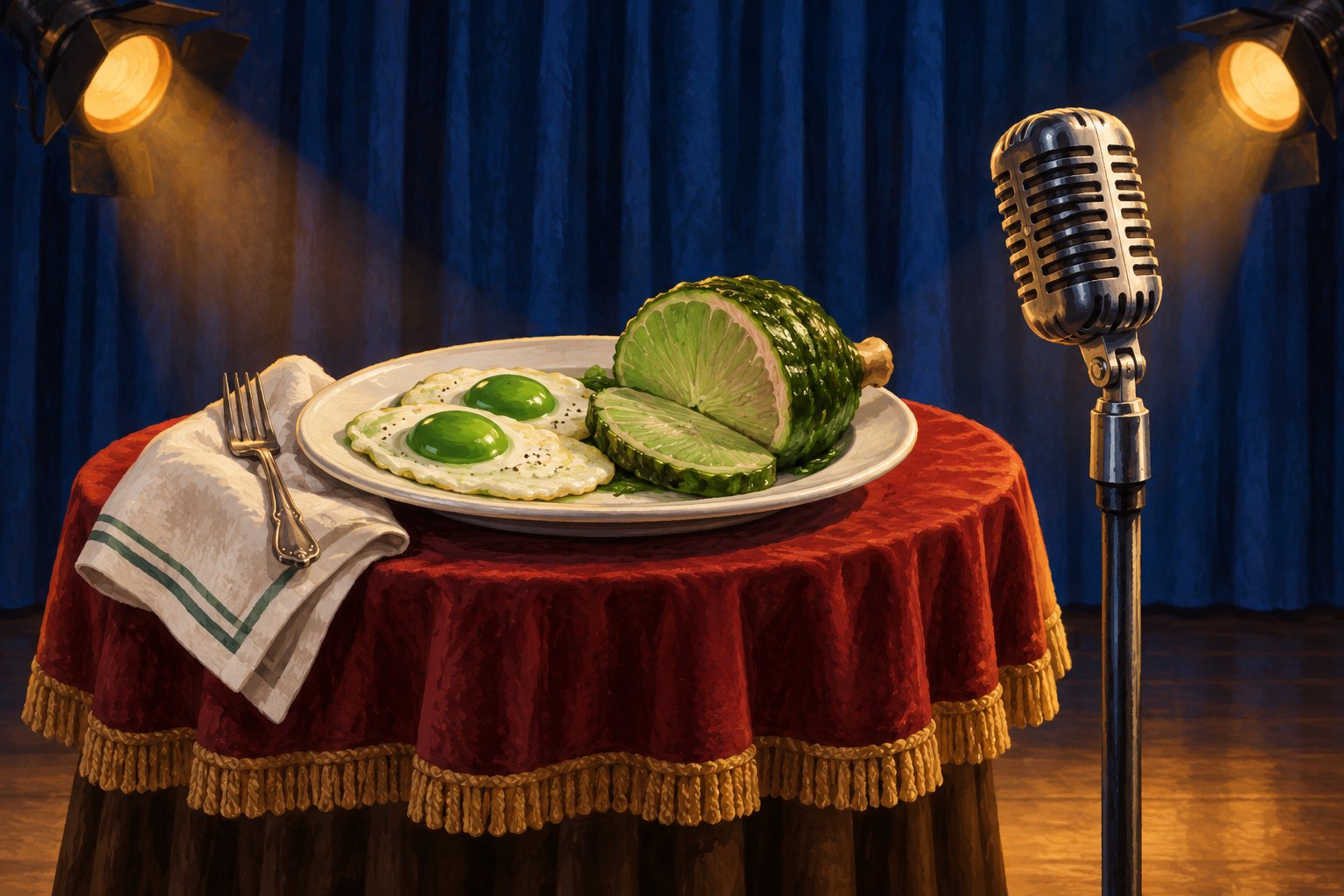
Shane Gillis dropped an F-bomb during Saturday Night Live’s “Green Eggs & Ham” sketch and apologized, according to Deadline. That establishes the central incident. Whether the slip made the comedy funnier, weakened it, or merely interrupted it remains a question of interpretation.
The apology deserves a similarly precise reading. Acknowledging an on-air mistake can address the mistake itself. It cannot determine how viewers should feel about the surrounding performance. For this particular incident, the most interesting critical question is how an adult expletive interacts with a title carrying such unmistakably child-friendly associations.
What the apology actually addresses
An apology following an accidental swear gives viewers an acknowledgment that something went wrong. Beyond that, its meaning depends on its wording and context. The fact that Gillis apologized does not, by itself, establish his intentions before the slip, his private feelings afterward, or how every viewer received it.
That distinction matters because apologies can become overloaded in entertainment coverage. They are asked to resolve questions of professionalism, sincerity, taste, and artistic quality simultaneously. Those questions require different evidence. A performer can acknowledge an error while viewers continue to disagree about the jokes. A viewer can accept the acknowledgment and still find the routine unfunny.
My view is that an apology should be judged against the specific action it addresses. Treating it as a verdict on an entire appearance gives it more explanatory power than it possesses. Likewise, treating an accidental profanity as proof of an entire comic philosophy asks one word to do too much work.
Why “Green Eggs & Ham” changes the comic equation
The sketch’s title is essential to understanding the incident’s potential comic force. “Green Eggs & Ham” evokes a world associated with children’s entertainment. An F-bomb introduces a sharply different register. Even without reconstructing the routine, that contrast is apparent: the language and the familiar cultural reference pull in different directions.
Such incongruity can produce a laugh because an audience recognizes a mismatch immediately. It needs little explanation. The surprise comes from hearing language that clashes with the expectations attached to the setting. In that sense, the title supplies context that a generic description of someone swearing on television would lose.
But contrast has limits as a comic device. Once the initial mismatch registers, a sketch still needs somewhere to go. Character motivation, escalation, and timing determine whether the surprise develops into a satisfying scene. An unexpected word may intensify a moment without supplying any of those elements itself.
That is the standard I would bring to evaluating this routine: what does the clash of registers reveal about the fictional situation? A memorable interruption and a well-built sketch can coexist, but the first does not establish the second.
Character gives strong language a purpose
For character-focused criticism, the useful question is what a line accomplishes between people. Does it express frustration, assert authority, expose insecurity, or change a relationship? Strong language can serve any of those purposes. Its dramatic value comes from the pressure behind it and the response it creates.
Applied to Gillis’s “Green Eggs & Ham” incident, that approach means resisting the temptation to evaluate the vocabulary in isolation. A full assessment would need to follow the characters’ objectives before and after the slip. The reported incident alone cannot establish those objectives, and it would be misleading to invent them.
The same interest in relationships guides our analysis of authority and audience in SNL’s USS Lincoln cold open. Who is speaking, who must listen, and what each person wants can tell us more about a scene than its most provocative phrase.
For viewers revisiting Gillis’s sketch, a practical test is to imagine the offending word replaced by an ordinary expression. Does the underlying conflict remain funny? If so, the comedy has a structure worth discussing beyond the accident.

Viewers can disagree without disagreeing about the facts
One viewer may enjoy the unpredictability of a live mistake. Another may find it distracting. A third may care primarily about the material around it. These are possible responses, rather than a claim about how the audience actually divided, and none requires disputing that the slip and apology occurred.
This is where criticism benefits from specificity. Saying the accident was amusing describes one experience. Saying the sketch succeeded requires an argument about the sketch. Saying an apology was adequate calls for attention to what was acknowledged. Collapsing these judgments into a single approval or rejection makes the discussion less useful.
Gillis’s public comic persona can also shape expectations, but it should not substitute for evaluating an individual scene. Our discussion of his “gas station egg” nickname and self-deprecating humor considers how a compact phrase can build a persona. Here, the critical challenge is different: an accidental utterance should not automatically receive the same interpretation as a deliberately constructed joke.
How to judge the sketch beyond the slip
A useful viewing approach is to track three things: the premise, the development, and the payoff. The premise establishes the comic problem. The development changes or intensifies it. The payoff gives that movement a destination. Those elements offer a firmer basis for evaluation than the mere presence of a taboo word.
Timing deserves separate attention. An interruption might disrupt a rhythm, create a new one, or leave the original structure intact. Determining which happened requires watching the surrounding performance. The existence of an apology supplies no answer to that artistic question.
My critical preference is for comedy that remains interesting once its surprise is familiar. On a second viewing, the audience already knows the accident is coming. Character choices and scene construction must then carry more of the experience. That is a demanding but useful measure of a sketch’s durability.
The larger tension: surprise within a familiar frame
Gillis’s incident brings two expectations into contact. Live comedy invites the possibility that something unexpected will happen. A familiar storybook reference supplies an especially recognizable frame. The reported profanity creates a collision between those expectations, while the apology acknowledges the mistake.
The deeper question is how much artistic credit an accident should receive. It can add spontaneity to an experience without explaining the quality of the writing or acting around it. For me, the fairest judgment leaves room for both pleasure and precision: enjoy the surprise if it works for you, assess the apology on its own terms, and give the sketch the attention its characters and construction deserve.
Original content by this site's editorial team. Published: October 11, 2026 at 13:16:07 PDT (Los Angeles time)