
The Atlantic Coast Conference has announced that it is joining Catapult Film Room as a launch partner. For readers encountering the name through an interest in movies, the relevant connection is sports footage and its interpretation. This is a partnership announcement, with an intriguing question for film-minded viewers underneath it: how much of our judgment depends on what a camera lets us see?
The confirmed news here is the ACC’s launch-partner role. The discussion that follows is critical commentary about viewing and interpretation, rather than a hands-on assessment of Catapult’s product. A partnership alone cannot establish the quality of a viewing experience, the usefulness of particular tools, or what an individual viewer will learn.
Still, the announcement provides a useful occasion to examine a habit shared by sports spectators and movie audiences. We tend to give the person at the center of the image the largest share of responsibility. Sometimes that attention is earned. Sometimes the frame has simply made everyone else harder to notice.
What the launch-partner announcement establishes
The phrase launch partner places the ACC in a relationship with Catapult Film Room at its introduction. It does not, by itself, explain the scope of every participating institution’s involvement or establish how successful the arrangement will become. Those are separate questions requiring separate evidence.
That distinction matters because announcements encourage readers to jump from participation to impact. An institution joining a project is an identifiable event. Better understanding, better analysis, and a more rewarding audience experience are outcomes that must be demonstrated.
Our editorial interest is therefore specific: what would make the viewing associated with a film room intellectually valuable? The strongest answer is the opportunity to test an initial impression against visible evidence. That standard applies whether the subject is a football play, a documentary sequence, or a scene whose meaning changes on a second viewing.
The frame distributes attention—and credit
Imagine a hypothetical football sequence presented in a tight shot. A player carries the ball into open space, and the image makes the run feel like an individual achievement. Widen that imagined shot, and other contributions may become visible: a teammate occupying a defender, a block creating a passage, movement elsewhere changing the available space.
Nothing about the original action has changed. Its apparent explanation has. The tighter image may convey speed and pressure effectively while offering less information about how the opportunity developed. A wider composition may clarify relationships while sacrificing the immediacy of a face or a collision.
Film criticism has a vocabulary for this. Framing selects what enters the image; staging arranges relationships within it; editing controls which moments we encounter together. Sports footage invites related questions even when the action itself is unscripted. Where does the image direct attention? What remains outside it? Does the sequence show a cause, or only its visible result?
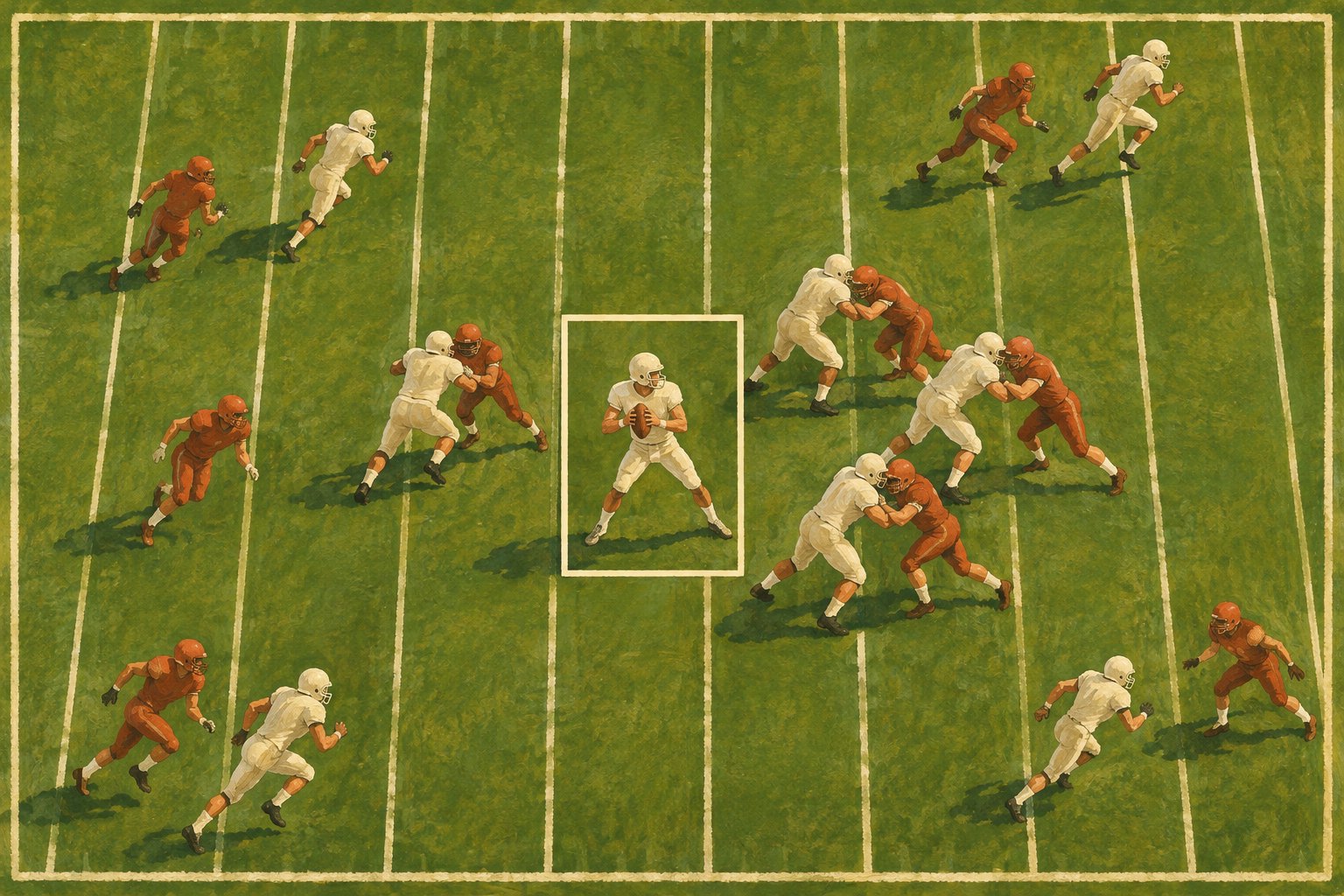
This is the most productive cinematic lens through which to consider the ACC–Catapult announcement. The question is how viewing can distribute attention more fairly among the people contributing to an event.
Consider the player’s perspective without inventing a motive
A character-focused movie review asks what someone wants, what they know, and which choices appear available. Looking closely at an athlete can begin with similar questions, but it requires a stricter boundary around motive. A fictional narrative may reveal a character’s thoughts through dialogue. An image of a real player does not automatically reveal an assignment, an instruction, or an intention.
Consider another hypothetical example: a quarterback appears to overlook an available receiver. From a distant camera position, the opening may seem obvious. That does not establish what the quarterback could see at that instant, when the opening emerged, or whether another movement affected the decision.
A careful viewer can describe observable details: the player turned, pressure approached, a teammate moved into space. Calling the decision careless requires an additional argument. Calling the player selfish goes further still, turning a reading of movement into a claim about personality.
The useful discipline is to distinguish observation from inference. The player moved toward the sideline describes an action. The player intended to draw coverage away proposes an explanation. Both can belong in analysis, provided the second remains recognizable as an interpretation.
Film study and the sports mini movie ask different questions
An edited sports story can organize an event around anticipation, reversal, and release. Its achievement may lie in making viewers feel the pressure of a moment. Analytical viewing asks how that moment developed and whether the visible evidence supports the explanation attached to it.
These purposes can coexist. Our commentary on the storytelling expectations behind the Notre Dame–Miami mini movie considers the emotional promise of presenting competition cinematically. The ACC’s Film Room partnership prompts a complementary question: what happens when the audience approaches images as material to examine?
My view is that neither emotional engagement nor scrutiny needs to disappear. Understanding a contribution outside the central action can make a sequence more affecting. The player who initially seemed incidental may become the person whose timing makes the moment possible. Attention can deepen appreciation without requiring a manufactured hero.
A practical method for watching more carefully
The partnership announcement also offers a useful prompt to improve our own viewing habits. These steps are general analytical practices, rather than claims about features available in Catapult Film Room:
- Watch the action once at normal speed. Establish its rhythm before pausing individual moments. A frozen image removes the pressure of moving time.
- Choose one question. Ask how space opened or when pressure arrived. A specific question produces a more useful second viewing than a search for someone to blame.
- Follow someone away from the central action. Notice whether their movement changes another person’s options.
- Separate description from explanation. Identify what is visible before proposing why it happened.
- Record what remains uncertain. Missing context should limit a conclusion, even when the image feels persuasive.
Knowledge of the ending deserves particular scrutiny. Once we know an action succeeded, its earlier stages can look inevitable. Our discussion of watching Cowboys–Colts without letting the final score determine every judgment explores that problem. Here, the same principle helps define a worthwhile film-room habit: assess the visible decision before allowing the outcome to settle the argument.
The deeper significance: visibility carries responsibility
The ACC joining Catapult Film Room is a concrete partnership development. Its broader meaning for screen culture is interpretive: images become more valuable when viewers learn to question how they allocate attention.
For a movie audience, that might mean recognizing how a reaction shot shifts sympathy. For someone studying football, it might mean noticing a contribution beyond the ball. In both cases, the reward comes from revising an easy first impression.
That is the standard I would bring to the partnership’s promise. More viewing should produce more precise observations and better-supported explanations. The most revealing second look may be the one that changes whose work we notice—and makes us more careful about claiming to know why someone acted.
Original content by this site's editorial team. Published: November 10, 2026 at 23:25:05 PST (Los Angeles time)