
Fort Worth’s historic LGBTQ+ film festival is returning after years of inactivity, according to Fort Worth Report. For local moviegoers, the significance extends beyond having another event to attend. A returning festival offers a place to encounter queer stories together, compare responses, and give films the sustained attention that a crowded entertainment calendar can make difficult.
The comeback is the news; its cultural meaning deserves a separate conversation. This is commentary on that return, rather than a review of an individual selection. The strongest case for welcoming the festival back is that it can make room for both enthusiasm and scrutiny: the pleasure of seeing a story recognized and the freedom to question how well that story is told.
What the Return Establishes—and What It Does Not
The reported development is specific: a historic LGBTQ+ film festival in Fort Worth is coming back after a prolonged inactive period. That does not, by itself, explain why the interruption occurred or establish how audiences will respond. Reading the hiatus as proof of declining interest, or the revival as evidence of guaranteed success, would turn an announcement into an unsupported narrative.
Nor should the festival’s importance become an advance verdict on its films. A meaningful cultural occasion can contain uneven filmmaking. An unfamiliar selection can deliver the weekend’s most rewarding experience. Keeping those possibilities open is part of taking a festival seriously as cinema.
For prospective attendees, practical planning should begin with the organizers’ current program and admission information. Confirm the screening time, venue, ticket requirements, and available accessibility services before making arrangements. Those details determine whether an appealing announcement becomes an experience someone can actually share.
Why a Local Screening Can Change the Experience
A film remains the same sequence of images when watched alone or with an audience, but attention behaves differently in a room full of people. Laughter may reveal a joke’s second meaning. A sustained silence may make a small gesture feel more consequential. Another viewer’s response can expose something that slipped past your own.
That does not make the crowd an authority. Collective enthusiasm can carry a weak scene, just as an uncomfortable audience can resist a challenging one. The value lies in having another response to consider. Afterward, a useful question is whether the film earned the reaction through performance, framing, and dramatic development—or whether recognition supplied what the filmmaking left unfinished.
Our discussion of audience recognition and film criticism at Austin Film Festival explores a related distinction. A shared response tells us something valuable about an encounter between a movie and its viewers. It still leaves room for an individual judgment.
Look for Characters Who Have More Than One Job
For this returning festival, the most productive critical starting point is the person on the screen. In a narrative film, what does that character want? What prevents them from pursuing it? What do they misunderstand about someone else? Those questions help distinguish a fully imagined life from a figure whose only function is to deliver a message.
Identity can shape every part of a story without explaining every decision a character makes. Attraction, ambition, money, family obligations, vanity, and boredom can overlap. A character becomes more interesting when those pressures pull in different directions. The test is whether the film allows that complexity to emerge through choices and consequences.
Supporting characters deserve the same attention. Does a friend have needs beyond advising the protagonist? Can a parent change without becoming a convenient solution? Does a romantic partner possess an interior life outside the central relationship? Our commentary on what makes an ensemble convincing approaches a similar issue: a collection of compelling individuals must also create believable relationships.
These are viewing questions, not claims about the returning festival’s selections. They offer a way to engage with whatever stories the program presents without deciding in advance what LGBTQ+ cinema should look or feel like.
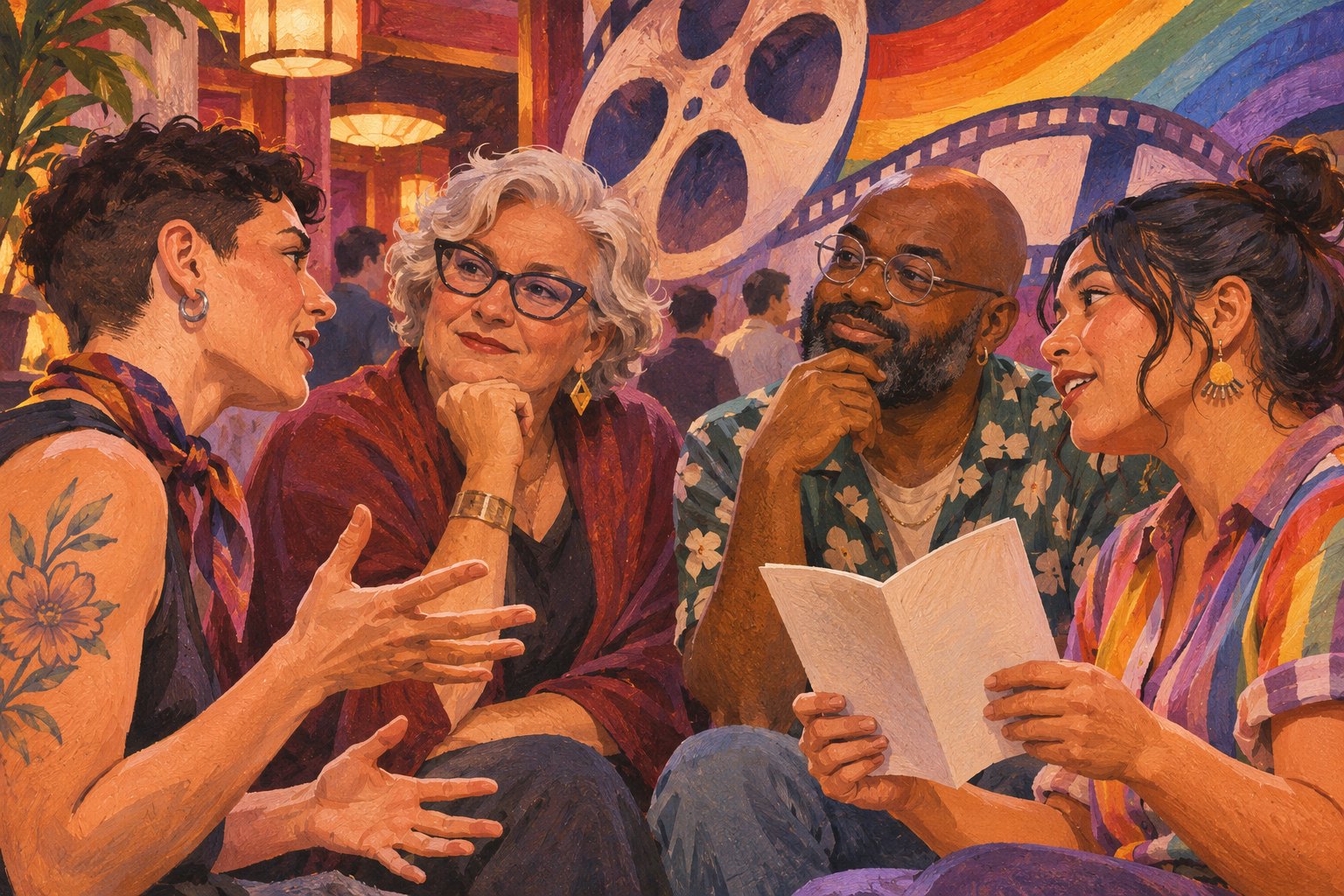
Make Room for Pleasure, Contradiction, and Disagreement
One limiting expectation placed on identity-centered storytelling is that every protagonist must serve as an admirable representative. That can flatten both the film and the conversation around it. Characters need the freedom to be funny, selfish, mistaken, generous, or difficult without every action becoming a verdict on a whole community.
Equally, seriousness is not the only measure of artistic value. Comic timing, romantic chemistry, suspense, and visual exuberance deserve close attention. A light scene can reveal a relationship with remarkable precision; a solemn speech can tell us very little. Tone should be assessed by what it accomplishes.
A worthwhile festival conversation therefore needs room for disagreement. One viewer may find an ending liberating while another sees an unresolved dramatic problem. The useful next step is to identify the scene or choice behind that response. Specificity keeps criticism from collapsing into either automatic praise or blanket dismissal.
How to Leave a Screening With a Sharper Opinion
A few simple habits can turn a festival visit into more than a list of titles watched:
- Remember a decision. Identify a moment when a character could have acted differently, then consider how the performance makes that choice understandable.
- Notice who receives attention. Track whose reactions the camera shows and whose perspective remains unavailable.
- Separate intention from effect. A scene may aim for intimacy or tension without producing it. Explain the gap through something observable.
- Ask another viewer about one moment. A focused question often opens a richer conversation than a request for a rating.
- Protect discoveries. Discuss performances and craft freely, but flag plot revelations before describing them.
If dialogue stays with you, consider what the actor does around it: a pause, a glance, a sudden change of subject. Memorable writing does not work independently of performance. Accurate quotation matters, too; an approximate recollection should remain a paraphrase.
A Return Worth Judging by What Happens Next
Fort Worth’s festival comeback offers an opportunity to renew a public relationship with film. The deeper promise is continuity: viewers returning, conversations developing, and individual movies acquiring a place in local memory. That possibility is worth welcoming without pretending its future is already settled.
The most generous response is also a demanding one. Show up curious. Give unfamiliar work your attention. Appreciate what succeeds and describe what does not. A historic LGBTQ+ festival gains renewed meaning when its audience treats the films as living works of art—capable of delighting, troubling, disappointing, and surprising the people gathered to watch them.
Original content by this site's editorial team. Published: November 10, 2026 at 20:17:38 PST (Los Angeles time)