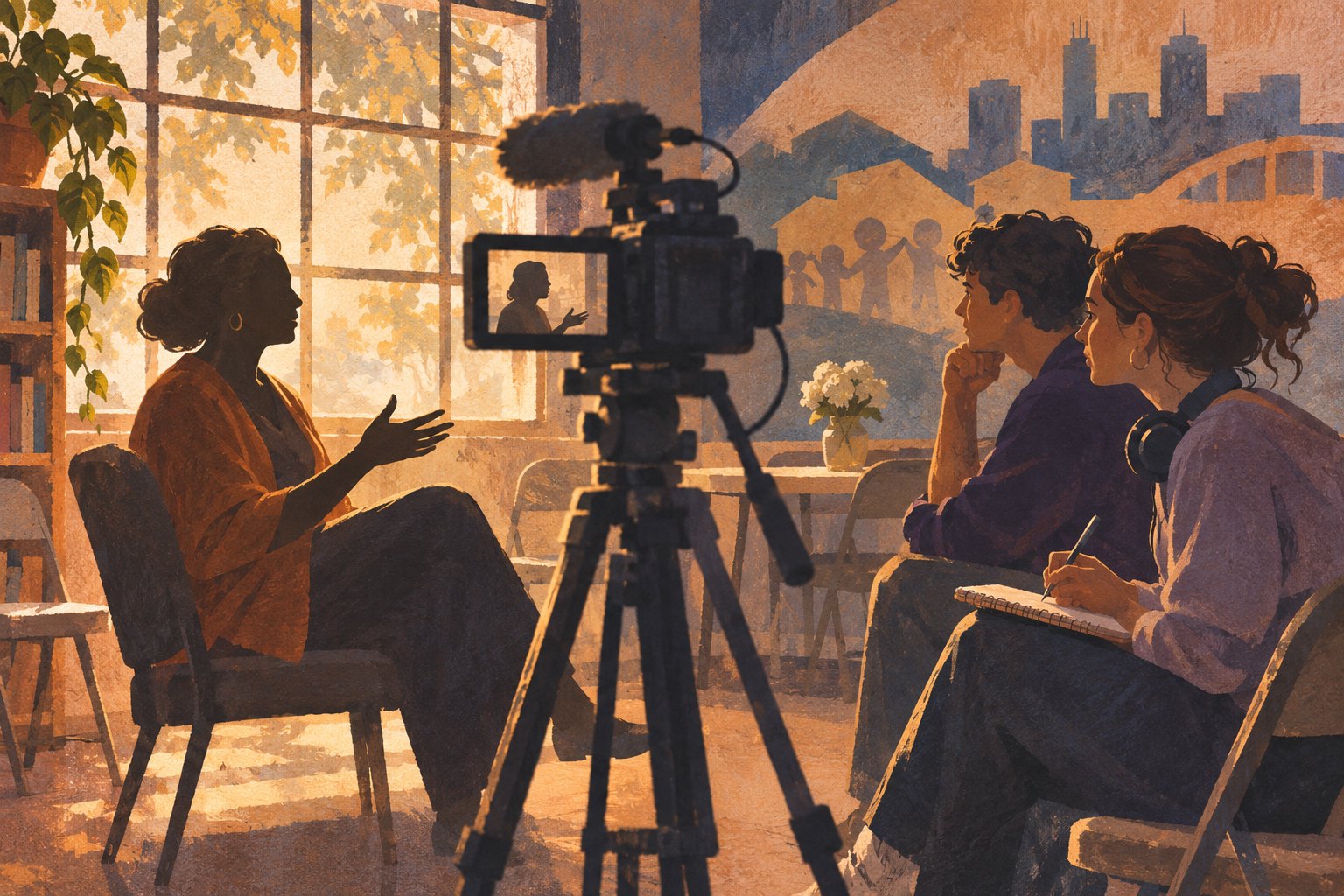
A Fort Worth nonprofit founder has joked that her life belongs in a movie. TCU students have taken that idea onto the screen, according to Fort Worth Report. The premise immediately raises an interesting question for anyone drawn to films about real people: what happens when someone who already tells her own story becomes the subject of someone else’s filmmaking?
The appeal is easy to understand. A personal history becomes a creative collaboration, and a local figure becomes the center of a screen narrative. Yet the most compelling possibility lies beyond the novelty of seeing a life filmed. It lies in whether the resulting portrait can preserve the founder’s individuality while helping an audience understand the experiences she considers meaningful.
This is spoiler-free commentary on the reported project, rather than a review of the finished film. Its scenes, dialogue, formal approach, and ending have not been verified here.
The Founder’s Joke Is a Starting Point, Not a Plot Summary
Describing your life as a movie is a familiar way of acknowledging how surprising experience can feel. It can convey amusement, disbelief, or the sense that events have exceeded anything you might have planned. The founder’s joke supplies an engaging introduction, but it does not establish which of those meanings she intended. Nor does it tell us what experiences the students chose to include.
That distinction matters because an appealing premise can quietly become an assumed storyline. A nonprofit founder might prompt expectations of struggle, perseverance, and eventual recognition. Those expectations belong to the audience until the film earns them through specific evidence. They should not be mistaken for this woman’s actual biography.
My interest in the project begins with the possibility of personality resisting that familiar template. A person’s humor, priorities, and way of explaining a decision can reveal more than a sequence of milestones. For this film, the crucial question is whether viewers encounter a distinctive individual or primarily recognize a story structure they already know.
Whose Perspective Organizes the Life?
A life and a film operate on different scales. People experience events without knowing which will later seem decisive. Filmmakers select beginnings, emphasize connections, and decide where to stop. Even a sympathetic portrait therefore introduces an organizing perspective that may differ from its subject’s own.
For the Fort Worth founder, that creates a potentially rich relationship between self-description and interpretation. Her understanding of an experience may be the film’s strongest guide. It may also leave room for other perspectives, provided the film establishes who is speaking and what they can reasonably know. Respect does not require treating a person as simple or completely knowable.
Watching from the central subject’s perspective means asking what choices were available to her at a given moment. What did she understand then? What does she understand differently now? These are questions for an eventual viewing, not claims about scenes in this project. They help distinguish a character-centered portrait from a retrospective account that makes every outcome look inevitable.
A related question runs through our commentary on how creative responsibility shapes a film’s perspective: centering one person gives a story focus, but it also makes the treatment of everyone around that person especially consequential.
A Nonprofit Story Needs More Than Admiration
The founder’s work gives this project a public dimension. The film concerns someone identified through an organization, so viewers may arrive expecting to learn both about an individual and about the purpose associated with her. Those interests overlap, but they are not interchangeable.
A strong portrait would make room for the difference. Learning why someone cares about an issue is not the same as understanding how an organization addresses it. Likewise, recognizing a founder’s commitment does not automatically reveal the experiences of people connected with her work. Each perspective requires attention on its own terms.
My preference would be for concrete choices over broad praise. In a film about community work, explanation becomes persuasive when viewers can understand what a decision involves and why it matters. That does not require manufacturing conflict or demanding private disclosure. It requires enough specificity for admiration to develop from understanding.
This is also where the supporting people matter. If others appear, do they have purposes and viewpoints beyond confirming the central figure’s importance? A portrait can remain firmly centered on its subject while acknowledging that the surrounding community contains lives as complex as hers.
The Students’ Most Important Choices May Be in the Edit
The involvement of TCU students adds another point of interest: the story is being shaped by emerging filmmakers. Their student status alone tells us nothing reliable about the film’s polish, ambition, or emotional intelligence. Those qualities must be assessed in the work itself.
What can be discussed now is the responsibility involved in selection. Giving one recollection more time than another changes its weight. Moving an explanation earlier can make a later choice seem clearer. Ending immediately after a moment of achievement can suggest closure, even when the subject’s life and work continue.

These decisions are not inherently distortions; they are part of making a film comprehensible. The critical question is whether the structure clarifies experience without smoothing away its complexity. An emotionally satisfying sequence should still leave viewers with a fair understanding of what they have seen.
Sound and pacing deserve the same scrutiny. Music can invite reflection, but it can also insist on an emotion before the material supports it. A pause can give a subject room to think, or become an editorial suggestion of uncertainty. Any eventual review should examine those choices before assigning the film an inspirational label.
What Viewers Should Look for Before Drawing Conclusions
For readers interested in seeing this project, a useful assessment begins with a few specific questions:
- Does the founder’s own perspective remain recognizable throughout the portrait?
- Does the film distinguish remembered experience from independently established information?
- Do people around the central subject contribute meaningful perspectives?
- Does the ending acknowledge the difference between a completed film and an ongoing life?
Screening information, the film’s title, and its credits need confirmation before readers make viewing plans. Memorable dialogue also requires direct verification; the founder’s reported joke should not be presented as a line from the film.
The project nevertheless offers a distinct reason to pay attention to local filmmaking. As our commentary on Fort Worth’s returning LGBTQ+ film festival and local film conversation explores, a city’s screen culture includes opportunities to consider whose experiences receive sustained attention.
A Life Does Not Need to Become a Legend
The deeper promise of the TCU project is the encounter between a woman’s understanding of herself and the students’ effort to make that understanding visible. Its value will depend on how thoughtfully that encounter reaches the audience.
The strongest possible outcome would leave viewers with more than the conclusion that an extraordinary person deserves a movie. It would help them recognize a particular person’s decisions, relationships, and perspective. Her joke may open the door. The filmmaking has to give us a reason to stay and listen.
Original content by this site's editorial team. Published: November 10, 2026 at 22:08:05 PST (Los Angeles time)