Fixing Michigan’s run game begins with a question that the final yardage cannot answer: where did the opportunity disappear? A runner meeting a defender behind the line might be dealing with penetration, an unfavorable alignment, a timing problem, or a mistaken read. Those explanations can produce similar-looking results while demanding different corrections.
Maize n Brew’s “Michigan Football Film Room: Fixing the Run Game” puts that issue at the center of discussion. Here, film means football footage. The useful critical task is to study movement, perspective, and cause before attaching blame. This article offers a framework for evaluating possible fixes; it does not present a verified diagnosis of particular Michigan snaps or attribute recommendations to the publication’s writers.
Start Before the Handoff
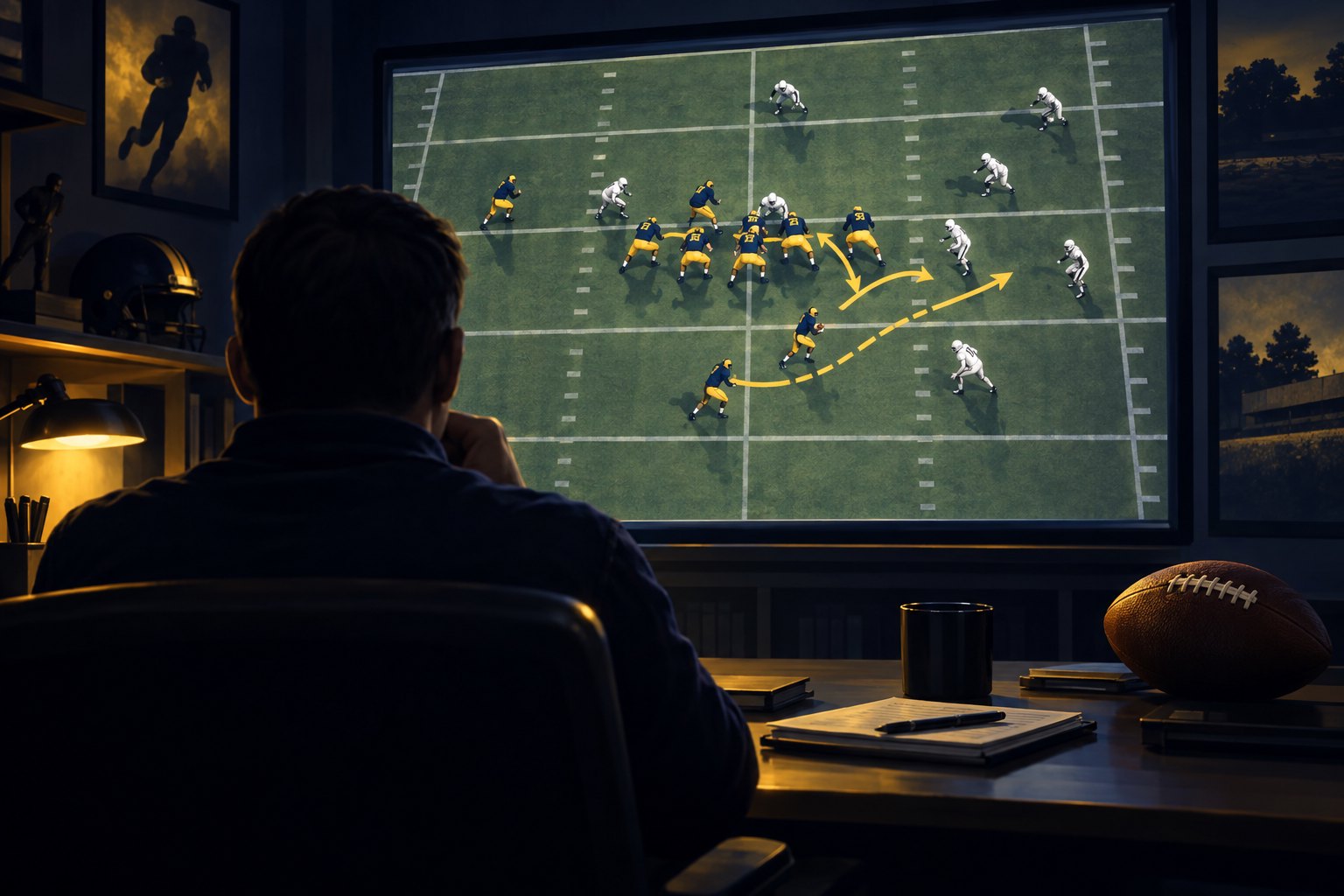
The temptation is to follow the ball. Resist it on the first replay. Begin with the space around the offensive line: where are the defenders positioned, which gaps look threatened, and how close are additional defenders to the expected running lane? A gap is simply the space between adjacent blockers. Its appearance before the snap is a starting point, not a promise that it will remain open.
For Michigan’s run-game discussion, the first distinction should be between a difficult assignment and a poorly executed assignment. A blocker encountering a defender with a favorable angle faces a different problem from one who reaches his opponent cleanly and then loses position. Calling both situations weak blocking conceals the information needed to improve either one.
Count nearby defenders, but avoid treating that count as a complete explanation. An apparently unblocked defender may be accounted for through a quarterback decision or another feature of the play. Without knowing the call, a viewer should describe what is visible before claiming to know who missed an assignment.
Find the First Breakdown, Not the Last Collision
A tackle is the ending of a play. Diagnosis requires tracing the events that made it possible. Watch whether a defender enters the backfield immediately, whether two blockers lose control while working together, or whether a runner has to change direction before reaching the intended area.
Consider a hypothetical snap in which an interior defender forces the runner sideways and a linebacker finishes the tackle. The linebacker appears at the decisive moment, but the earlier penetration may explain why the play failed. Conversely, a runner might have a usable opening and leave it for a less favorable path. These are possibilities to test against footage, not conclusions about Michigan’s current personnel.
The distinction resembles evaluating whether a movie’s resolution grows out of earlier choices. Our discussion of what makes an ending feel earned asks a related question about cause and consequence. In football footage, too, the final image becomes more informative when you trace the sequence that produced it.
Watch Blocks as Relationships
Instead of asking only whether an offensive lineman pushed someone backward, watch where the defender ends up relative to the runner. A block can create a useful path by controlling an angle. A dramatic collision can accomplish little if the defender still occupies the space the ball carrier needs.
When two linemen initially engage one defender, pay attention to what happens as one moves toward a linebacker. Does the remaining blocker retain control? Does the departing blocker arrive while the linebacker is still reachable? That transition can help explain why a lane briefly appears and then closes. The intended timing, however, cannot always be established from video alone.
Read the Play From the Runner’s Position
An elevated camera gives the audience an advantage the running back does not possess. We can see openings beyond bodies, pause the action, and compare multiple paths. The runner must make a decision while moving, with defenders and teammates obstructing his view.
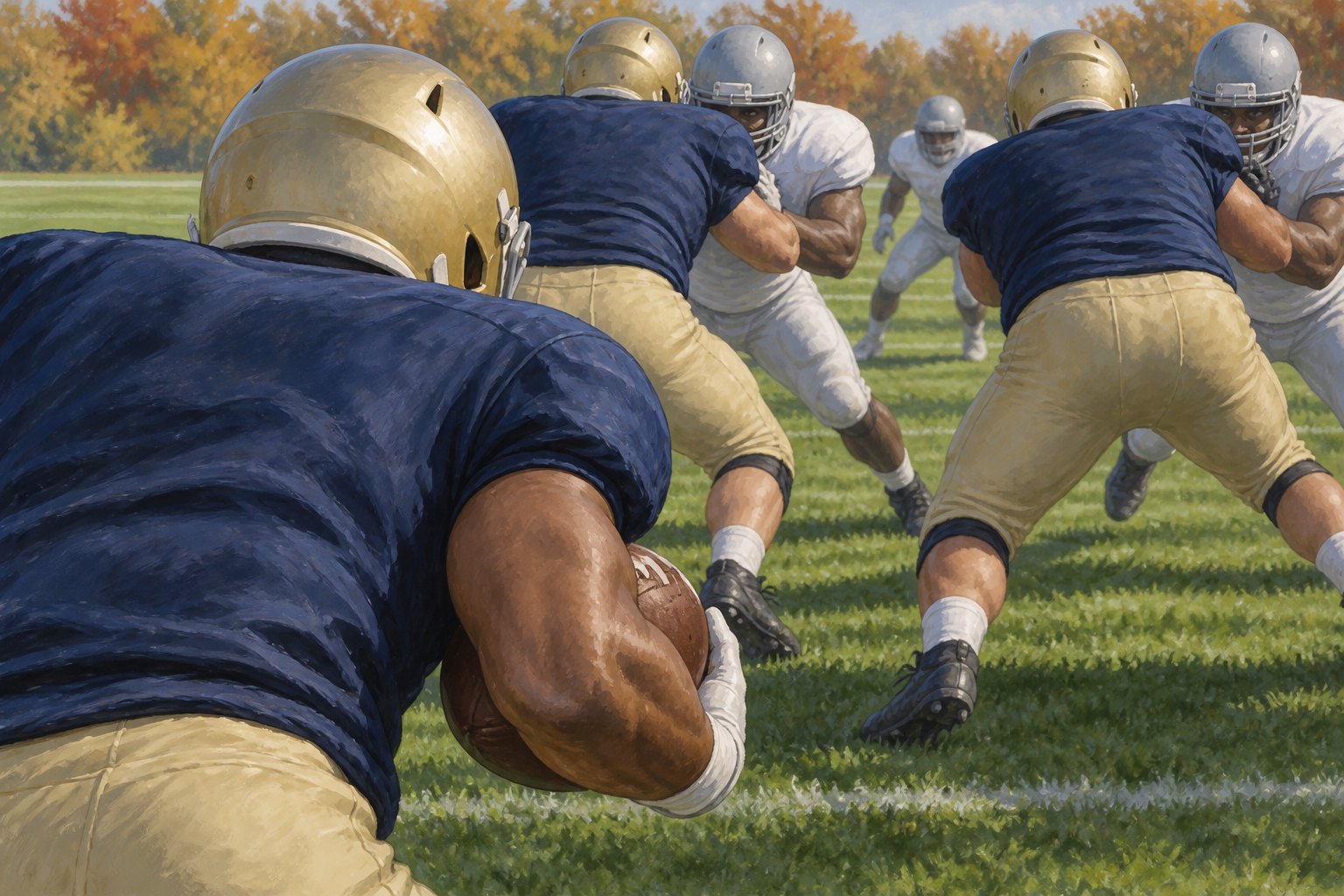
Before declaring that a Michigan runner missed a hole, ask when that hole became available. Was it open before he committed his weight? Did it emerge only after his movement drew a defender elsewhere? Could he reasonably reach it without stopping or exposing the ball? An opening visible in a freeze-frame is not automatically a viable decision at playing speed.
Patience also needs a precise meaning. Waiting can allow a block to develop, but waiting behind immediate penetration can make a bad situation worse. Decisiveness can exploit a brief opening, but committing before the blocking develops can send a runner into traffic. The useful question is whether his tempo fits the opportunity in front of him.
Match Each Proposed Fix to Its Evidence
My view is that a convincing Michigan run-game argument should connect every recommendation to a recurring, observable problem. Demanding more physicality or greater creativity may express frustration, but neither phrase identifies a correction by itself.
- If early penetration repeatedly disrupts the handoff: examine initial positioning, footwork, and how adjacent blockers handle defensive movement before focusing on the runner’s later choices.
- If defenders consistently arrive unimpeded: investigate how the play accounts for them. A blocking error and a defender the design deliberately leaves unblocked require different explanations.
- If openings appear but close before the runner arrives: compare the runner’s track and pace with the development of the blocks.
- If a run works only against one defensive look: ask whether the offense has an answer when that look changes, rather than assuming the same call should keep succeeding.
These are conditional directions for analysis. Establishing which applies to Michigan would require relevant footage and repeated examples. One unsuccessful carry cannot justify rebuilding an offense, just as one explosive run cannot establish that its underlying problems have disappeared.
Use the Camera Without Letting It Decide the Verdict
A sideline view can clarify spacing and the runner’s route while hiding contact inside the line. An end-zone view can make blocking angles easier to follow while compressing depth. Neither gives automatic access to the play call or the players’ instructions.
That matters because presentation influences judgment. In our examination of how motion and physical sensation change a screening, the central concern is how an experience directs attention. Football replays do something comparable through framing and speed: slow motion can make a fleeting opening look inviting and a split-second decision look leisurely.
A practical viewing sequence is to watch once at normal speed, replay the action while following the blockers, and then watch again while following the runner. Finish at normal speed. That last pass restores the time pressure that close inspection can erase.
What Meaningful Improvement Would Look Like
For Michigan, evidence of a healthier run game would need to extend beyond a memorable breakaway. Look for fewer plays disrupted before they develop, clearer coordination between blocks and the runner’s path, and useful gains in comparable situations. Down, distance, defensive alignment, and game context should accompany any comparison.
The deeper value of film-room analysis is that it distributes attention more fairly. The player holding the ball is easy to cast as the central character, yet his choices depend on several other people acting within a very small window. Good analysis makes those relationships visible without pretending to read minds.
Fixing the run game should ultimately mean making that shared work more dependable. The strongest explanation will identify what repeatedly breaks, show why it matters, and describe a correction the footage can help evaluate. Michigan’s answer belongs in those connected details.
Original content by this site's editorial team. Published: September 9, 2026 at 09:11:09 PDT (Los Angeles time)