
Hope takes a familiar creature-feature question—what is attacking this community?—and opens up a more unsettling one: how much can frightened people understand while they are fighting to survive? Na Hong-jin’s Korean thriller combines a village emergency with an expanding science-fiction story. Its most interesting dramatic possibility is the collision between those scales: a local officer needs an immediate answer, while the situation exceeds everything his experience has prepared him to recognize.
Spoilers follow for the premise, character roles, and changes in perspective. This critical reading draws on official film materials and published screening accounts; judgments about its themes are interpretations, rather than a firsthand assessment of the finished theatrical presentation.
Hope Harbor: A Community With Too Few Answers
The central setup is straightforward. Police chief Bum-seok, played by Hwang Jung-min, and officer Sung-ae, played by Hoyeon, respond to a mysterious creature devastating Hope Harbor. Nearby, Sung-ki, played by Zo In-sung, joins hunters searching the forest, where their pursuit becomes a struggle to escape. The distributor’s description explicitly connects the ensuing disaster with ignorance and misleading perceptions. [Official film synopsis](https://www.neonrated.com/film/hope)
That arrangement gives the story two different relationships to danger. The police must respond to what is happening among the people they serve. The hunters deliberately enter uncertain territory. Both groups want to act, but neither begins with a reliable account of what its actions might provoke.
The distinction matters because a monster story can make violence feel self-explanatory. Something attacks; someone retaliates. Here, the premise invites us to examine the missing step between witnessing damage and deciding that we understand its cause.
Bum-seok: Responsibility Without Understanding
Robert Daniels’s Cannes review describes Bum-seok pursuing the aftermath of destruction, with sounds of violence repeatedly placing the danger ahead of him. That account suggests a useful way to understand the chief: movement gives him a task before knowledge gives him a plan. He can keep going even when he cannot interpret what he encounters. [Robert Daniels’s Cannes review](https://www.rogerebert.com/reviews/hope-na-jong-hin-movie-review-2026)
For a police officer, stopping carries its own moral pressure. People may need help around the next corner. Yet urgency also creates a trap: each new sign of devastation can reinforce the first explanation instead of prompting a better one.
My reading is that Bum-seok’s position exposes the difference between responsibility and certainty. Having a duty to intervene does not mean possessing the knowledge to intervene well. That is a stronger dramatic problem than simply making an authority figure foolish. It allows his determination to be understandable while leaving its consequences open to criticism.
Sung-ae: Competence Has Its Limits
The Cannes synopsis adds a crucial constraint: reinforcements are occupied with wildfires, communications are down, and the officers must defend a village of elderly residents. Their isolation is therefore practical as well as psychological. There is no functioning support system waiting to explain the threat or absorb the consequences. [Cannes synopsis and credits](https://www.festival-cannes.com/en/f/hope/)
From Sung-ae’s perspective, this turns the emergency into a problem of immediate care. Whatever the creature ultimately means, people remain vulnerable now. The character’s role holds the story close to that obligation, even as its world grows stranger.
Competence in such a situation should not be mistaken for complete control. A person can make effective decisions within a crisis whose larger causes remain obscure. That tension gives Sung-ae an important place in a character-centered reading: practical courage matters, but it cannot settle every question that courage encounters.
Protection becomes similarly complicated in our analysis of safety and control in Bunker. In both discussions, the useful question is what protection demands of the people expected to accept it.
Sung-ki: When Pursuit Stops Feeling Like Power
Sung-ki’s forest storyline reverses an apparent advantage. Hunters enter the landscape intending to locate a creature; discovering that they are vulnerable changes what their expertise can accomplish. Knowledge of familiar terrain does not automatically translate into knowledge of an unfamiliar life-form.
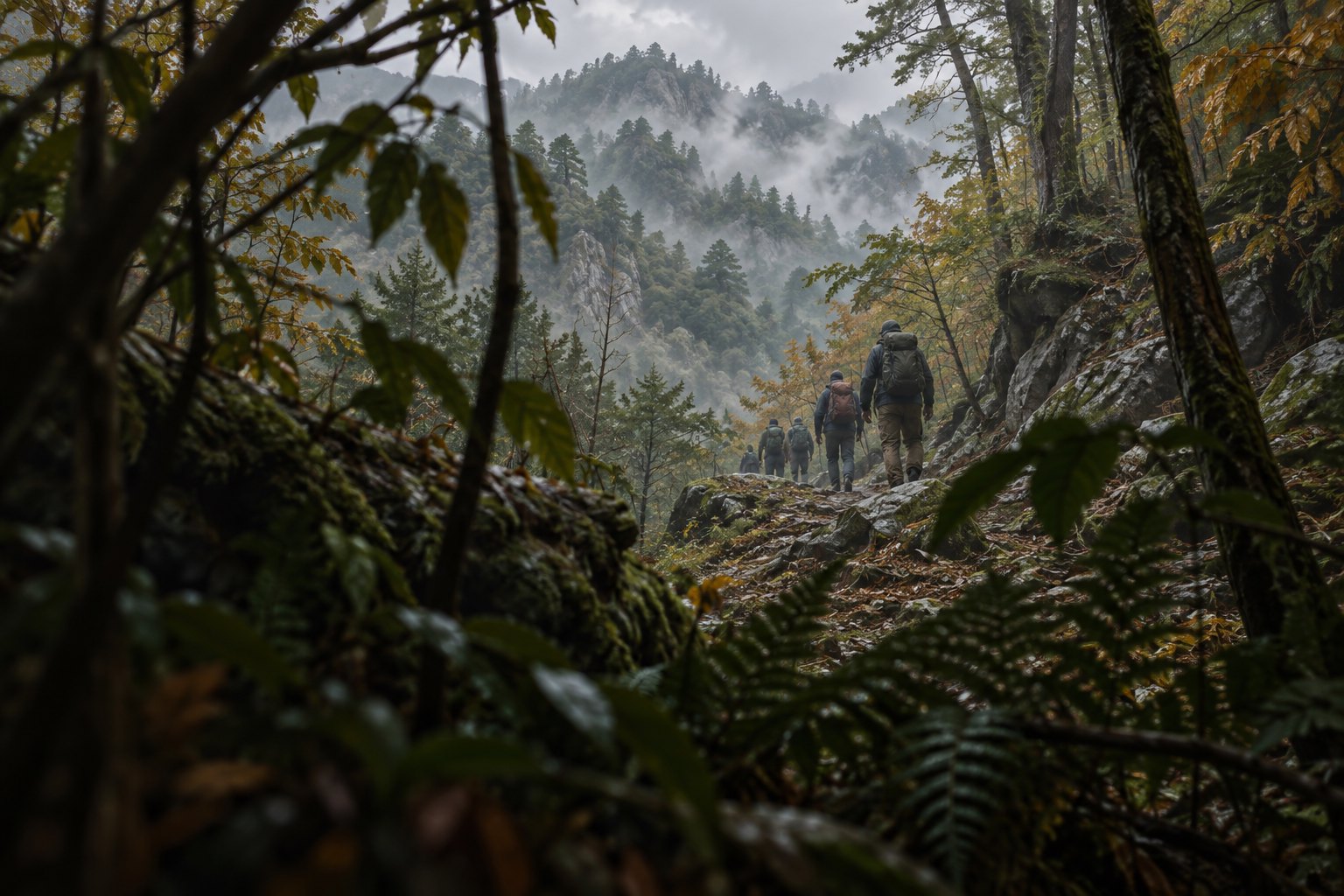
The forest also offers a different kind of uncertainty from the village. Streets organize space around human use. Vegetation conceals distances and interrupts sight. As a thematic setting, the woods make the limits of observation tangible: looking carefully can still leave most of the situation invisible.
This is where the hunter’s confidence becomes worth examining. Confidence can help someone respond decisively, but it can also make revising an assumption feel like surrender. The premise of Hope gives that ordinary human difficulty unusually severe stakes.
The Words That Define an Outsider
Jake Coyle’s AP review identifies a sign reading “Protect the nation against infiltration” and describes the film eventually granting its extraterrestrial visitors subtitled speech. Those two uses of language establish a striking contrast: one classifies an arrival as a threat; the other makes unfamiliar beings intelligible. Coyle also finds the spectacle exciting but uneven, citing its length and visual effects. [Jake Coyle’s AP review](https://apnews.com/article/e941af2cf57513e58c286901928c180f)
The sign is an environmental statement, not character dialogue. Its importance lies in the interpretive habit it expresses: decide what belongs before asking what has arrived.
Subtitles can complicate that habit without making dangerous behavior harmless. Understanding another being is not the same as forgiving it. It means acquiring information that fear alone cannot supply.
Does the Spectacle Leave Room for People?
For a viewer who values character development, the key reservation is whether continual emergency allows individuals to become more than their reactions. An officer, a hunter, and a visitor can embody distinct perspectives without receiving equally developed inner lives.
That distinction should guide expectations. A film may offer provocative ideas about human behavior while providing less of the intimate psychology that some viewers seek. Our discussion of performance and spectacle in Primetime considers a related question: when does dramatic force deepen a character, and when does it overwhelm one?
A Deeper Reading: Hope as the Will to Reconsider
Na has connected the project’s origins to xenophobia and misunderstandings between different perspectives. That stated interest supports reading the creature encounter as a crisis of interpretation, while leaving the film’s individual choices open to judgment. [Na Hong-jin’s Cannes interview](https://apnews.com/article/a46d51b2c2e414754697b6ceef007c11)
To me, the title’s most productive meaning is the possibility of revision. Hope exists when a person can recognize that an explanation was incomplete and still change course. The challenge is that emergencies reward speed, while reconsideration requires attention.
Through its officers, hunters, and visitors, Hope brings those competing demands together. Survival requires action. Understanding requires the willingness to look again. The unsettling possibility is that people can succeed at the first while making the second increasingly difficult.
Original content by this site's editorial team. Published: September 10, 2026 at 05:09:21 PDT (Los Angeles time)