
Bunker places Penélope Cruz and Javier Bardem inside a marriage confronting an uncomfortable question: when does protecting a shared life become a way of refusing to change it? Florian Zeller’s drama connects an architect’s prospective survival shelter for a billionaire with the defenses accumulating inside his own household. Its most interesting conflict concerns what each spouse believes their years together should entitle them to expect.
Spoiler note: This character analysis discusses the premise, domestic conflicts, and brief dialogue excerpts documented in published screening accounts. It does not describe the final confrontation or claim a firsthand screening assessment. For the broader introduction, see our overview of Bunker’s central ensemble and divided lives.
A commission that unsettles a marriage
The official Venice synopsis identifies the central problem: an architect becomes involved in building a survivalist bunker for a technology billionaire, prompting his wife to question their seventeen-year marriage. Zeller describes the relationship as the personal lens through which the film considers contemporary fear and inequality. The festival lists a running time of 126 minutes. [Venice’s official film information](https://www.labiennale.org/en/cinema/2026/venezia-83-competition/bunker)
That premise gives the couple a disagreement with two different scales. One concerns responsibility toward strangers: what does it mean to help someone purchase an escape from collective catastrophe? The other concerns responsibility toward a spouse: what happens when an attractive professional opportunity makes an existing imbalance harder to ignore?
My reading is that the second question gives the first its emotional stakes. An argument about a wealthy client can remain abstract indefinitely. An argument about whose priorities have organized a household cannot. Every explanation Miguel offers about work is also potentially an explanation of what he expects Sofia to keep accepting.
Sofia: the cost of accommodating someone else’s ambition
Cruz plays Sofia, a publishing editor living in London with Miguel and their daughters. Lou Thomas’s screening account describes her disappointment when a possible promotion fails to materialize and the effect of accompanying a younger visiting novelist. Those developments give her dissatisfaction a professional history, rather than reducing it to a reaction against her husband’s latest project. [Time Out’s review](https://www.timeout.com/movies/bunker-review-2026)
Seen from Sofia’s position, material comfort cannot settle whether the arrangement remains fair. A beautiful house may register as evidence of shared success to one partner and as the setting for postponed ambitions to the other. Neither meaning disappears because both people can afford to live there.
The novelist’s significance therefore extends beyond the possibility of romantic disruption. Someone outside a marriage can make a familiar compromise newly visible. Attention becomes unsettling because it reminds a person that her current role is not the only available account of who she is.
One short line captures Sofia’s understanding of commitment: “Things last when you consider them fragile.” Guy Lodge quotes it in his review. Read as a statement about her predicament, it makes care an ongoing activity. Longevity offers no guarantee that a relationship is receiving the attention it needs. [Lodge’s review](https://nz.news.yahoo.com/bunker-review-javier-bardem-pen-170000899.html)
Miguel: when competence becomes a defense
Bardem’s Miguel has a profession built around making spaces work. That makes the commission dramatically apt: he can approach a disturbing request as a problem that his expertise qualifies him to solve. Professional recognition supplies an inviting route around the more difficult question of whether solving it is worthwhile.
Jane Crowther’s review records his assertion that “in the end it all comes down to money.” The remark crystallizes a practical vocabulary that cannot adequately answer Sofia’s concerns. Payment can measure the value of a commission to its client; it cannot measure the effect of that commission on a marriage. [Crowther’s screening account](https://hollywoodauthentic.com/author/mike/)
My interpretation is that Miguel’s vulnerability lies in treating solvable problems as the most legitimate ones. A design can be revised. A fee can be negotiated. Another person’s unhappiness requires listening without a guaranteed outcome. His professional strengths may consequently become habits that make emotional uncertainty harder to tolerate.
This is also why reducing him to greed would weaken the discussion. The more useful question is how a person turns continued advantage into apparent common sense. If Miguel believes that opportunity benefits his family, he can experience disagreement as ingratitude while overlooking the sacrifices already embedded in that family’s success.
Toby’s window makes privacy a shared problem
Stephen Graham’s Toby introduces a more immediate dispute. Published screening accounts describe an opening made in the boundary wall so that his cramped property can receive daylight. Miguel objects because the proposed window would overlook the family’s garden. The conflict places two understandable desires on opposite sides of the same structure. [International Cinephile Society’s review](https://icsfilm.org/festivals/venice/2026-venice/venice-2026-review-bunker-florian-zeller/)
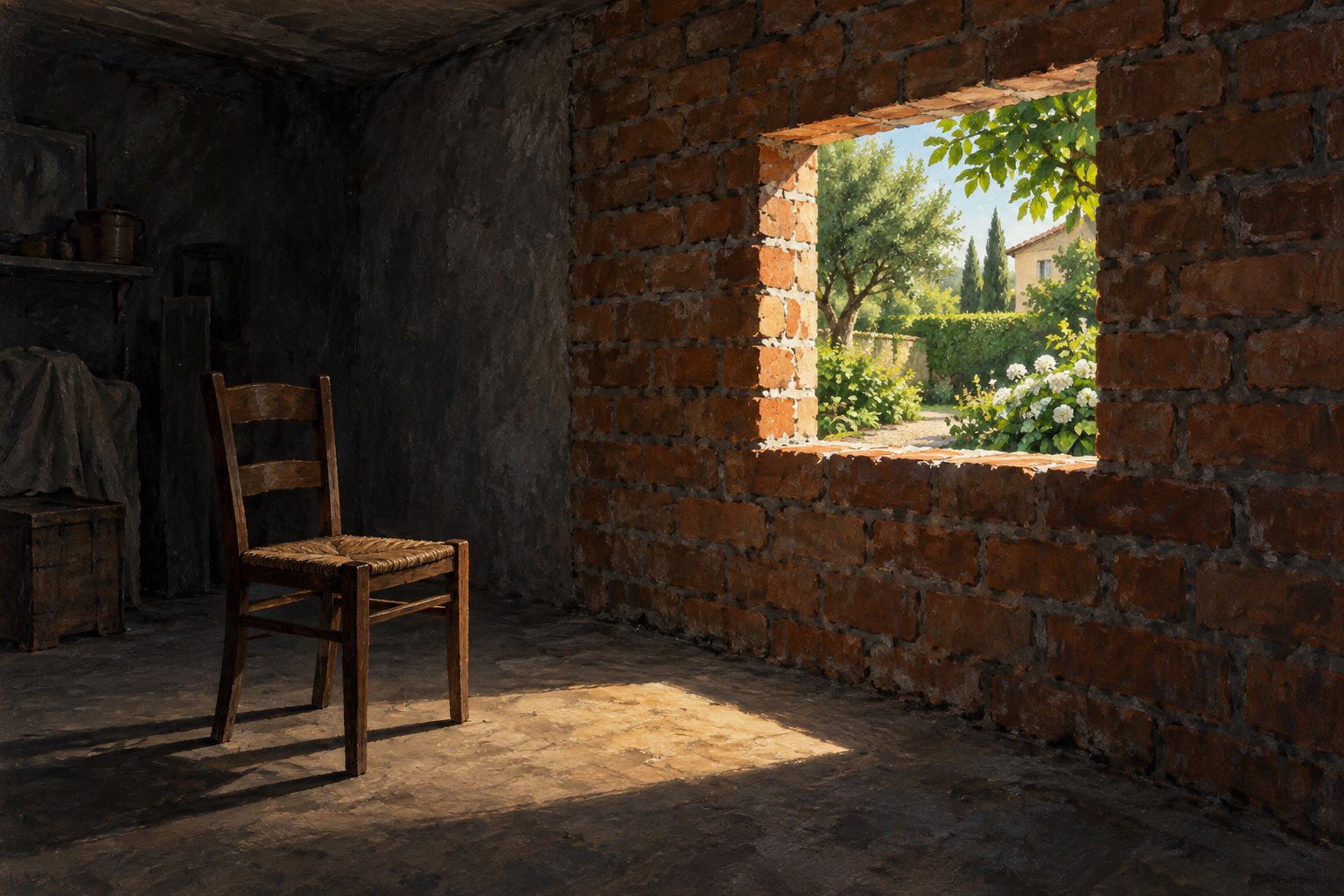
The useful distinction is between understanding a grievance and endorsing the action taken to address it. Toby’s need for light does not automatically justify breaching a boundary. Miguel’s desire for privacy does not make the neighboring deprivation irrelevant. Holding both thoughts together produces a more demanding interpretation than assigning either man sole possession of the moral argument.
The window also changes the scale of the bunker debate. It is relatively easy to discuss an exceptionally wealthy stranger’s isolation. Negotiating how much of one’s own comfort another person may disturb is harder. The neighboring property makes that contradiction tangible.
The billionaire and the limits of buying safety
Paul Dano plays the technology magnate Andrew. Ben Croll’s review describes a remote conversation about a luxurious shelter and connects it with Miguel’s growing investment in security at home. The commission brings the promise of extraordinary protection into contact with an already comfortable household’s anxieties. [TheWrap’s review](https://www.thewrap.com/creative-content/reviews/bunker-review-penelope-cruz-javier-bardem-florian-zeller/)
For me, the troubling implication is that safety can become an expanding demand. Once money makes additional defenses possible, each remaining uncertainty can start to look like a defect requiring another purchase. The endpoint keeps moving because the existence of a barrier cannot establish that everything beyond it is under control.
That interpretation connects the client and architect without making their circumstances identical. Their resources differ enormously. What links them is the temptation to answer uncertainty through greater control over space.
Why the performances and the argument divide critics differently
The published responses suggest an important distinction. Thomas praises the central relationship and its intelligence. Croll appreciates the actors’ pairing while questioning the movement between satire and menace. These are different assessments of how successfully the dramatic machinery supports the people inside it.
That distinction matters to prospective viewers: Bunker invites attention to marital negotiation, professional disappointment, and class discomfort. Its survival-shelter premise should not be taken as a promise of sustained underground action. Our guide to reading beyond festival-review verdicts explores why agreement about performances need not produce agreement about a whole film.
A deeper reading: care requires an opening
The most persuasive interpretation available from these character conflicts is that preservation and care can pull in different directions. Preservation tries to prevent alteration. Care requires noticing when an existing arrangement has stopped serving someone within it.
Sofia’s frustration asks whether their relationship can accommodate a changed understanding of her needs. Miguel’s defensiveness asks whether continuity can be secured without making those changes. Their disagreement becomes meaningful because love does not automatically supply the answer.
Through that lens, the title’s strongest implication is domestic. A marriage can become a protected structure whose inhabitants have difficulty reaching one another. The difficult work is recognizing that an opening may be necessary for the life inside to continue.
Original content by this site's editorial team. Published: September 10, 2026 at 04:15:23 PDT (Los Angeles time)