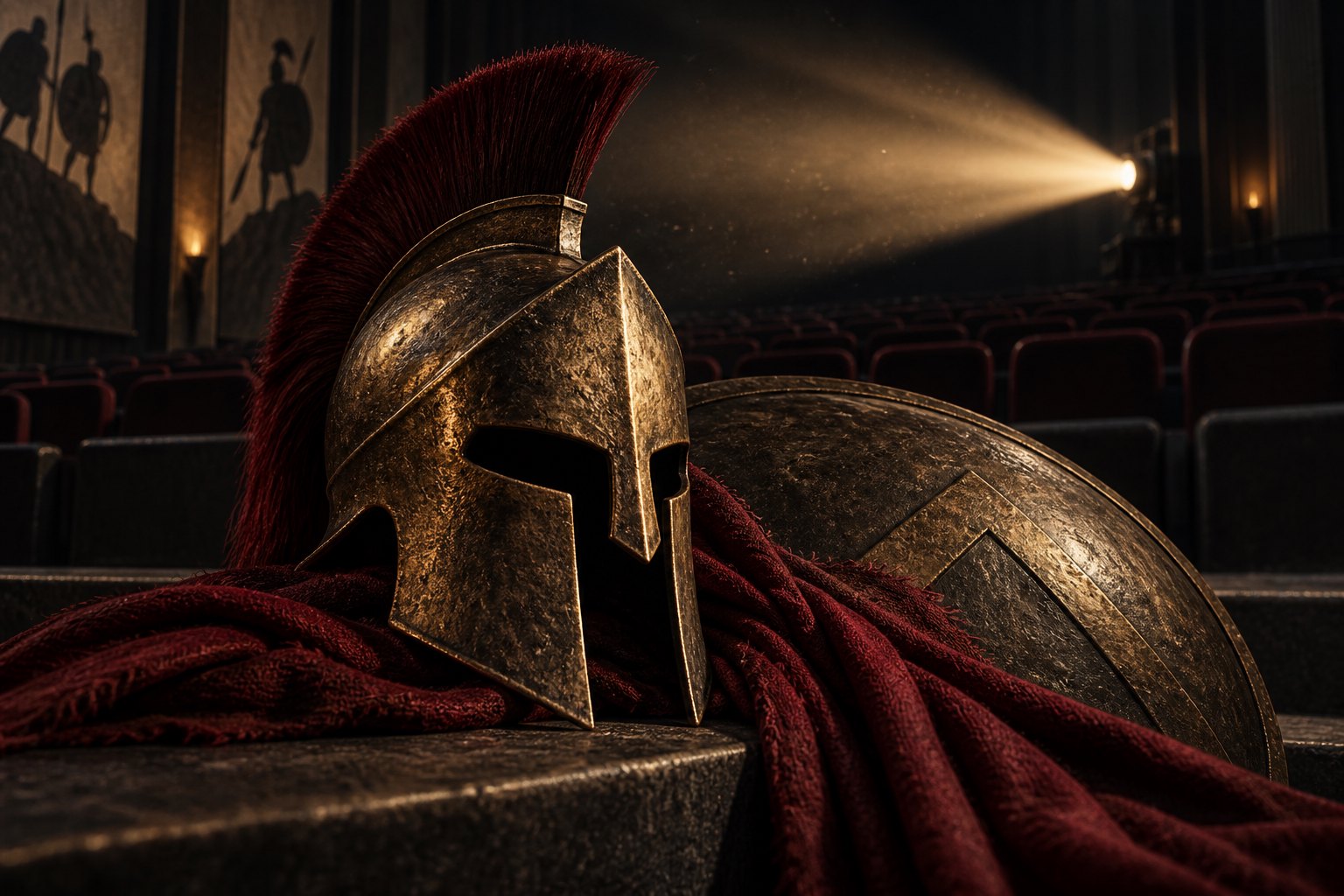
Zack Snyder’s rejection of fascist interpretations of his work raises a question that his most provocative defense cannot answer by itself. Variety’s headline quotes him saying, “I made the gayest movie ever made.” But a film’s fascination with male beauty and its attitude toward power are different subjects. Both deserve attention, especially when the film is 300.
Snyder has previously described 300 in similar terms, discussing its celebration of the masculine body in a 2020 Total Film interview. That provides useful context without making his intention the final authority on what viewers see. [Total Film’s interview](https://pocketmags.com/total-film-magazine/july-2020/articles/body-talk).
My reading is that 300 remains an exhilarating action fantasy whose emotional force depends on a troubling distinction: some bodies embody freedom, while others become evidence of corruption or inadequacy. Its characters make that tension more interesting than a simple verdict about its director.
Spoilers follow for 300, including its ending.
Leonidas Makes Authority Feel Like Loyalty
Gerard Butler’s Leonidas gives the film its strongest argument for the society it celebrates. He stands with the soldiers who will die beside him. His physical exposure matters: the king shares their landscape, their exertion, and their vulnerability. Leadership becomes something visible in a body taking the same risks as everyone else.
That is the emotional distinction between Leonidas and Xerxes. One king places himself inside the fighting unit; the other presents himself as an elevated object of submission. Before the film develops that opposition through dialogue, its staging has already encouraged us to choose.
“This is Sparta!” compresses Leonidas’s appeal into three words. Butler delivers identity as an action. The declaration does not invite discussion; it makes his violence feel like the inevitable expression of belonging. As action filmmaking, the moment is brutally efficient. As a portrait of authority, it deserves a second look. The king’s certainty is so charismatic that the audience has little time to consider what certainty permits. [Dialogue reference](https://www.imdb.com/title/tt0416449/quotes?item=qt0447691).
There is genuine tenderness beneath that certainty, particularly in his relationship with Gorgo. Yet affection does not displace the warrior ideal. It gives sacrifice something valuable to consume. The film asks us to admire a man who loves his life and has already accepted that his finest public act may be leaving it.
Admiring Male Bodies Does Not Resolve the Politics
The homoerotic possibilities of 300 are hardly difficult to notice. Exposed torsos, sculptural lighting, and lingering movement make male bodies objects of attention and pleasure. Its warriors are presented to be watched as intensely as they watch their enemies.
That visual pleasure can exceed the story’s stated relationships. A viewer does not need an explicitly romantic scene to find desire in the images. Snyder’s emphasis on the male form therefore identifies a real feature of the film, even if a superlative about its gayness remains a provocation rather than a useful critical measurement.
The next question is what those bodies are allowed to mean. In my reading, the Spartans’ physical discipline functions as a certificate of moral worth. Their beauty is bound to endurance, aggression, and their ability to fit together as a military unit. Desire may broaden the audience’s relationship to that ideal without making the ideal itself inclusive.
It also matters that the film’s sensuality is unevenly valued. Spartan exposure reads as strength; Xerxes’s ornamentation and seductive presentation are attached to domination. The issue is the moral work performed by these contrasting images, not whether a viewer can find either side attractive.
Ephialtes Exposes the Cost of Belonging
Ephialtes is the character who most sharply tests Leonidas’s world. He wants to serve Sparta and recover a place within its story. His longing makes him more than an obstacle conveniently positioned beside the battlefield.
Leonidas rejects him from the fighting formation because he cannot raise his shield high enough to protect the adjacent soldier. The scene gives that rejection a concrete tactical explanation. Ephialtes subsequently betrays the Greeks by revealing the route around their position. [Plot reference](https://en.wikipedia.org/wiki/300_%28film%29).
For me, the discomfort lies in how neatly physical exclusion becomes moral confirmation. The man who cannot match the ideal eventually acts against it. His betrayal is his own decision, but the narrative offers little sustained space for an honorable identity outside the standard he fails to meet.
Consider the scene from his perspective. He arrives with a skill, a family inheritance, and a desperate need to be recognized. The battlefield is also an imagined doorway into community. When that doorway closes, the film understands his humiliation more readily than it imagines another future for him.
This is where the question of bodily beauty becomes a question of power. As our discussion of bodies and autonomy in horror explores from another genre’s perspective, a body’s appearance can shape the freedom a story grants its owner.
Dilios Turns Spectacle Into Persuasion
Dilios provides the strongest reason to treat 300 as a constructed legend. He is a warrior and a storyteller, and his account carries the Spartans’ experience forward. The production notes explicitly describe his narration as an opportunity for embellishment, with Snyder explaining that Dilios enlarges events to motivate his audience. [Warner Bros. production notes](https://madeinatlantis.com/movies_central/2007/300.htm).
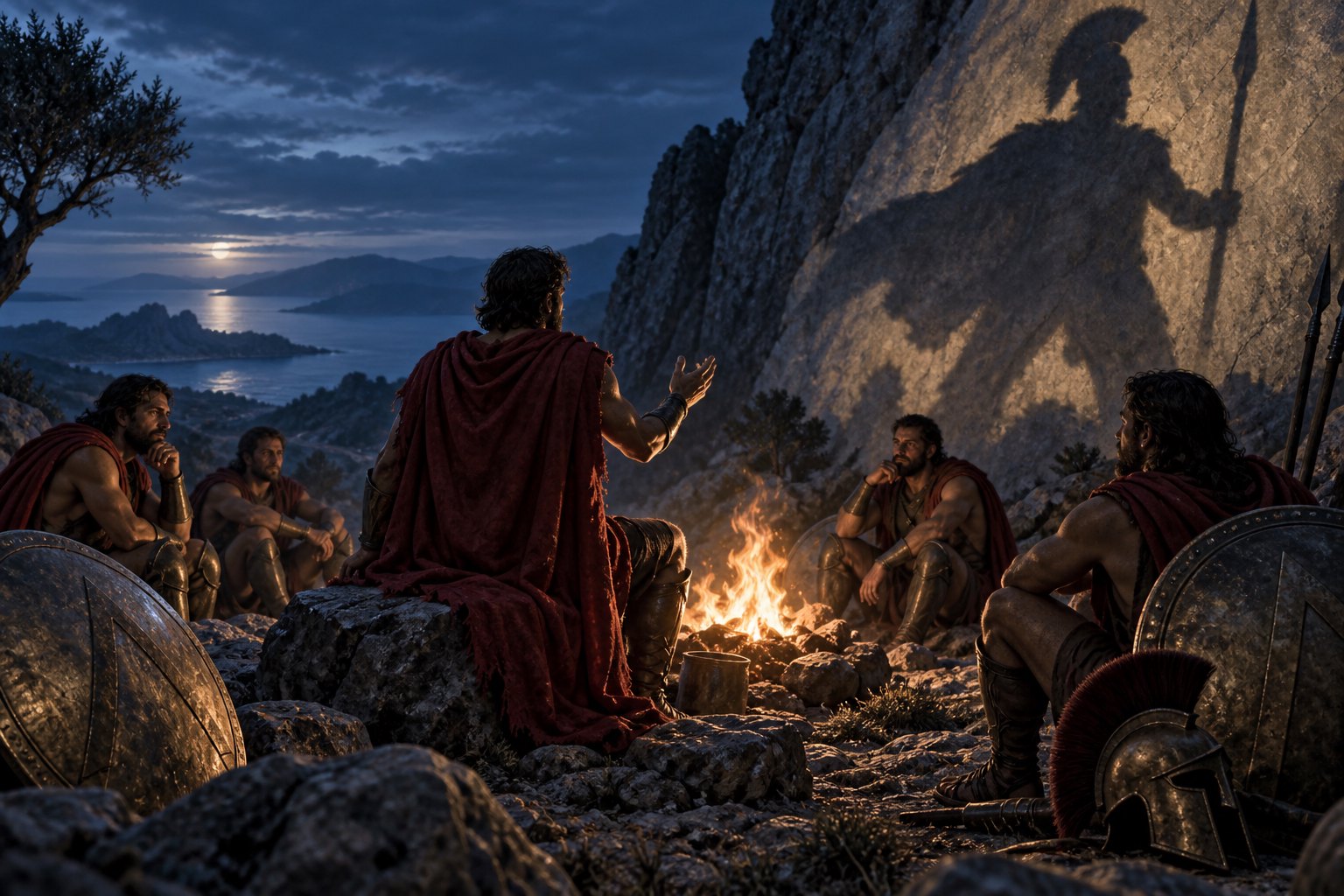
This makes the exaggerated imagery intelligible. A storyteller gathering courage around a military cause has reasons to make friends magnificent and enemies monstrous. His listeners need a usable legend. Precision may be less valuable to him than conviction.
That framing also creates an unresolved critical problem. Explaining who produces a heroic story does not automatically create distance from it. The camera, editing, and physical performances make that story intensely pleasurable. We can recognize the machinery of persuasion while still feeling it work.
The film’s final movement converts the lost battle into a resource for another army. My interpretation is that Dilios becomes the most consequential survivor because he determines the emotional shape of the defeat. Leonidas gives his life; Dilios gives that death a future audience.
What 300 Ultimately Asks Us to Admire
The fairest criticism of 300 begins by acknowledging its achievement. Its images have purpose. Its action turns coordination into beauty, and Butler makes loyalty feel physically immediate. The same attention to a performer’s persuasive force informs our character-focused reassessment of Jerry Maguire: charisma matters most when we examine what it persuades us to accept.
Here, the cost is a narrow distribution of dignity. Leonidas receives intimacy and grandeur. Ephialtes receives longing followed by betrayal. Xerxes receives spectacle without comparable emotional access. Dilios gives those unequal portraits the authority of a remembered sacrifice.
Snyder’s defense can illuminate the pleasure he sees in these images. It cannot exhaust their meanings, and the images alone cannot establish his personal politics. The deeper interpretation is that 300 dramatizes how admiration becomes allegiance: we admire a body, trust a leader, mourn a sacrifice, and inherit a story. Its lasting fascination comes from how powerfully it carries us through those steps—and how much becomes visible when we pause between them.
Original content by this site's editorial team. Published: September 15, 2026 at 12:45:15 PDT (Los Angeles time)