
Zach Cregger’s Resident Evil gets an essential horror idea right: recognizing danger does not mean knowing what to do about it. Bryan, the medical courier played by Austin Abrams, occupies that miserable gap. He can recognize the usefulness of a weapon without understanding its operation. He can identify an escape route without being able to open it. His confusion gives this adaptation its most interesting tension: the audience understands the genre, while the person trapped inside it still has to learn the practical details.
The film’s appeal rests heavily on whether that predicament feels funny, frightening, or both. My reading is that its comedy has a purpose beyond providing relief. Bryan’s mistakes interrupt the fantasy that ordinary people become capable action heroes as soon as circumstances demand it.
Spoiler notice: This critical essay discusses the premise, weapon handling, a gate sequence, and recognizable game references. It leaves the ending undisclosed. Scene descriptions and brief dialogue quotations are drawn from published coverage; the interpretation is original criticism.
Bryan’s ordinary job gives the nightmare its scale
The story follows a medical courier whose delivery takes him toward Raccoon City and into an outbreak. That occupation matters. A courier normally navigates a world of functioning connections: someone dispatches an item, roads connect locations, and someone receives it. Bryan’s work assumes that reaching the destination will resolve the task.
Survival horror makes each of those assumptions unstable. A journey becomes a succession of immediate problems, and professional responsibility offers no preparation for them. The appealing thing about this setup is its modesty. Bryan enters the story with a practical objective that an audience can understand without a lecture about the franchise.
His perspective also keeps the scale personal. An outbreak may have enormous consequences, but the experience of surviving it consists of smaller questions. Can he get through this space? Does he have what he needs? How much time will a mistake cost? Those questions make a large fictional catastrophe legible through one person’s limitations.
Our earlier analysis of Bryan’s delivery and the film’s ending considers the assignment’s moral consequences. Here, the revealing material is the physical business of trying to complete it.
A weapon does not automatically create a hero
“I only use guns in video games,” Bryan says in dialogue quoted by the Associated Press. It is an unusually direct admission for the protagonist of an action-heavy horror movie. The line acknowledges a difference that screen violence often compresses: knowing what a tool accomplishes is separate from knowing how to operate it.
The joke briefly strips the weapon of its reassuring symbolic power. In an action movie, acquiring a gun often signals that the balance has shifted. Bryan still has to deal with an unfamiliar object while other people and immediate danger compete for his attention.
That distinction creates a useful way to read Abrams’s character. His incompetence is situational. He has arrived with habits and knowledge that belong to another environment, and those habits cannot simply be transferred. Panic makes the translation harder.
The accompanying complaint, “It’s confusing in real life!”, reduces that problem to an exasperated sentence. It also invites an uncomfortable kind of identification. Viewers may understand the scene’s mechanics while overestimating how well they would perform inside it. Bryan exposes the distance between watching confidently and acting under pressure.
The locked gate turns impatience into suspense
The film’s recurring trouble with locks develops the same idea through objects. Published accounts describe an escape attempt in which shooting a padlock fails, and driving into the gate also goes badly. A corresponding key offers the solution Bryan has failed to use.
The scene puts impatience in conflict with observation. Bryan wants a direct physical answer because stopping to solve a problem feels intolerable when danger is approaching. His reasoning is understandable even when it produces the wrong action.
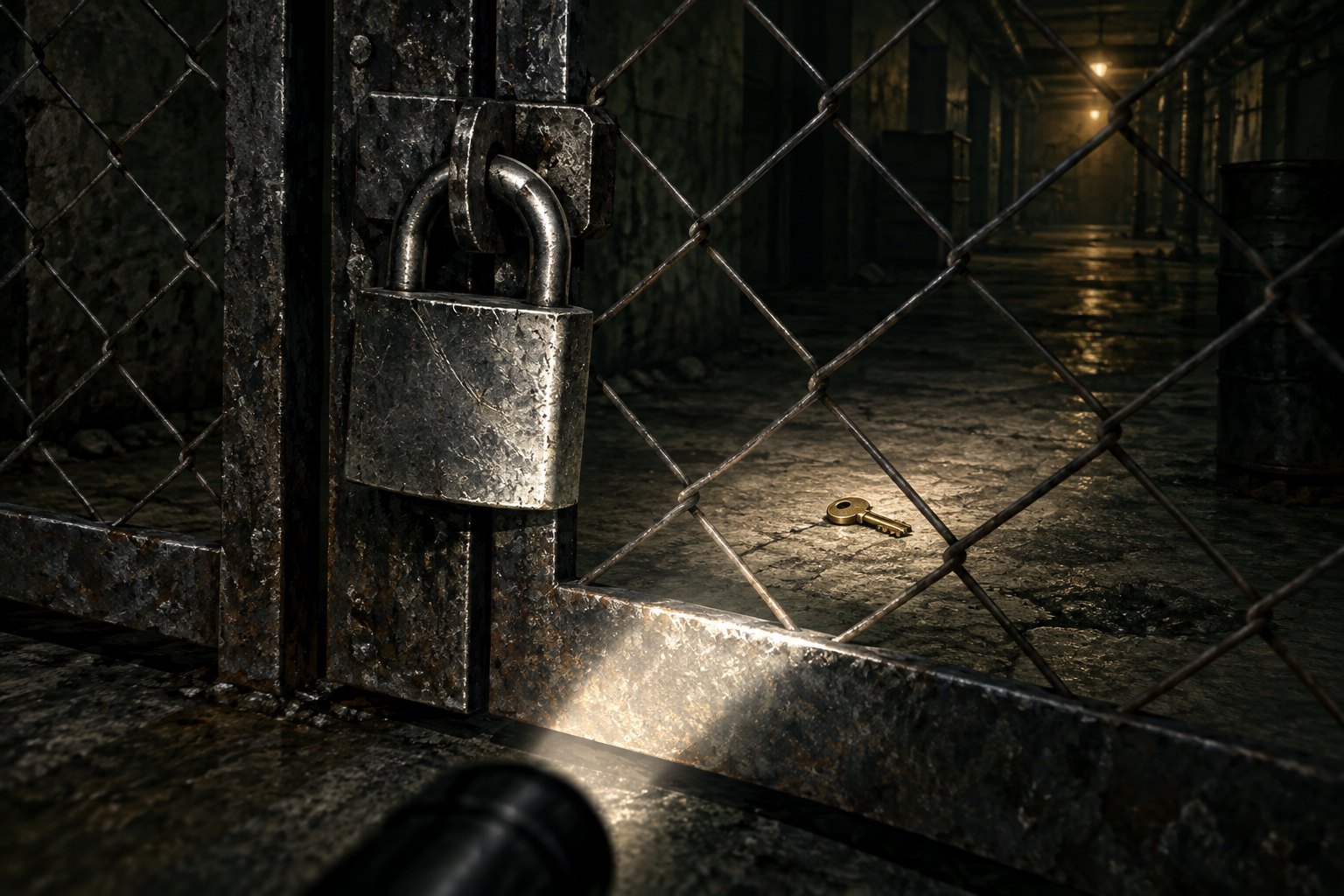
For the audience, a lock can become more aggravating than a monster. The monster announces a threat; the lock withholds an apparently available escape. Its smallness sharpens the frustration. An object that would be an inconvenience on an ordinary day becomes the center of the world.
This is where an adaptation can communicate something specific about playing a game without reproducing a familiar protagonist. Attention becomes a scarce resource. Bryan must notice the environment while wanting desperately to leave it. The viewer gets the pleasure of understanding the obstacle and the discomfort of being unable to help.
When laughter deepens fear—and when it weakens it
There is a meaningful distinction between laughing at danger and laughing at someone’s response to danger. Bryan’s weapon trouble belongs to the second category. The threat remains serious; the human response is awkward enough to produce laughter.
That balance depends on consequences. If mistakes consume time, restrict movement, or increase exposure, humor can make vulnerability more tangible. A joke becomes another indication that the protagonist has limited control.
Repetition creates a risk, however. If every new difficulty promises another comic failure, viewers may begin anticipating the gag more than fearing the outcome. A character can seem protected by the film’s desire to keep him entertaining, even while the plot continues to punish him.
The divided critical response is useful here. Eileen Jones’s Jacobin assessment emphasizes the combination of horror and comedy, while other reviews question the humor’s effect on tension. My judgment is that the central idea is strong, but its effectiveness depends on how much sustained frustration a viewer enjoys. Bryan’s appeal and Bryan’s limitations are inseparable.
The game references work best as practical problems
Reported visual references include a typewriter, green herbs, and distinctive key-and-lock combinations. These details offer recognition for players, but recognition alone is a modest achievement. An object becomes more valuable dramatically when it changes how a character behaves or how an audience understands a space.
The locks meet that standard particularly well. They make a familiar convention into an obstacle with immediate consequences. Even someone who misses the reference can understand the problem.
The smaller background references operate differently. They provide texture and familiarity without requiring viewers to bring a complete history of the games. The useful distinction is between an Easter egg that rewards attention and information that the story requires an audience to possess. This film’s ordinary protagonist gives newcomers a natural point of entry.
The deeper sting is the failure of instant competence
The strongest interpretation of Cregger’s approach concerns how quickly fiction expects people to become useful in a crisis. Bryan’s situation demands skills that his previous life did not supply. The demand itself does nothing to create them.
That makes his vulnerability worth taking seriously even when it is funny. Fear does not produce expertise on command. Understanding what should happen does not guarantee the ability to make it happen. Our discussion of Bruce Wayne’s conscience and power approaches heroism through moral restraint; Bryan raises the complementary question of what heroism can look like before capability arrives.
For me, that is where this Resident Evil finds its bite. Its recognizable objects and grotesque dangers matter because they confront a person who cannot immediately master them. Bryan makes survival look awkward, contingent, and exhausting. The fear lives in the possibility that, given the same emergency, the rest of us would need instructions too.
Original content by this site's editorial team. Published: September 23, 2026 at 07:40:06 PDT (Los Angeles time)