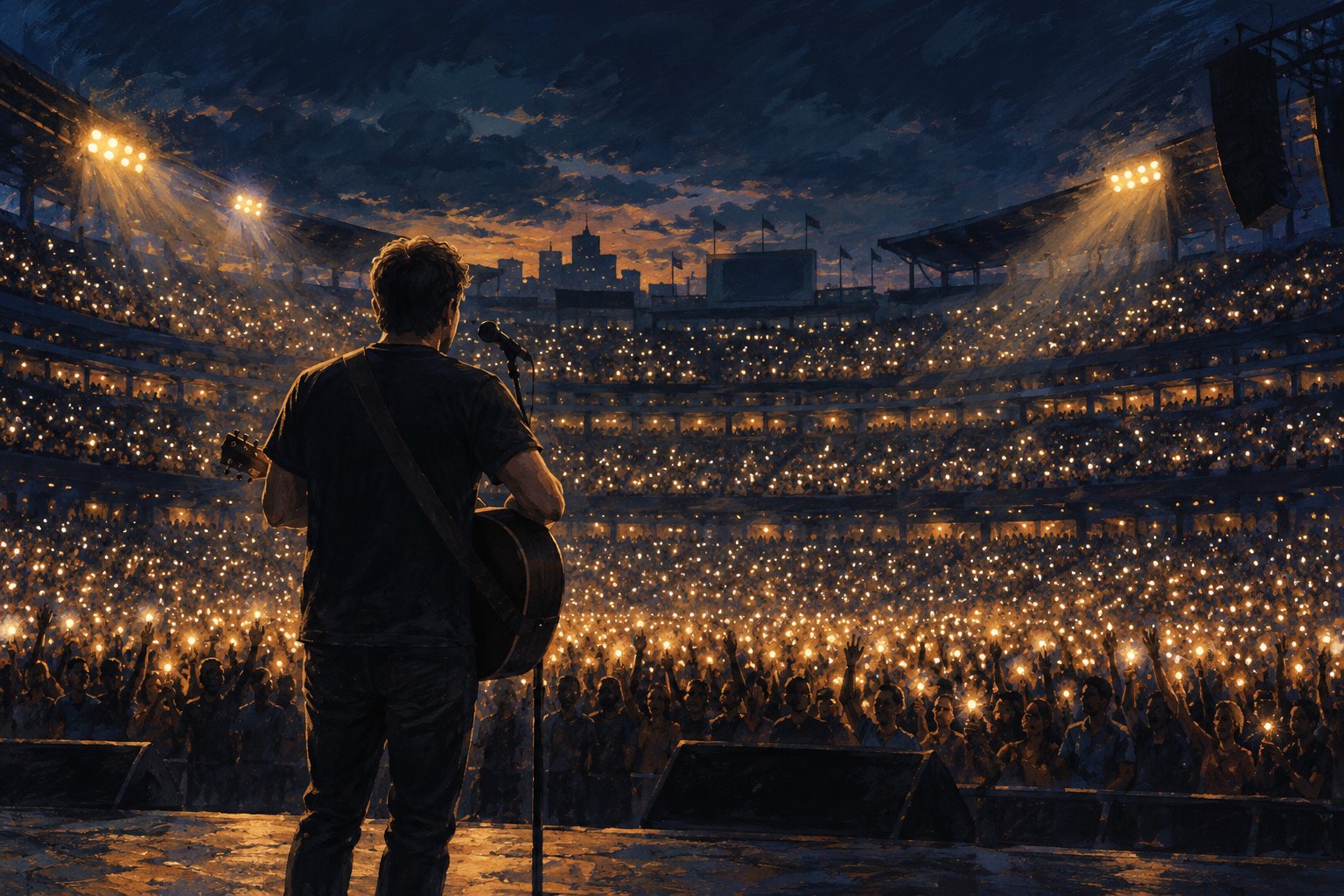
Zach Bryan wore a shirt reading “Free Palestine” during his Gillette Stadium concert, placing a plainly stated political message inside an entertainment venue already associated with controversy over pro-Palestinian expression. NBC News reported the appearance weeks after the uproar surrounding Ed Sheeran’s tour. The central fact is straightforward: Bryan brought those words onto that stage.
The setting gives the gesture its particular significance. Coverage of the earlier dispute involved Macklemore and Gillette Stadium, while The Boston Globe framed Bryan’s shirt as defiance of Robert Kraft. That description offers an interpretation of the act. It does not, by itself, establish Bryan’s private reasoning or prove that a confrontation occurred backstage.
This is cultural commentary on a reported concert appearance. The useful question is how a visible statement acquires meaning through the performer, the venue, and the audience’s knowledge of what preceded it.
What the shirt communicates—and what it leaves unanswered
“Free Palestine” is an explicit political message. Wearing it in public makes that message part of the wearer’s presentation, and wearing it while performing gives it access to an audience gathered for another purpose. It is reasonable to describe Bryan’s clothing as an expression of support for Palestinian freedom. Treating the words as meaningless wardrobe decoration would ignore their content.
Nevertheless, a slogan is not a complete interview. It cannot establish every position Bryan holds, which developments he had in mind, or whether he intended to address a particular person. Those questions require statements or other evidence beyond the garment itself.
This distinction strengthens criticism. An observer can take the message seriously while resisting the temptation to supply an imagined explanation. The visible choice carries enough significance to examine on its own.
My reading is that the shirt’s force comes from its economy. A performer can incorporate a political statement into his appearance without turning every moment of the show into an explanation of that statement. The music and the message then occupy the same space, leaving spectators to decide how much attention each deserves.
Why Gillette Stadium changes the meaning
A political shirt at an unrelated venue would still communicate a position. At Gillette Stadium, the recent dispute surrounding Sheeran’s tour creates an additional association. The venue becomes part of the statement’s context, even without an accompanying explanation from Bryan.
Film criticism offers a useful way to understand this effect. A location changes how viewers read an action. The same sentence spoken at a family dinner and at a public hearing carries different pressures because the setting establishes relationships, expectations, and possible consequences. Here, the concert’s location encourages audiences to connect a visible message with an existing controversy.
That connection should remain precise. Bryan’s appearance and the earlier tour dispute involve different performers and circumstances. The available facts do not establish identical contractual arrangements, identical discussions with organizers, or identical professional risks. Comparisons that assume all those conditions were the same make the story appear simpler than the evidence allows.
The broader issue concerns who can shape the meaning of a commercial entertainment space. A venue provides the infrastructure; an artist supplies a performance and a public identity; ticket holders arrive with their own expectations. Those interests can overlap without becoming interchangeable.
That tension also informs our examination of creative choice under entertainment ownership. Ownership helps determine where art reaches people, while performers continue to make expressive decisions within those spaces.
Clothing becomes part of the performance
Screen audiences routinely interpret clothing as meaningful. A costume can suggest affiliation, authority, resistance, or an effort to belong. At a concert, clothing likewise contributes to how a performer presents himself, although a real person’s wardrobe should never be treated as a fictional character’s fully scripted motivation.
Bryan’s shirt makes this relationship unusually direct because it carries a readable statement. The garment joins the performer’s body to the words. An audience encounters the message as something he is wearing while doing the work for which people came to see him.
In my view, that proximity matters more than whether the gesture looks elaborate. Political expression does not need elaborate staging to alter a performance’s meaning. A few words can introduce a subject that spectators might otherwise have kept separate from the evening.
Nor does that observation establish anything about the concert’s musical quality. A review of the singing, arrangements, pacing, or sound would require evidence about those elements. Agreement with a performer’s politics cannot substitute for listening closely, just as disagreement cannot establish that a performance was poor.
A concert image can show a choice without explaining everything
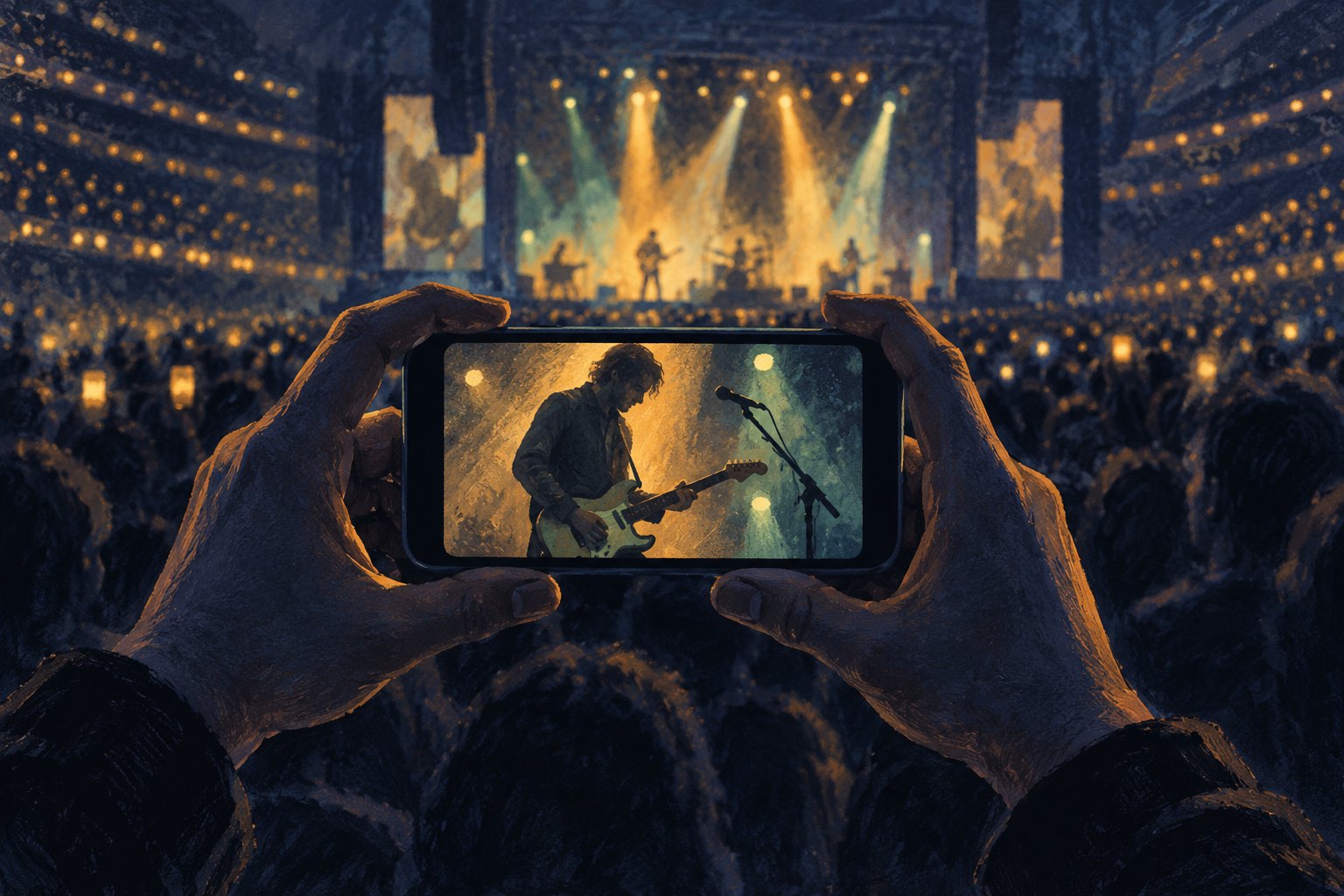
A tightly framed concert image can make a shirt legible while leaving almost everything else outside the frame. That selectivity helps explain why a wardrobe choice can become the defining image of a much longer event. It also establishes a limit: visibility is evidence of what can be seen, not automatic access to everything that happened.
For readers encountering Bryan’s appearance through coverage, three questions help keep the interpretation grounded:
- What is directly established? Bryan wore the message during his Gillette Stadium appearance.
- What context changes its significance? The recent controversy surrounding Sheeran’s tour and the venue’s association with it.
- What remains an inference? Bryan’s precise intentions, private conversations, and any claim that the audience shared one response.
The distinction resembles the question explored in our analysis of documentary access and the limits of what a camera establishes. An image can be revealing without being comprehensive. Recognizing its boundaries lets viewers engage with its actual content more carefully.
Keep the people named by the message in view
Celebrity coverage can turn political expression into a contest over the celebrity’s reputation. Was the performer brave, calculating, consistent, or provocative? Those questions can be worth asking when evidence supports them, but they can also push the subject of the message out of the discussion.
In this case, the words name Palestine. An interpretation focused entirely on Bryan’s standing with fans would miss that outward reference. Equally, the presence of the slogan does not make him a substitute for Palestinian voices or make a concert appearance a comprehensive account of the issue.
The most persuasive reading holds both points together: this was a meaningful public expression by a prominent performer, and its subject extends far beyond him. Its significance does not depend on imagining universal approval or predicting consequences that have not been established.
Bryan’s shirt makes the Gillette Stadium appearance worth examining because it places artistic self-presentation and political expression in the same visible frame. My judgment is that the gesture gains its sharpest meaning from that encounter: an artist brings a message into a space whose recent history makes the choice especially noticeable. What follows should be assessed through further evidence. What happened onstage already gives audiences something concrete to consider.
Original content by this site's editorial team. Published: October 3, 2026 at 14:05:09 PDT (Los Angeles time)