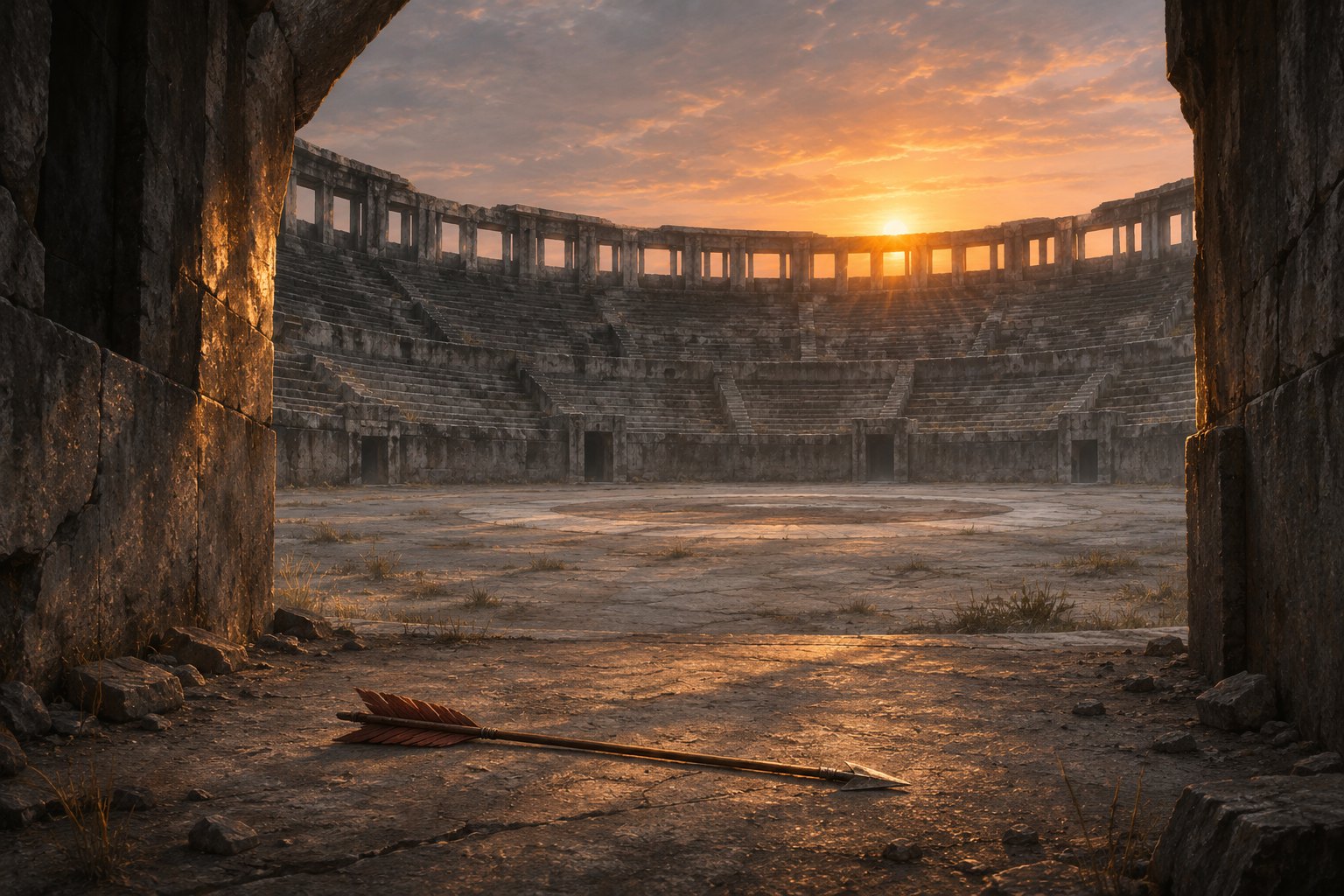
Another Hunger Games movie is not something audiences should assume will arrive on a predictable sequel schedule. Variety’s reporting points toward a wait, but that should not be mistaken for a cancellation announcement or a confirmed interval between films. The larger creative question is whether another visit to Panem can offer something more substantial than a different roster of tributes.
There is a practical reason for that uncertainty. Reporting on the franchise’s future describes Suzanne Collins’s writing as the foundation for another adaptation. That makes the existence of a meaningful new story more important than simply identifying a character audiences want to see again. It also fits the films themselves: their most powerful moments challenge the machinery that keeps demanding another performance.
Spoilers follow for The Hunger Games and The Hunger Games: Mockingjay – Part 2. This is a critical reassessment of the existing films, not a review of an unannounced sequel.
What the wait does—and does not—tell us
A franchise can remain commercially recognizable without having its next story ready. Those are different conditions. Audience enthusiasm supplies an incentive to continue; it does not supply a screenplay, a production commitment, or a release date.
In an interview with Digital Spy, director Francis Lawrence said he did not know whether Collins was writing another book. The publication also reported Lionsgate chairman Adam Fogelson’s comments about respecting her creative leadership. Those remarks explain why fans should be cautious about treating possible stories as projects already moving toward theaters. They do not establish that Collins has stopped writing about Panem.
The distinction matters because speculation often skips the hardest step. Asking which victor deserves a movie is enjoyable. Establishing why that person’s experience needs its own dramatic form is considerably harder. Our assessment of Finnick as a potential lead considers that character question. The more immediate issue is what any continuation would have to earn.
Katniss begins by refusing the role assigned to her
Rewatching the first Hunger Games film reveals how little its central appeal depends on the novelty of its contest. Katniss becomes compelling before she enters the arena. When Prim is selected, her response is immediate: “I volunteer!” The words are memorable because they collapse an elaborate public ritual into a private emergency.
From Katniss’s perspective, this is a decision about her sister. From the Capitol’s perspective, it becomes usable television. That disagreement gives the film its dramatic energy. Almost every subsequent act can be understood both as something Katniss feels and as something other people can package.
Jennifer Lawrence makes that tension visible through guarded reactions. Katniss often seems to be calculating how much of herself she can safely reveal. The presentation sequences are therefore more than interruptions before the action. They establish that survival involves managing an audience whose sympathy can help her without making its appetite innocent.
My judgment is that the first film works best when it preserves this friction. Its action gives the story urgency, but Katniss’s discomfort gives it meaning. A continuation that supplies more elaborate dangers while losing that divided perspective would reproduce the format without reproducing the drama.
Rue changes what surviving can mean
Katniss’s relationship with Rue interrupts the competition’s governing assumption: every other child is ultimately an obstacle. Their cooperation has practical benefits, but the emotional significance exceeds strategy. Katniss recognizes someone vulnerable whom she wants to protect, even inside a structure designed to punish attachment.
After Rue dies, Katniss surrounds her with flowers. The gesture does not undo the killing or provide a tactical advantage. It insists that Rue deserves attention as a person after the broadcast has extracted its suspense from her danger.
This is where the film’s moral argument becomes especially clear. The Capitol can display a death, but Katniss contests its meaning. Flowers turn a contestant’s elimination into a child’s mourning. Her act of care becomes politically disruptive because the system depends on viewers accepting its categories.
That scene offers a useful standard for future films. A new installment needs moments that alter how we understand a character’s choices. Another tragic death alone cannot do that. The story must establish the relationship, the compromised alternatives, and the specific human value that the violence threatens.
Peeta makes identity part of the stakes
Peeta’s importance is easy to flatten into the question of whom Katniss loves. His deeper contribution is a concern about what survival might require him to become. Before the Games, he worries about retaining himself under conditions deliberately engineered to strip that self away.
The poisonous berries bring that concern into the action. When the promise of two winners is withdrawn, Katniss and Peeta threaten to deny the Games their surviving victor. Their resistance exploits a weakness in the spectacle: the organizers need an ending they can present.
Yet the moment also leaves an emotional problem unresolved. Publicly performed intimacy and private attachment have become difficult to separate. The film’s ending is effective precisely because escape does not restore uncomplicated honesty between them. They have survived through a story that other people now expect them to keep telling.
This is why revisiting familiar characters requires more than affection. Their unresolved experiences can support further drama, but only if the film understands what has already changed. Repetition without consequence would make their survival feel strangely disposable.
Mockingjay’s ending gives the franchise a demanding boundary
Mockingjay – Part 2 takes the argument beyond the arena. Katniss discovers that opposing Snow does not automatically make another leader worthy of trust. Coin’s proposal for a final Hunger Games involving Capitol children exposes how readily punishment can be presented as justice.
Katniss ultimately shoots Coin at the ceremony intended for Snow’s execution. The decision is disturbing rather than conventionally triumphant. She breaks with the public role prepared for her again, but the cost of reaching that recognition cannot be repaired by one arrow.
For me, the film is strongest when it lets that exhaustion complicate victory. Its quieter ending matters because Katniss and Peeta are no longer required to make their relationship useful to a national spectacle. Their exchange, “Real or not real?” followed by “Real,” reduces an enormous political story to the fragile possibility of trust.

That domestic resolution establishes a boundary any continuation should respect. Peace is an achievement within this story. Treating it merely as an inconvenient pause before renewed danger would weaken the meaning of what these characters endured.
What would make another return worthwhile?
A prequel can honor that boundary while examining another period, but historical distance is not enough by itself. A worthwhile film needs a perspective that changes our understanding of power, complicity, resistance, or recovery. Our analysis of visual beauty and Haymitch’s tragedy considers a related question: how cinematic presentation can complicate the suffering a story asks us to witness.
The deeper interpretation of Katniss’s journey is that freedom includes escaping the demand to remain interesting to an audience. She starts as a child protecting her sister, becomes an image claimed by competing authorities, and eventually gains room for a life that does not need public approval.
That makes patience an unusually appropriate response to uncertainty about another Hunger Games movie. There may be more to say about Panem. The existing films give us a clear measure of whether the next story deserves telling: it should reveal a person whose life exceeds the spectacle built around them.
Original content by this site's editorial team. Published: November 22, 2026 at 15:38:32 PST (Los Angeles time)