Oklahoma’s appeal to major movie productions is best understood through three questions: Can a project make its budget work there? Can its crew complete the shoot reliably? And can the location deliver the world the story needs? Those questions provide a useful explanation of how a state becomes a viable filming destination, although they do not establish why any particular production selected Oklahoma.
News 9’s coverage puts the state’s attraction for major productions in focus. For moviegoers, the interesting issue extends beyond where cameras and trailers turn up. A location decision can influence the spaces actors inhabit, the time available to stage a scene, and how convincingly a fictional life takes shape. This is production commentary, rather than a review of an individual film; its judgments concern what Oklahoma’s appeal could mean for the work on screen.
The budget question involves the entire shoot
Cost is a sensible starting point, but describing a filming destination as inexpensive explains very little. A production needs to consider the combined expense of people, equipment, accommodation, transport, location preparation, and working time. A promising location loses some of its financial appeal if reaching it or making it usable requires additional spending elsewhere.
Consider a hypothetical production choosing between two streets for the same sequence. One might require extensive set dressing but place several other locations nearby. The other might look right immediately while demanding a substantial daily journey. The cheaper choice depends on the schedule and the script, not simply the fee charged for the street.
Incentives, where applicable, belong within that calculation. Their significance depends on eligibility, qualifying expenditure, availability, and payment arrangements. Without verified terms and a particular production’s accounts, attaching a savings figure to Oklahoma would create false precision. The useful question is whether the complete production plan becomes more achievable there.
There is a creative consequence to that calculation. If a location makes the schedule more manageable, filmmakers might have greater room for rehearsals, additional coverage, or complicated staging. Those are possibilities, not guaranteed benefits: a lower expense can also simply reduce the budget. Viewers should judge the resulting scenes rather than assume that savings automatically reach the screen.
A beautiful location must also function as a workplace
A camera-ready view is only one part of a usable film location. Productions also need to establish where equipment can go, how performers reach the set, whether sound can be recorded, and what happens when conditions change. A place may suit the director’s visual imagination while presenting difficulties for every department tasked with realizing it.
For Oklahoma, the practical test is therefore specific to each project. An intimate drama, a period production, and an effects-heavy action film would bring different demands. Crew availability, equipment access, interior options, and travel distances should be assessed against those demands. A successful shoot for one kind of movie does not prove that every other kind will find the same advantages.
Reliability matters because filmmaking joins many dependent tasks. A location change can affect lighting, costume continuity, transport, and the order in which performances are captured. The strongest argument for a filming destination is a workable plan across those departments. A striking landscape earns its place in the movie when the production can actually use it.
What the location can give a character
From a film criticism perspective, the most compelling reason to care about Oklahoma as a production destination is the relationship between place and behavior. An environment can make a character’s circumstances legible before anyone explains them. Distance, privacy, visibility, and access all influence how a scene feels.
Imagine two fictional characters meeting in a diner. If the window exposes them to everyone passing outside, a private disagreement gains a public edge. If the nearest exit requires one person to move past the other, leaving becomes a physical decision. These are hypothetical examples, but they show why scouting is also a form of dramatic interpretation.
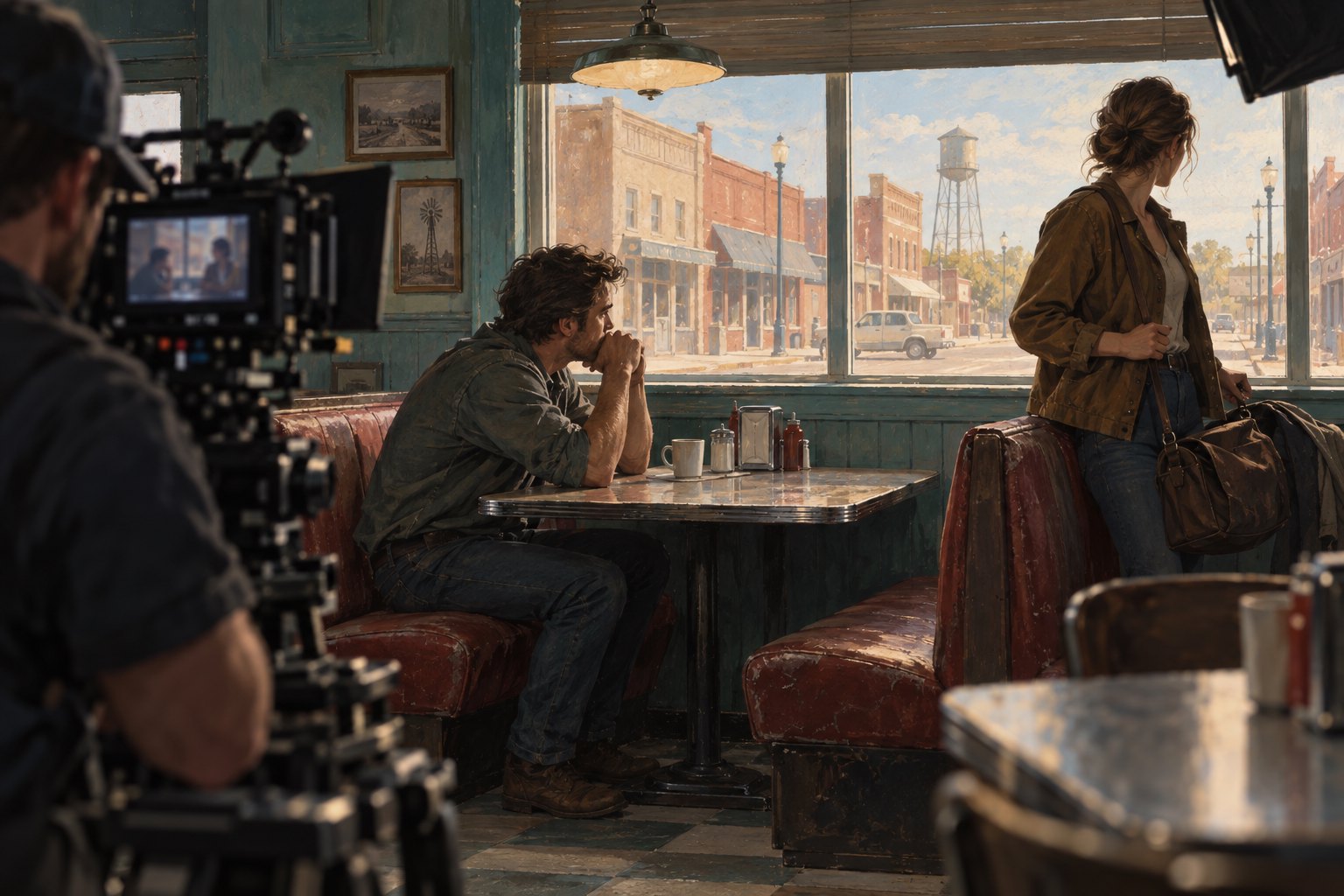
The same principle applies to exterior space. A wide composition might suggest freedom to one character and exposure to another. A long route home might register as independence, obligation, or isolation, depending on whose experience the film follows. The landscape acquires meaning through performance, framing, sound, and editing.
Our commentary on setting and ensemble expectations in Paper Tiger approaches a related critical question: what does an environment contribute to the people within the story? Oklahoma-based productions deserve that same attention. Recognizing where something was filmed is a starting point; understanding what the location does is the richer exercise.
Filming in Oklahoma and telling an Oklahoma story are different choices
A production’s shooting address does not necessarily identify its fictional setting. A location might portray itself, represent somewhere else, or supply separate pieces of an invented geography. That distinction matters when evaluating claims of authenticity.
If Oklahoma stands in for another place, the artistic test is coherence. Do the selected streets, interiors, and exterior views appear to belong to the same world? Do transitions make spatial sense? A convincing screen environment can emerge from careful selection, even when viewers would never identify the actual filming location.
If the story explicitly concerns Oklahoma, the standard becomes more demanding. Attractive scenery cannot establish the credibility of its characters’ relationships, work, or community life. Those elements require attention in the writing and performances, supported by production choices that respect the particular setting.
My critical preference is for films that let locations complicate their characters. A place becomes dramatically useful when it creates obligations, memories, opportunities, or restrictions. Merely presenting it as picturesque leaves much of its storytelling potential untouched.
How to judge whether the attention becomes lasting value
Major productions attract notice, but announcements alone cannot establish a durable production base. Useful evidence would include repeat work, sustained employment, opportunities for local workers to advance, and facilities that continue finding users. Those are measures to investigate, not outcomes that should be assumed from a prominent arrival.
For audiences, a parallel distinction applies. More filming activity does not automatically mean stronger films. Our analysis of what a larger Paramount slate could offer moviegoers makes the related case for evaluating what production volume delivers. Scale becomes meaningful when it supports distinctive work.
Oklahoma’s appeal ultimately deserves attention at both levels: whether productions can accomplish their work there, and whether filmmakers make expressive use of the places they choose. The first question concerns the conditions that get a movie made. The second concerns what makes it worth watching. The most satisfying outcome would be films in which the setting feels inseparable from the characters’ choices—where viewers understand a little more about a person because they have seen the world that person must navigate.
Original content by this site's editorial team. Published: September 24, 2026 at 11:41:05 PDT (Los Angeles time)