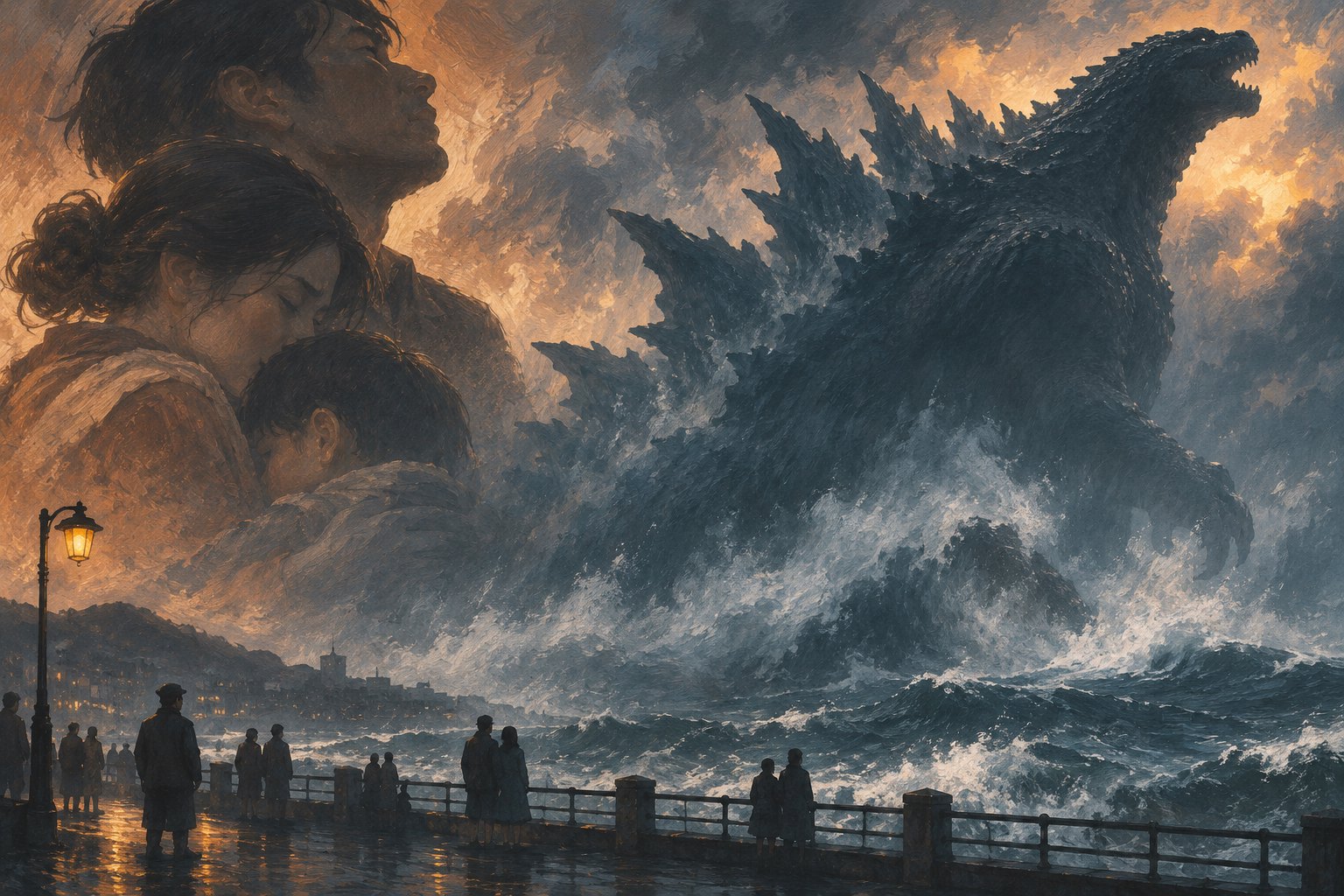
Godzilla Minus Zero sits at a difficult intersection of monster spectacle and family melodrama. The central complaint in Jake Coyle’s AP review is that its emotional material overwhelms the entertainment surrounding it. That is a criticism of proportion, and it deserves a more careful response than simply demanding additional destruction. A monster movie needs people worth worrying about. It also needs their worries to develop into something more than repeated declarations of distress.
This is a critical analysis of that argument and the film’s reported character situations, rather than a firsthand screening verdict. Limited story spoilers follow.
The problem is what the emotion accomplishes
Takashi Yamazaki’s sequel takes place in 1949 and returns to Kōichi, Noriko, and their daughter Akiko. Coyle describes a family still living with the emotional consequences of catastrophe. He praises the film’s visual imagination while arguing that its human characters cannot sustain the dramatic weight placed upon them.
Those two judgments can coexist. Beautifully staged danger does not automatically make the surrounding relationships convincing. Equally, an emotionally forceful conversation can contribute as much suspense as an approaching monster. The useful question is whether each scene changes what a character wants, understands, or is prepared to risk.
My view is that melodrama becomes exhausting when its intensity stays fixed. If every conversation carries the emotional pressure of a farewell, an actual farewell has less room to register. A film can establish devastating stakes early and still benefit from ordinary behavior afterward: irritation, practical problem-solving, uncertainty, even an awkward joke. These variations make people feel alive before the screenplay asks us to fear their deaths.
Kōichi and Noriko: responsibility pulls in two directions
The parents’ involvement in the response to the new threat creates an immediate conflict: protecting others can mean leaving Akiko. That situation deserves serious attention because neither side of the choice is morally empty.
From a parent’s perspective, staying close to a child is an active responsibility. From the perspective of a threatened community, refusing to help can have consequences for many other families. A compelling screenplay allows both obligations to exert pressure. It should make the audience understand why a person hesitates without treating hesitation as a character defect.
This is where character-centered criticism becomes more useful than counting action scenes. Does a discussion reveal a new disagreement between the parents? Does it expose a difference in how they understand duty? Does one person change the other’s decision? If so, the conversation is moving the film forward even when nobody leaves the room.
If successive conversations merely restate the danger of separation, emotional intensity can replace development. The audience understands the dilemma but receives no new way to experience it. Coyle’s criticism invites precisely this distinction: a serious subject still needs dramatic movement.
Our earlier exploration of survival in Yamazaki’s Godzilla films considers what continuing to live might mean. The question here is narrower: how can the shape of an individual scene make that meaning felt?
Akiko and the danger of making childhood symbolic
One detail in AP’s account is especially revealing: the parents caution Akiko about displaying happiness around children who have lost their own parents. It places the family’s private relief beside a wider community’s grief.
My reading of that situation is that survival creates an uneasy social obligation. Happiness can feel inconsiderate even when it is innocent. For a child, however, being asked to manage adult awareness of loss is a considerable burden. The scene’s premise opens a question that deserves space: must the survivors continually reduce their joy to demonstrate that they remember the dead?
Akiko’s perspective also offers a useful standard for judging the family drama. A child should have a recognizable experience of events, rather than existing only as the reason adults suffer. Curiosity, confusion, impatience, and attachment can all make childhood specific. The more particular that experience becomes, the less the film needs to announce how precious it is.
A line about peace needs room to resonate
Empire’s review quotes the dialogue, “Will we ever live in peace?” It is a direct expression of exhaustion, and its simplicity makes the dramatic challenge clear. Once a character has asked that question, what can the next scene contribute?
The strongest answer would come through behavior. Someone attempting an ordinary task, trusting another person, or making a modest future plan could give peace a concrete meaning. The audience then has something specific to imagine losing. Repeating the question at a higher emotional pitch would offer less.
This is also why memorable dialogue cannot be judged entirely apart from its placement. A plain sentence can become devastating after a sequence of restrained choices. An eloquent speech can feel weightless if it tells us what the preceding scenes have already made obvious. Emotional force depends on preparation and contrast as much as wording.
Monster spectacle can carry the character drama
It is tempting to discuss human scenes and monster scenes as competing allocations of screen time. That approach overlooks the possibilities of staging. Scale, distance, visibility, and movement can express a person’s vulnerability without pausing for explanation.
A human figure dwarfed by danger gives the audience an immediate physical understanding of limited control. A clear route through a hazardous space creates a practical objective. Losing sight of that route changes the emotional situation. Action becomes character drama when we understand the choice being made inside it.
Conversely, destruction becomes less involving when its relationship to the characters is unclear. Bigger images cannot compensate indefinitely for uncertain geography or an indistinct objective. The crucial issue is whether the audience can connect what it sees with what someone stands to lose.
Commercial enthusiasm cannot resolve that question. As our discussion of Godzilla Minus Zero’s box-office comparison with Ramayana explains, financial performance and artistic judgment answer different questions.
The deeper question: can ordinary life be enough?
The most productive interpretation of this debate concerns the value of ordinary existence. If family life matters only because it can supply a heartbreaking separation, the story risks reducing love to an instrument for producing anguish. Giving relationships texture between crises establishes a more substantial reason to care.
For me, that is the standard behind the melodrama complaint. Emotional ambition is welcome; it needs specificity, variation, and consequences. Godzilla’s enormous scale makes human life look physically small. The drama’s task is to show why that small life remains immeasurably important—and to trust that a quiet moment can sometimes make the case.
Original content by this site's editorial team. Published: November 8, 2026 at 12:07:12 PST (Los Angeles time)