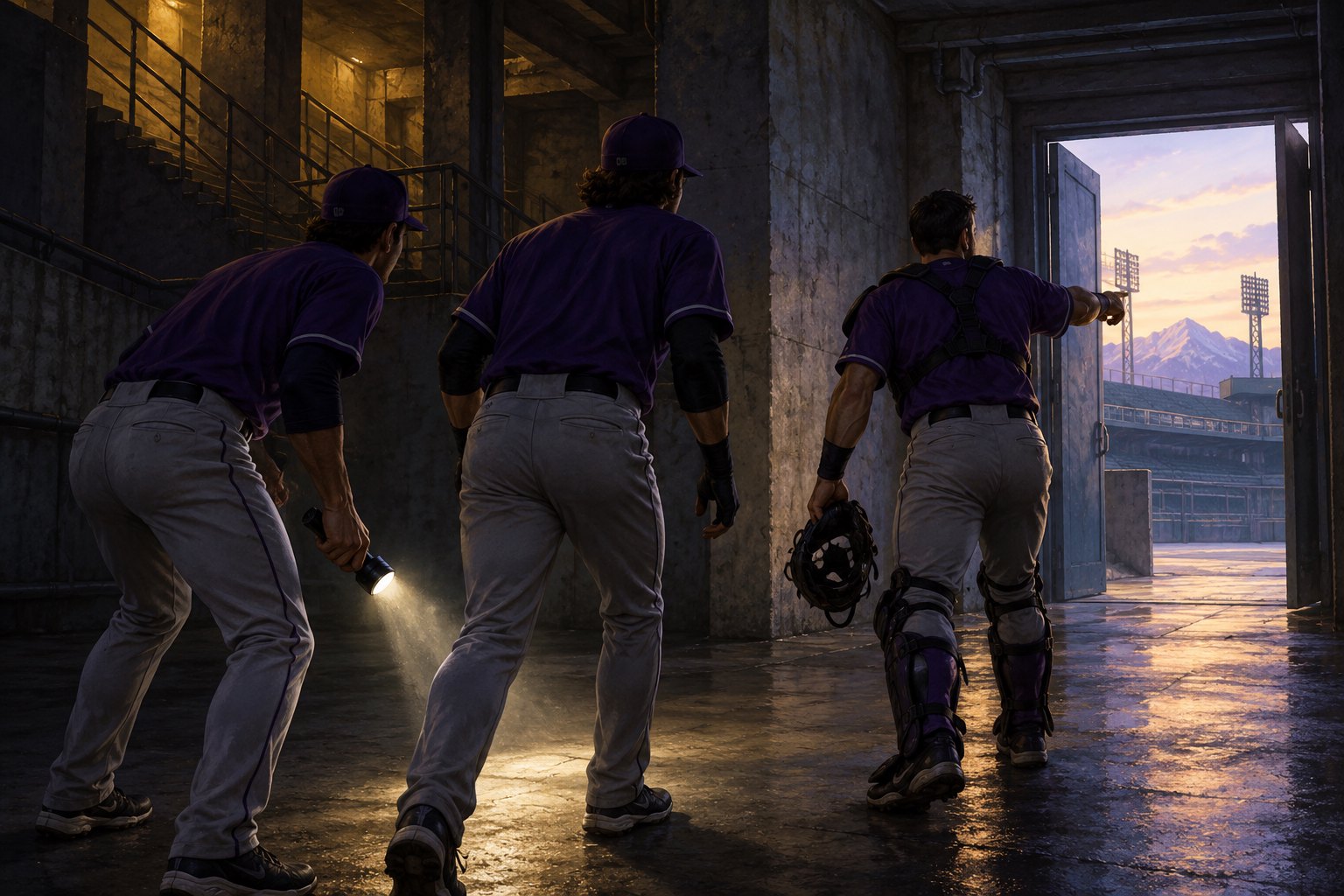
The Colorado Rockies most likely to survive a horror movie would be the ones who notice trouble early, communicate clearly, and resist turning every emergency into an individual highlight. My first pick would come from behind the plate: the catcher, imagined as the ensemble’s observer and organizer. The fastest runner gets a strong supporting role. The player determined to confront the threat alone gets a much less reassuring character arc.
That is a casting judgment, not a prediction about any athlete’s real courage. Baseball performance cannot tell us how someone would respond to an impossible nightmare. But the Rockies horror-survival premise makes an entertaining film question because it asks which familiar sporting strengths would remain useful after the rules stopped making sense.
This is a hypothetical casting exercise, not a review of an existing Rockies horror film. The situations below are imagined, and no movie spoilers are required.
The catcher gets my vote for the final survivor
In a fictional Rockies ensemble, I would build the central perspective around the catcher. The appeal is visual before it is tactical: this is a character accustomed to watching a situation develop while everyone else waits for something to happen. A horror director could turn that watchfulness into suspense without giving the character an explanatory speech.
Imagine the camera remaining with the catcher as another player crosses an empty concourse. We see the observer register a sound before we see its source. A small change in expression tells us that the familiar environment has become unfamiliar. The scene would make attention, rather than strength, the character’s defining advantage.
The limitation matters just as much. Reading a baseball situation does not confer knowledge of a supernatural threat. A compelling protagonist would have to admit that the first explanation was wrong. My imagined catcher survives because he changes his assessment and shares what he learns, not because his position makes him magically perceptive.
That distinction gives the character somewhere to go. He might begin by believing that keeping everyone calm means sounding certain. By the final act, he would understand that honest uncertainty can be more useful than confident instructions based on a bad assumption.
The fastest Rockie needs a destination
Speed is the obvious survival pick, and it deserves consideration. In a pursuit scene, a quick runner could create distance, reach help, or reconnect with teammates. Movement also gives a filmmaker immediate dramatic clarity: someone wants to get somewhere, and something stands between them and that destination.
But speed becomes less persuasive when the character does not understand the space. Sprinting into an unfamiliar passage could exchange one danger for another. For my fictional Rockies runner, the decisive quality would be route selection. Does he notice where the others went? Does he know whether the door ahead leads outside? Can he stop when new information makes the original plan useless?
I would give this character an early success that creates a later temptation. Escaping once through athletic ability might encourage him to believe he can always escape alone. The more satisfying development would be learning to use that advantage on behalf of the group.
Different kinds of horror put different pressures on that choice. A physical chase rewards movement; a story about confinement removes it. Readers choosing between those moods can use our Halloween movie quiz organized around viewing preferences. The same distinction determines which imagined Rockie gets the best survival odds.
Patience helps only when the character knows when to act
A patient hitter offers another appealing character model. In this imagined story, he would be the player who refuses to accept the first apparent opening. He examines the situation, listens to the entire explanation, and asks what everyone else has overlooked.
That could make him valuable in a mystery-driven horror scenario. It could also become his fatal weakness if deliberation turns into delay. The interesting version of this character would not simply be the smart one. He would be someone whose useful habit becomes unreliable under unfamiliar conditions.
From his perspective, acting too soon might feel irresponsible. From a teammate’s perspective, waiting might look like abandonment. Letting both interpretations remain understandable would produce more tension than dividing the Rockies into sensible survivors and foolish victims.
My casting preference would be to pair this cautious character with the runner. One wants more information; the other wants immediate movement. Their disagreements could reveal genuine competing needs, with neither player automatically right.
The power hitter needs more than a heroic swing
A baseball bat makes the power hitter an easy visual centerpiece. It also creates an expectation that the story should question. Being able to strike something forcefully is useful only if force can affect the threat—and if approaching it does not create a worse problem.
I would write this imagined Rockie as someone who feels responsible for protecting everyone. His vulnerability would come from that obligation. If teammates expect him to handle the danger, stepping back could feel like letting them down, even when retreat is plainly the better decision.
That is a richer emotional problem than assuming a strong athlete must be reckless. The character could be thoughtful, frightened, and still drawn toward a confrontation because he mistakes visible action for useful action.
The best payoff would let him protect somebody through restraint: holding a door, helping an injured teammate move, or accepting another person’s plan. Our discussion of character consequences in the planned Call of Duty movie considers a related dramatic question: what makes physical action matter to the people inside the story?
The strongest ending lets the Rockies remain a team
My survival ballot therefore starts with the catcher as the central observer, adds the runner as the group’s mobility, and gives the patient decision-maker a crucial supporting role. The power hitter’s chances improve when he stops treating protection as a solo assignment. These are fictional roles built from baseball’s demands, not personality assessments of individual Rockies.
The deeper appeal of this premise is that baseball gives everyone a recognizable job, while horror can make those jobs suddenly inadequate. The runner may have nowhere to run. The observer may lack enough information. The strongest player may face something he cannot overpower. Each person must decide who he is when his most dependable skill stops providing an answer.
For me, that would be the meaningful ending: the Rockies survive by allowing one another to change roles. Someone asks for help without losing authority. Someone follows instructions without becoming passive. Someone abandons a brilliant individual plan because it leaves a teammate behind.
The player I would trust to reach the end credits is the one who notices that somebody is missing—and gets the others to notice before they close the door.
Original content by this site's editorial team. Published: November 1, 2026 at 00:15:22 PDT (Los Angeles time)