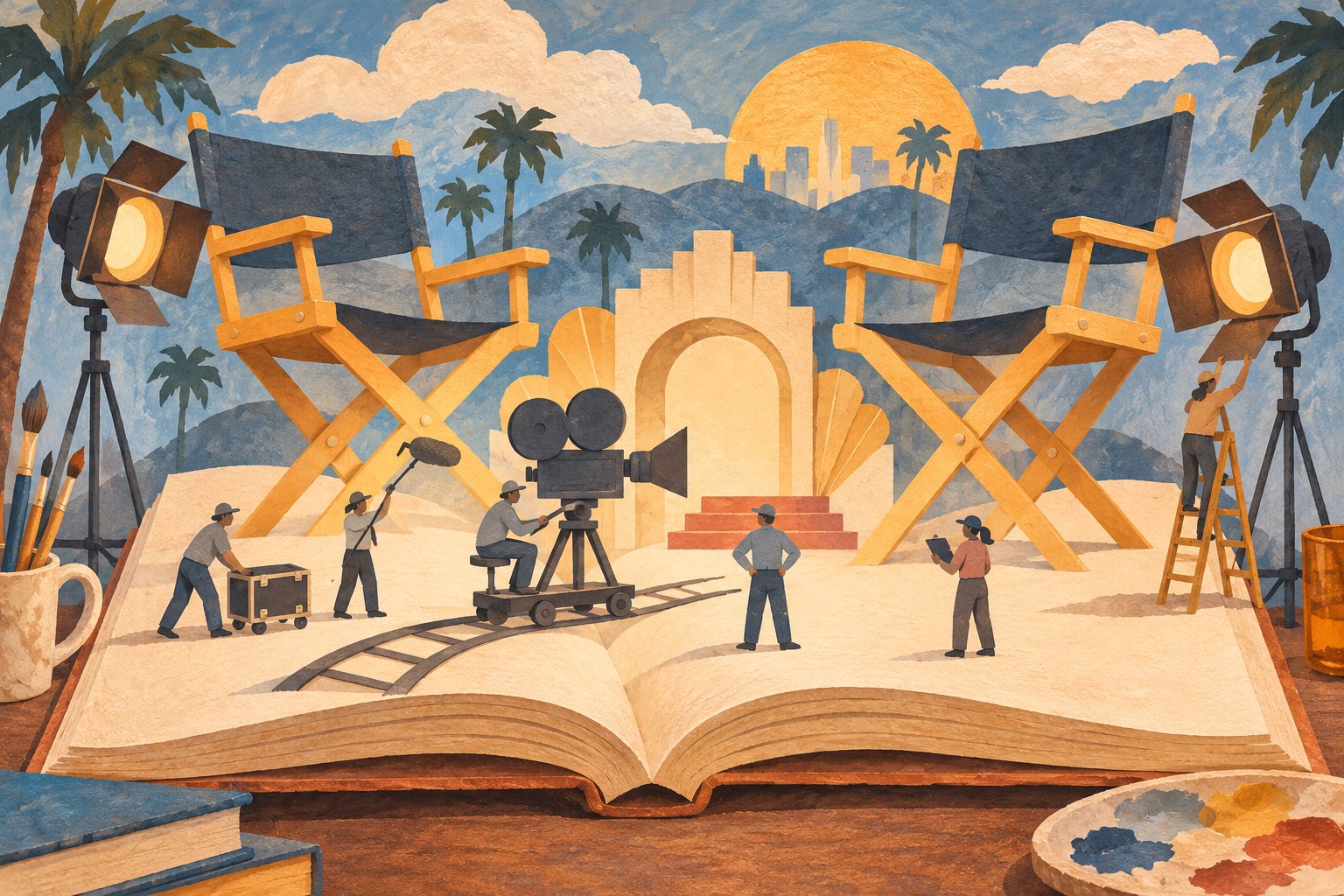
We Make a Movie takes an appealingly modest form—a satirical picture book—and points it at Hollywood’s enormous sense of importance. The premise invites a useful question for anyone who loves movies: what happens when an industry accustomed to explaining its own complexity becomes the subject of something deliberately simple?
The immediate attraction is the mismatch in scale. Moviemaking suggests elaborate machinery, specialized labor, money, and prestige. A picture book suggests an experience that can be grasped one page at a time. Bringing those forms together creates an opportunity to expose behavior that sounds reasonable in a meeting but looks ridiculous when stripped to its essentials.
This is spoiler-free commentary on the book’s premise and title, rather than a review of its individual pages. Its identification as a satirical picture book about Hollywood establishes the subject; it does not establish particular characters, jokes, or a narrative ending. The interesting critical territory begins with what that premise makes possible.
The Most Interesting Word in the Title Is “We”
We Make a Movie sounds cooperative. The sentence has a subject, an action, and a tangible result. Nobody appears to be competing for attention. Nobody is taking sole credit. The group simply makes something together.
Read as the title of Hollywood satire, however, that collective pronoun becomes unstable. Who belongs to the group? Does it include everyone whose work reaches the screen? Everyone who approves a decision? Everyone invited to stand beside the finished product? Those categories overlap, but they are hardly interchangeable.
My reading of the title is that it offers a particularly effective entrance into questions of authorship. A movie can be a shared accomplishment while its participants possess very different amounts of influence. Collaboration describes a relationship between contributions; it does not automatically describe an equal distribution of power.
That distinction gives the premise more potential than a simple parade of vain celebrities. A joke about an inflated ego can land immediately. A joke that reveals how collective language conceals individual authority can stay with a reader after the laugh.
Why a Picture Book Can Make Hollywood Look Strange Again
The picture-book format offers a useful mechanism for satire: words and images can disagree. A reassuring sentence can sit beside a scene that makes reassurance impossible. The reader notices the contradiction without needing a narrator to explain it.
That is a possibility of the medium, not a claim about a specific spread in We Make a Movie. It matters because institutional behavior often becomes easier to examine when its explanation and its visible consequences occupy the same frame. Someone’s account of a harmonious process can be tested against who is actually doing the work.
Page turns offer another advantage. They can separate a promise from its consequence, or an apparent achievement from the qualification that follows. In film, an editor controls when a reaction arrives. In a book, the reader participates in that timing by turning the page, pausing, or looking back.
For my taste, the strongest visual satire trusts that second look. An obvious central gag welcomes the reader; a quieter detail changes the meaning. The challenge is to make simplification revealing. Reducing Hollywood to a few recognizable symbols would be easy. Finding the relationship between those symbols is where criticism begins.
Look for Power, Not Just Personality
A useful way to approach Hollywood satire is to ask who can change another person’s day. Who can demand another attempt? Who can refuse? Who must keep smiling while the terms shift? These questions turn an abstract complaint about an industry into a readable relationship between people.
They also provide a character-centered approach without pretending this book is a feature film. In any workplace story, a person’s desires become dramatically interesting when they collide with someone else’s authority. Wanting recognition is ordinary. Needing recognition from someone who can also remove your opportunity creates tension.
Our examination of Cliff Booth’s working life and dependence on being useful approaches a related critical problem: employment can shape how a character behaves long before anyone explains that character’s beliefs. Applied here as a reading method, attention to dependence would help distinguish a joke about someone’s temperament from a joke about their position.
The distinction matters ethically and comically. Laughing at a powerful person’s demand is different from laughing at a worker’s inability to resist it. A satire’s point of view emerges through that allocation of sympathy, even when no explicit moral appears.
A Hollywood Roast Needs More Than Familiar Targets
Hollywood offers readily recognizable comic material: self-importance, elaborate praise, anxiety about success, and arguments over creative ownership. Recognition can make a joke accessible. It can also allow a joke to arrive already exhausted.
The more interesting question is whether a satire connects behavior to incentives. Why does someone agree with a decision they dislike? Why might praise become a means of applying pressure? Why does a supposedly shared objective produce competing definitions of success? These are questions a sharp Hollywood comedy can investigate without requiring readers to know private industry gossip.
Specificity need not mean naming a famous person. It can mean identifying a precise imbalance: one participant can postpone a decision indefinitely while another cannot afford to wait. That relationship is understandable far beyond filmmaking. It gives an industry joke a human consequence.
Equally, satire becomes less persuasive when it treats every compromise as evidence of stupidity. Creative collaboration genuinely requires revision, negotiation, and competing judgments. The sharper target is the moment a necessary process becomes an excuse for vanity or control. Preserving that distinction gives the criticism something solid to stand on.
What Movie Lovers Can Take From the Premise
For readers of film reviews, the appeal of We Make a Movie is not limited to whether Hollywood deserves teasing. Its premise encourages attention to the stories that surround finished movies: stories about who created them, whose judgment mattered, and how success should be understood.
That attention can improve criticism, provided it does not replace watching the work. A production anecdote cannot tell us whether a performance is convincing. A claim of artistic unity cannot settle whether a scene holds together. The movie and the account of its making remain different objects of judgment.
Our commentary on what makes a festival conversation valuable beyond a celebrity appearance raises a complementary question: does access help us see the work more clearly? Hollywood satire can offer a different route to that clarity by making the language of prestige feel less automatic.
The Deeper Question Behind Making a Movie
The title’s promise remains attractive even under scrutiny. People coming together to make a movie is worth caring about. That is precisely why the distance between shared effort and shared authority makes such fertile material for satire.
My strongest response to the premise is therefore curiosity about inclusion. Who gets to speak for the group? Who becomes visible only when something goes wrong? Who disappears when the finished work acquires a simpler, more marketable story about its creation?
We Make a Movie gives those questions a compact starting point. The lasting critical opportunity is to make readers hear its opening word differently: as a claim whose generosity depends on whom it actually includes.
Original content by this site's editorial team. Published: November 29, 2026 at 01:34:36 PST (Los Angeles time)