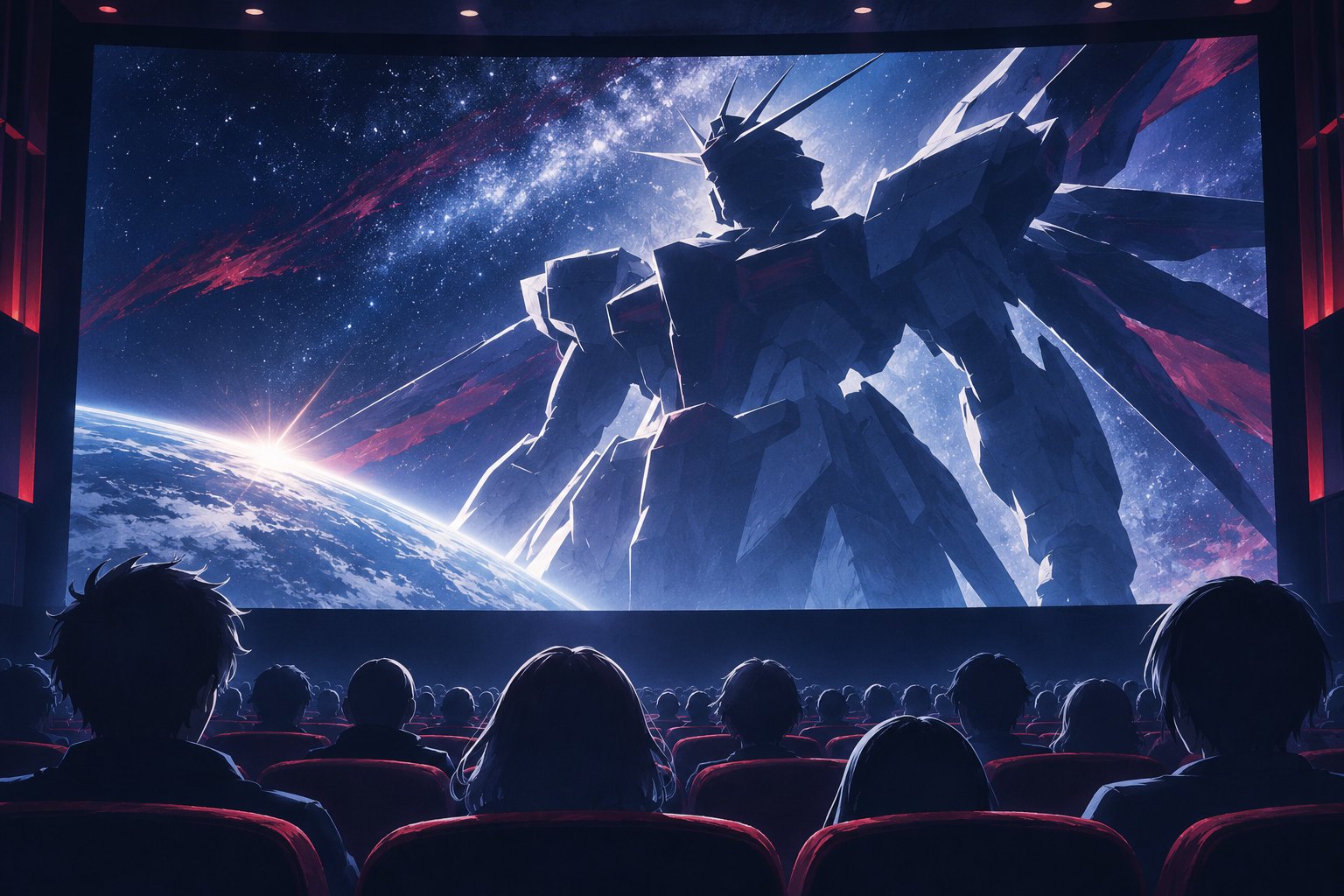
Mobile Suit Gundam SEED FREEDOM ZERO has released a main trailer and promotional visual, according to Crunchyroll’s announcement. For viewers following the anime film, that is the immediate news: two new pieces of its public presentation are available. The more interesting critical question is what will make this chapter matter beyond the pleasure of seeing its name return.
My starting point is character. Mechanical spectacle can make an action film immediately attractive, but a character’s reasons for entering a fight give that spectacle its emotional shape. For SEED FREEDOM ZERO, the most useful expectation is that its human decisions will prove as compelling as its machinery.
Spoiler-free preview commentary: This article considers the announcement and the standards a character-centered review should apply. It does not offer a verdict on the completed film or a scene-by-scene assessment of the trailer.
What the trailer announcement actually establishes
The reported development is specific: a main trailer and a visual have been released for Mobile Suit Gundam SEED FREEDOM ZERO. Those materials serve different purposes. A trailer can introduce movement, voices, rhythm, and atmosphere. A promotional visual compresses an identity into a single composition. Together, they give audiences material around which to build expectations.
Neither format, by itself, establishes the quality of a complete character arc. A striking confrontation might be the culmination of carefully developed tension, or a brief interruption in a very different story. The surrounding scenes determine which. Likewise, a character’s prominence in promotional artwork does not measure their narrative agency or screen time.
The announcement alone also does not establish a local release date, ticket availability, runtime, or viewing platform. Those practical details require their own confirmation. The useful distinction is between knowing that promotional materials exist and knowing precisely when, where, and in what form an audience can see the film.
The person inside the machine should be the starting point
From a character’s perspective, an action sequence begins before the first attack. It begins with a belief about what must be protected, an understanding of the available choices, and a willingness to accept some consequences while refusing others. That is where a future review of SEED FREEDOM ZERO should concentrate its attention.
Consider the difference between technical ability and judgment. A pilot can execute a maneuver perfectly while misunderstanding the situation that made it necessary. A successful rescue can still damage trust. These are hypothetical examples of dramatic possibilities, not claims about this film’s events. They illustrate why winning a fight and resolving a character’s conflict are separate achievements.
For my taste, the strongest action storytelling allows both achievements to complicate each other. Skill becomes interesting when it cannot answer the most important question. A character may know how to act while remaining uncertain about whether the action is right. That uncertainty gives an audience something to consider after the visual excitement subsides.

Look for relationships that change decisions
A character-centered approach also asks whether relationships alter behavior. Affection, resentment, loyalty, and grief matter most when they change what someone chooses to do. Simply placing familiar people beside each other cannot carry that dramatic burden.
When evaluating SEED FREEDOM ZERO, a useful question will be whether its characters can surprise one another in ways that remain believable. Does one person’s objection force another to reconsider? Does trust allow an action that would otherwise be impossible? Does disagreement have consequences beyond a moment of raised voices? These are standards for assessment, not predictions of particular scenes.
Our commentary on how The Mosquito Bowl frames heroism approaches a related problem: an ensemble needs individual motives if shared danger is going to feel personal. The same critical principle is useful here. Audiences should be able to understand why different people would experience the same crisis differently.
A promotional visual invites interpretation, with limits
The visual accompanying the trailer deserves attention as a piece of presentation. In promotional artwork generally, scale, distance, lighting, and the direction of a character’s gaze can suggest hierarchy or connection. Those choices can shape expectations before a viewer hears a line of dialogue.
But interpretation becomes unreliable when composition is treated as a plot diagram. Two figures placed apart may suggest tension without confirming estrangement. A large mechanical presence may advertise spectacle without revealing what drives the story. Visual emphasis tells us what the campaign wants viewers to notice; the film must establish what those elements mean.
That distinction is especially useful when discussing a familiar property. Recognition can feel like understanding. Identifying an image, a silhouette, or a recurring design is satisfying, but the richer question is whether its eventual use changes our understanding of a person or relationship. Recognition begins the conversation; dramatic context gives it substance.
Why dialogue needs its surrounding scene
Memorable dialogue belongs in a close film review when its wording and context can be verified. No lines are quoted here because the announcement does not provide verified dialogue on which to base an interpretation. Inventing a plausible declaration would create a false impression of what the film actually says.
Context matters even when a trailer quotation is accurate. Editing can place a sentence beside an image from another moment, while music can lend confidence or tragedy to words whose original delivery is more ambiguous. A line that sounds like conviction in isolation might reveal doubt within its scene.
The eventual test is whether dialogue gains meaning through behavior. A declaration of loyalty becomes dramatically valuable when keeping that promise becomes difficult. A statement about freedom becomes more substantial when a character must recognize someone else’s right to choose. The words and the choices should illuminate each other.
Keeping anticipation useful
There is no need to suppress excitement about the SEED FREEDOM ZERO reveal. Anticipation is part of the pleasure of following movies. It becomes less useful only when it hardens into a verdict before the work has had an opportunity to establish its own priorities.
That is also the concern behind our discussion of the expectations surrounding David Fincher’s possible farewell film: advance narratives can become demands that obscure the characters in front of us. Here, the productive approach is to stay curious about what the film chooses to emphasize.
My deeper interest lies in the tension suggested by the word freedom itself. As a critical lens, freedom involves more than possessing power or escaping restraint. It involves accepting that another person may make a choice we would not make for them. Whether SEED FREEDOM ZERO develops that idea remains a question for the film. The trailer-and-visual announcement gives us a reason to look forward; the characters’ choices will determine what stays with us afterward.
Original content by this site's editorial team. Published: November 28, 2026 at 22:37:18 PST (Los Angeles time)