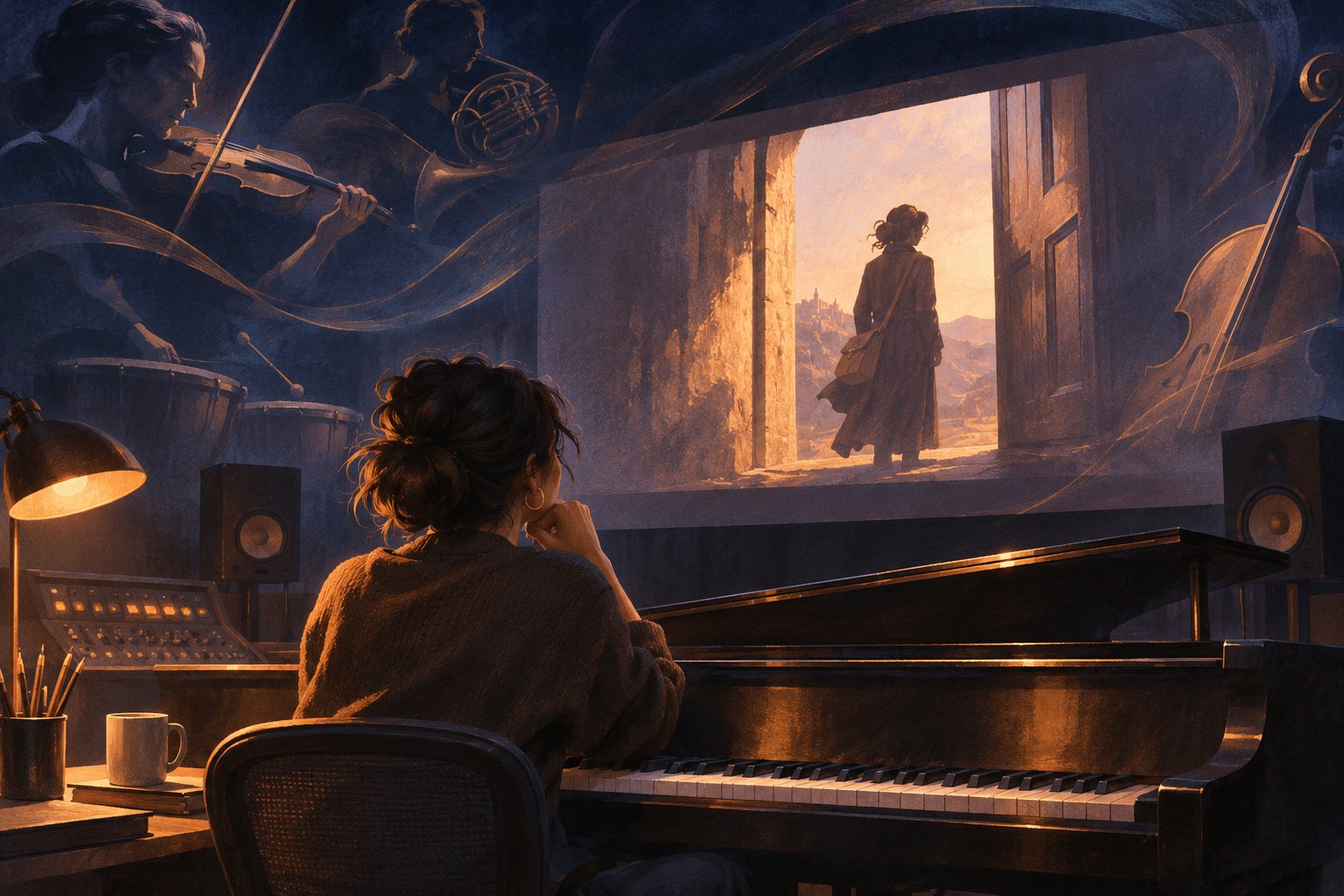
UCLA has received recognition for film composition, according to an announcement from the UCLA Herb Alpert School of Music. For movie lovers, the news draws attention to a discipline that can profoundly influence a performance without appearing on camera: writing the music that helps us understand a character.
The recognition concerns education, rather than a particular film or soundtrack. Its most interesting connection to film criticism is therefore a question of craft. What should a composer understand about the person on screen before deciding what the audience should hear?
Our view is that a strong score earns its place through dramatic insight. A beautiful melody can enrich a movie, but beauty alone cannot determine whether the music understands the scene. Sometimes the decisive achievement is a hesitation, an unresolved phrase, or the choice to let an actor finish a thought without accompaniment.
What UCLA’s Recognition Establishes
The UCLA Herb Alpert School of Music has announced recognition of UCLA as a leading school for film composition. That is the central reported development. It should not be stretched into promises about individual graduates, employment prospects, or the quality of every score associated with an institution.
For prospective students, the announcement offers a reason to investigate. For audiences, it offers an opportunity to think about what composition education should make possible. The discussion that follows is an editorial assessment of the craft, rather than a description of particular UCLA classes, assignments, or facilities.
A useful standard is whether a composer can connect musical decisions to dramatic consequences. Why does a cue begin here? Whose experience does it express? What changes if it stops? Those questions connect the study of composition directly to the close attention that good film reviews demand.
A Score Chooses Whose Experience We Share
A camera can show two people in the same room while the music places us emotionally beside only one of them. This is among scoring’s most consequential choices. The visible action may be shared; the inner experience is not.
Consider a hypothetical reunion. One person arrives expecting forgiveness, while the other has agreed only to listen. A warm melody could align us with the visitor’s hope. A brittle repeating figure could emphasize the listener’s unease. Leaving the encounter unscored could make us study pauses, posture, and the distance between the performers.
None of these approaches is automatically correct. Each proposes a different reading of the relationship. The composer’s task is to recognize that difference before turning an emotional assumption into music.
That is why character analysis belongs in any serious conversation about film composition. What someone wants, what they admit, and what they understand about themselves can be three separate things. A score can move between those layers, but it needs a reason for doing so.
Music Can Complicate What a Character Says
Memorable dialogue often leaves something unsaid. A declaration of confidence may conceal fear; an apology may contain an attempt to regain control. Music can bring that tension into focus, although it can also flatten it by announcing a single interpretation too forcefully.
Imagine a fictional character insisting that a painful separation no longer matters. A returning musical phrase might suggest that the past still has a hold on them. Yet an overtly mournful cue could make the performance feel less complex, turning a struggle between pride and grief into an uncomplicated display of sadness.
In our judgment, the more compelling approach often gives the audience room to notice the contradiction. A familiar phrase might return with its ending missing. A previously steady pulse might become uncertain. The music can register a disturbance without explaining every part of it.
This relationship between musical expression and a person’s inner life also informs our character-focused discussion of A. Rimbaud. For a composer, the broader lesson is to listen for the dramatic work already happening before deciding what another expressive layer should add.
Collaboration Turns Musical Ideas Into Dramatic Choices
The UCLA announcement also invites consideration of how composers learn to communicate. Musical imagination matters, but scoring involves decisions that must make sense to directors, editors, performers, and the people shaping the final soundtrack.
A director might describe a scene as lonely, while a composer hears anger underneath it. That disagreement can be productive if both connect their interpretations to something observable: an interrupted gesture, a withheld response, or a cut that changes whose reaction we see.
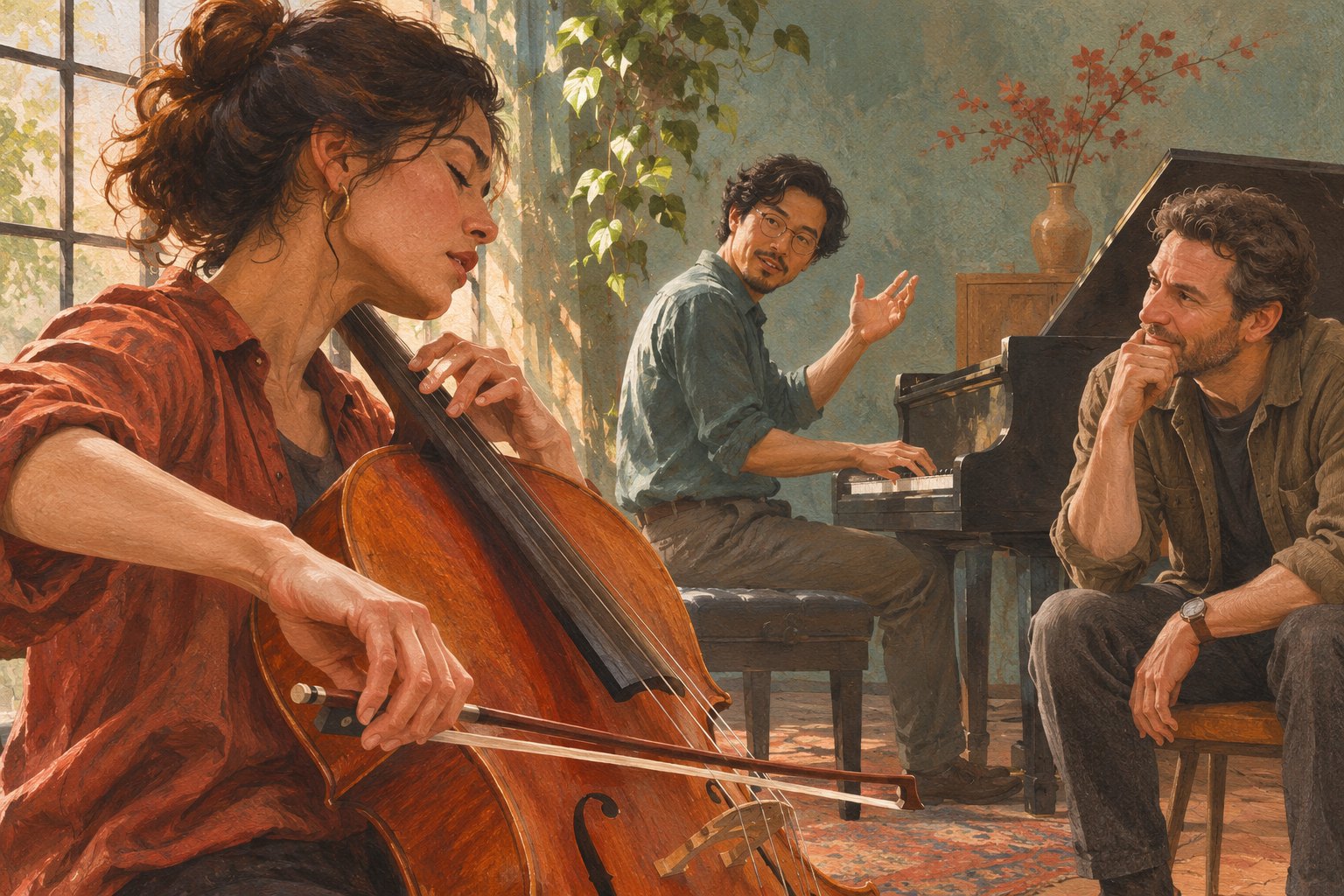
For someone evaluating a composition program, useful questions follow from this collaborative reality. Are there opportunities to write against moving images, receive specific feedback, and revise? Can students hear how performers transform a musical idea? Can they discuss why a cue works dramatically, beyond whether it sounds polished?
These are questions to investigate, not claims about UCLA’s curriculum. They help turn an encouraging announcement into a more thoughtful assessment of educational fit.
Silence Deserves as Much Attention as Melody
Music changes the space available to other sounds. A breath, a shoe scraping the floor, or a voice losing its steadiness can carry crucial character information. A cue that competes with those details may weaken the very emotion it intends to strengthen.
Silence also has structure. When music stops, viewers may suddenly become aware of a room’s physical dimensions or the uncomfortable length of a pause. When it returns, that entrance can suggest a shift in attention, an emotional breakthrough, or a retreat into memory.
Our preference is for restraint that responds to the scene. A sparse score is not inherently more sophisticated than an expansive one. The question is whether the scale of the music serves the experience being dramatized.
The practical relationship between sound, pacing, and human attention also runs through our guide to filming and editing an event reel that feels alive. Even in a short piece, continuous musical energy cannot substitute for meaningful changes in rhythm.
How to Listen More Closely on Your Next Viewing
You do not need musical training to examine a score’s dramatic choices. On a second viewing, choose one scene and concentrate on a few concrete questions:
- Notice the entrance. Does the music begin with an action, a reaction, or a realization?
- Identify the perspective. Does it express one character’s feelings, or give the audience information that character lacks?
- Follow a returning idea. Does repetition reinforce an earlier meaning, or change it?
- Listen beneath dialogue. Does the accompaniment deepen uncertainty or resolve it too quickly?
- Pay attention to the exit. What becomes more noticeable when the music disappears?
These questions make criticism more precise. Instead of describing a soundtrack only as moving or intense, a viewer can explain how it redirects attention and changes the meaning of a performance.
The Deeper Stakes of Learning to Score
UCLA’s recognition brings welcome attention to the education behind film music. Its lasting relevance for audiences lies in the kind of storytelling that thoughtful musical training can support: work attentive to motives, relationships, and the limits of what a character can express.
At its most persuasive, a score allows us to feel a person’s uncertainty without taking that uncertainty away. It can hold affection and resentment together, make a familiar place sound newly alien, or let a confident gesture reveal its fragility.
That is the standard we would bring to film composition from a critic’s seat. The music should reward close attention to the people on screen. A melody may stay with us after the credits; the deeper achievement is that it changes how well we understand the person we watched.
Original content by this site's editorial team. Published: November 16, 2026 at 19:45:27 PST (Los Angeles time)