
Tuner makes hearing a source of livelihood, danger, and frustrated desire. Deadline’s Contenders Los Angeles coverage places sound designer Johnnie Burn’s personal familiarity with the film’s sonic affliction at the center of that conversation. The connection invites a more revealing reading of Daniel Roher’s thriller: its protagonist’s remarkable hearing matters because living with it has a cost.
Leo Woodall plays Niki, a gifted piano tuner whose auditory abilities also prove useful for opening safes. That premise supplies an inviting crime-movie hook. From Niki’s perspective, however, it raises a harder question: what happens when other people value an ability more than they understand the person who possesses it?
Spoiler note: This analysis discusses the premise, Niki’s motivations, and relationship tensions. It leaves the ending unrevealed and draws on documented story details rather than a firsthand screening assessment.
Why Burn’s connection matters
The reported overlap between Burn’s experience and the film’s subject gives the sound discussion a personal dimension. It does not, by itself, prove that every effect accurately represents every listener’s experience. Its significance is more specific: the designer’s relationship to the material encourages attention to discomfort as something lived through, rather than merely an opportunity for an arresting soundtrack.
That distinction matters for Niki. An audience can admire exceptional hearing from a comfortable distance. A character must negotiate what that hearing allows, what it interrupts, and how other people respond to his limits. The creative challenge is to keep those consequences present even when the crime plot makes his talent entertaining.
As our guide to reading Contenders discussions beyond the famous names argues, a craft conversation becomes useful when it changes what viewers notice. Here, the productive question is how sound establishes Niki’s circumstances before we judge his decisions.
Niki’s talent does not give him control
The film’s official promotional material describes a piano tuner whose heightened hearing leads to an unexpected aptitude for safecracking. Deadline’s event program adds that his sensitivity ended his music career and that he works alongside veteran tuner Harry Horowitz, played by Dustin Hoffman. Those details establish a painful mismatch between skill and opportunity: Niki remains close to music while being separated from the career he once pursued.
My reading is that tuning offers him a complicated kind of continuity. He can still contribute to music, exercise judgment, and do work requiring concentration. Yet supporting another person’s performance may also keep an abandoned ambition within reach. The instrument is both a workplace and a reminder.
That makes his brief protest, “I’m just a piano tuner, man,” especially useful as a character statement. The line appears in the trailer coverage published by MusicRadar. It sounds like an attempt to establish a boundary: this is my work; this is the life I recognize. Once criminals discover another application for his skill, his description of himself loses its protective force.
The tension is compelling because competence and authority are separate things. Niki may understand an instrument or a mechanism exceptionally well without controlling the conditions under which someone expects him to use that knowledge.
Harry turns the crime plot into a question of obligation
Associated Press reporting describes Niki initially helping criminals during a robbery to protect himself. Harry’s subsequent hospitalization introduces medical bills and a reason to become further involved. The progression matters: a frightening encounter becomes an ongoing temptation through a relationship that already carries emotional weight.
From Niki’s position, helping Harry can make a dangerous decision feel necessary. A mentor represents more than employment. He can provide continuity, recognition, and a place in the world when an earlier plan has collapsed. Financial pressure threatens that structure as well as an individual’s health.
Still, a sympathetic motive cannot settle the morality of what follows. The interesting question is how Niki uses obligation to explain his choices to himself. Caring for someone can be sincere while also becoming permission to ignore consequences. A character study gains depth when it allows both possibilities to coexist.
That is the strongest interpretive route into the safecracking premise. The suspense concerns whether Niki can perform the task; the drama concerns the promises he makes himself before agreeing to it.
Listening becomes labor—and something others can exploit
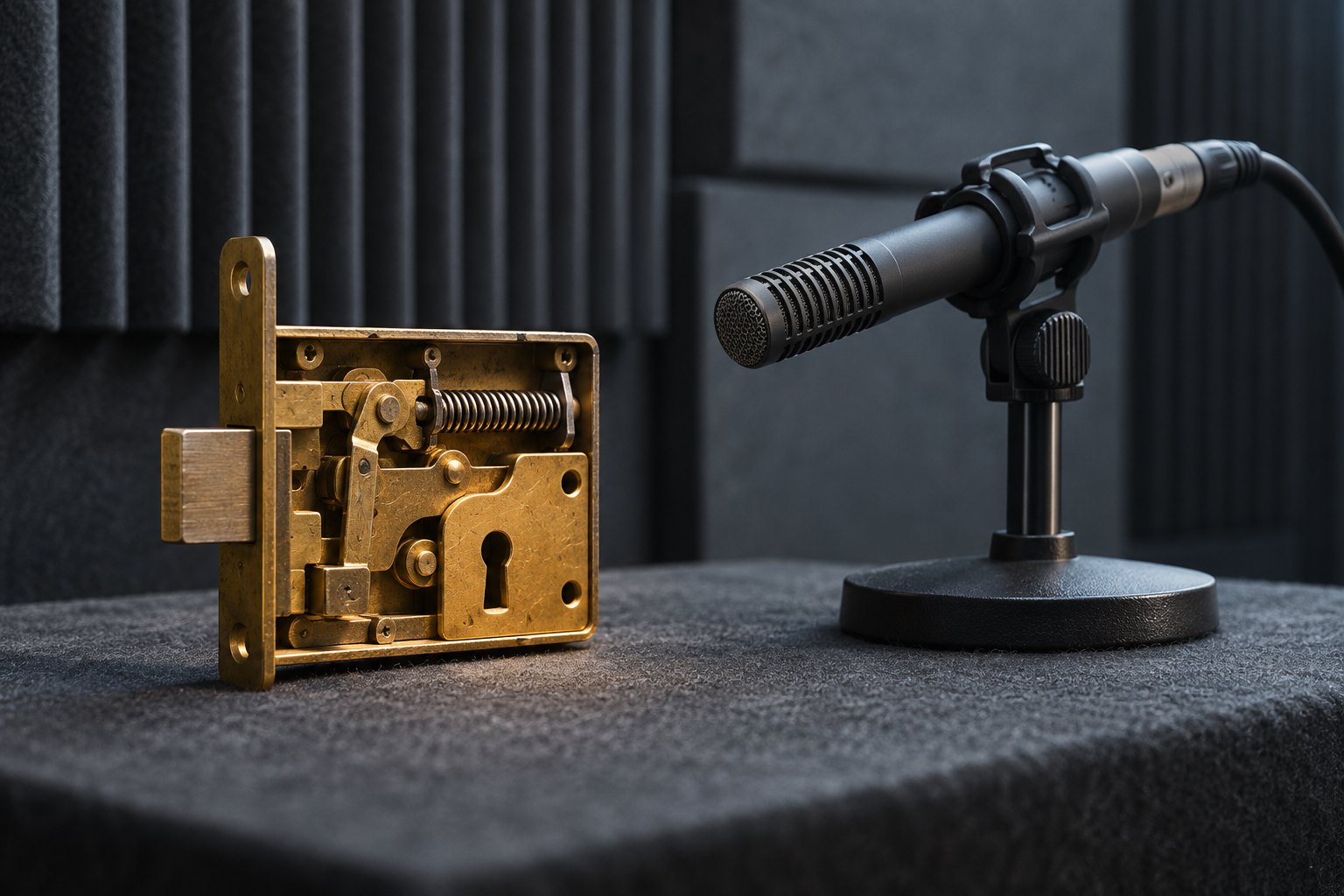
Piano tuning and opening a safe give attentive listening different moral purposes. One activity prepares an instrument for expression. The other breaches a barrier. The connection makes a small sound potentially consequential without requiring the protagonist to become a conventional action hero.
The accompanying image is a conceptual illustration of recording mechanical detail, not a production photograph. It points toward a useful distinction in discussing Burn’s work: an audible detail becomes dramatic through context. A click has little inherent meaning. A listener’s objective, vulnerability, and fear give it importance.
Sound and editing share that dependence on selection. Our discussion of how editing turns abundant material into emotional clarity explores a related principle: what an audience is allowed to notice shapes its understanding of a character.
For Tuner, the revealing distinction is between listening voluntarily and having to listen under pressure. The same ability can feel like professional independence in one situation and compulsory service in another. That change is where a clever premise acquires emotional stakes.
Ruthie exposes what hearing cannot solve
Havana Rose Liu plays Ruthie, a pianist and aspiring composer. Sight and Sound’s account describes a relationship complicated by Niki’s envy of the musical life she pursues. That conflict gives the film a useful counterweight to its criminal danger: exceptional perception does not guarantee generosity.
From Ruthie’s perspective, being heard should mean more than having technical weaknesses detected. A response to her work can acknowledge effort, ambition, and uncertainty. From Niki’s perspective, her opportunity can reopen his own loss. The resulting tension makes listening an interpersonal responsibility as well as a sensory act.
My interpretation is that this is where sympathy for Niki needs to remain demanding. His disappointment helps explain resentment without making Ruthie responsible for repairing it. She has a creative life of her own, and his suffering does not erase its importance.
The deeper meaning: a person exceeds his usefulness
Niki’s aversion to “the P-word”—perfect, as reported by Sight and Sound—offers a compact way into the film’s larger concerns. Read alongside his competing obligations, it suggests the limits of treating life as something that can be brought into flawless adjustment.
A mechanism may yield to patient attention. Another person remains independent, with needs that cannot be resolved through technical mastery. Niki’s ability to recognize fine distinctions in sound therefore creates an illuminating contradiction: he can perceive extraordinary detail while struggling to understand what others need from him.
Burn’s connection to the sonic affliction makes that contradiction worth taking seriously. The most persuasive interpretation of Tuner is that talent never cancels vulnerability, and usefulness never exhausts a person’s value. Its crime premise asks what Niki can hear. Its more enduring human question is whether the people around him can recognize the cost of listening.
Original content by this site's editorial team. Published: November 14, 2026 at 22:28:57 PST (Los Angeles time)