VHS still has a place in Northwest movie culture because a film format can remain meaningful long after it stops representing technological progress. OPB’s coverage describes renewed interest in physical media alongside a continuing attachment to videotapes among Northwest film fans. That distinction matters: a comeback implies an absence, while continued use tells a story about people who kept finding value in what they already had.
The most interesting question is what that attachment contributes to watching movies. A cassette can be a familiar possession, a recommendation passed between friends, or an invitation to revisit a performance. It can also deliver a compromised image. Taking VHS seriously means considering both its pleasures and its limitations.
This is film-culture commentary, with no plot spoilers.
A comeback story can overlook the people who stayed
The broad premise of OPB’s coverage supports a modest conclusion: VHS has retained an audience among Northwest film fans even as physical media attracts renewed attention. It does not, by itself, establish the size of that audience, a regional sales increase, or a single explanation for why people keep tapes. Those are separate questions.
As an editorial judgment, the persistence is more revealing than the comeback framing. It asks us to consider movie culture as something maintained through ordinary choices: keeping a working player, making room for a collection, and deciding that an older copy remains worth watching.
There is no need to assume that every collector shares the same motivation. Someone might value the packaging, another person the viewing ritual, and another the particular edition. Treating all three as nostalgia flattens meaningful differences. Remembering a childhood screening and discovering an unfamiliar movie for the first time are distinct experiences, even when both begin with a cassette.
Owning a movie gives repeat viewing a physical place
A tape on a shelf makes a film available to your attention before you decide to watch it. Its presence can prompt a memory of an unresolved ending, an actor’s unexpected restraint, or a scene you understood differently years ago. The collection becomes a visible record of encounters that might be renewed.
Ownership also creates a specific relationship to access. A playable cassette and compatible equipment allow a screening without an internet connection or a subscription. That independence is useful, although it depends on the condition of both the tape and the machine. Possession is not a guarantee of permanent playability.
For film criticism, the real benefit is the opportunity to return. First viewings often prioritize events: who escapes, who betrays whom, which explanation proves correct. Later viewings can reveal how the film prepared those events through hesitation, blocking, and changes in a relationship. A collection earns its space when it makes those return visits happen.
The image matters because the characters live inside it
Affection for VHS should leave room for honest evaluation of what appears on screen. Softness, unstable playback, or indistinct dark areas can affect the information a viewer receives. An atmospheric impression may be pleasurable while still obscuring a look or gesture that matters to the scene.
Framing deserves particular attention. Some widescreen movies received VHS editions that reframed the image for a narrower television screen; other releases preserved widescreen compositions. The format alone does not tell you which presentation a particular cassette contains.
That difference can change character analysis. Imagine a scene composed around one person speaking while another silently reacts at the edge of the frame. If the presentation excludes the listener, the exchange may seem more straightforward than the staging intended. Dialogue remains audible, but part of the relationship disappears.
This is why a useful movie review should distinguish a film’s choices from the limitations of the copy being watched. Before calling a scene visually confusing, consider whether the edition makes its spatial relationships clear. Before praising murky suspense, consider whether the obscurity belongs to the filmmaking or the playback.
The same attention to what changes between versions informs our discussion of adaptations that weaken character choices. An adaptation and a home-video transfer involve different processes, but both reward a precise question: what information reaches the viewer, and what has been lost?
Passing someone a tape can begin a better conversation
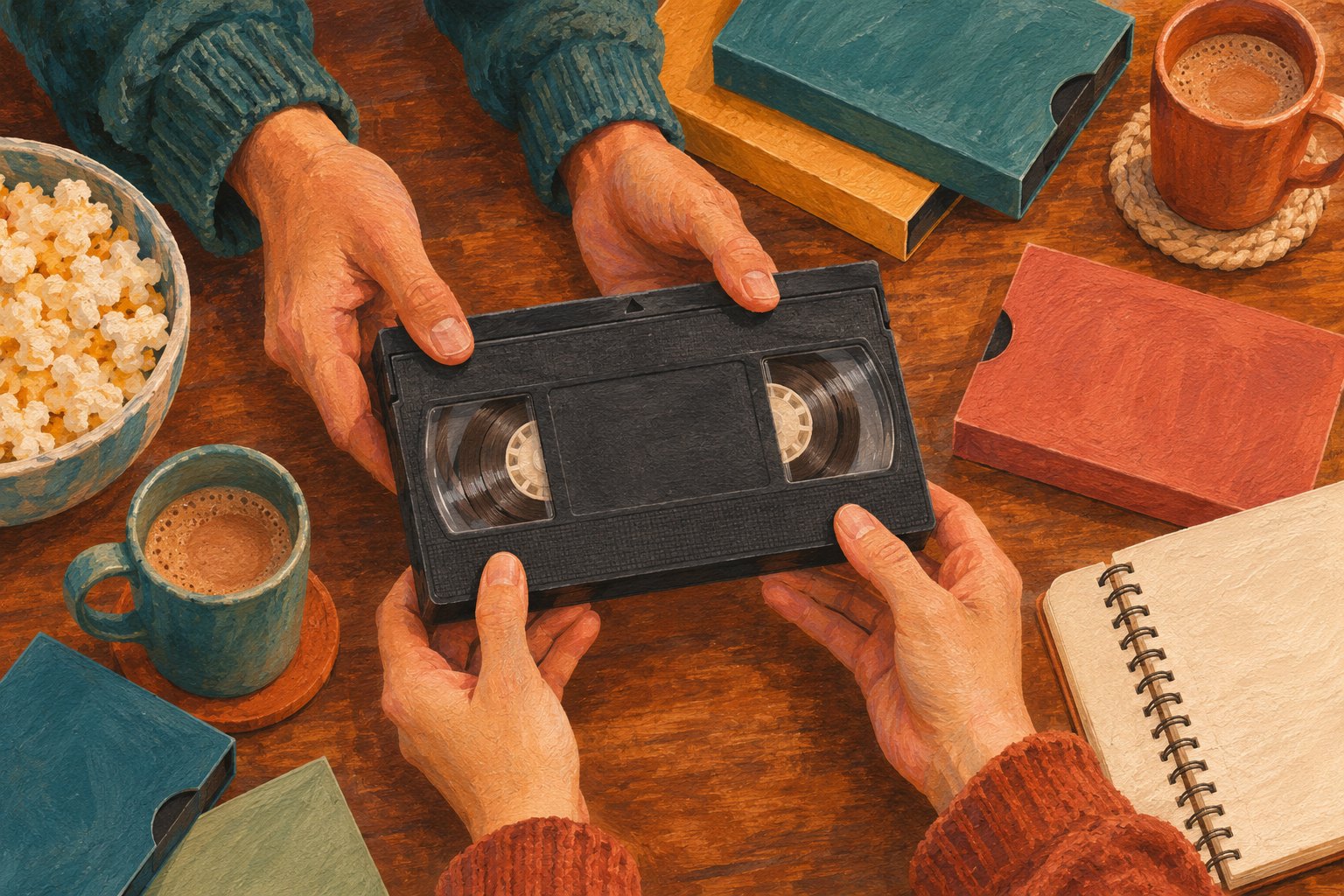
One appealing possibility of a tape collection is the recommendation that comes with it. Handing someone a movie creates an opportunity to explain your enthusiasm in human terms: the uneasy friendship, the supporting performance, the moment when a character’s confidence starts to fracture.
That conversation becomes more useful when it offers a way into the film without prescribing a verdict. Suggest watching how two people occupy a room together. Point toward the tension between a character’s stated intentions and actual behavior. Leave the recipient room to disagree.
These habits do not belong exclusively to physical media. They are valuable wherever people watch movies. A cassette simply gives the exchange a tangible center: something offered, borrowed, and eventually discussed.
Our approach to watching films through character agency offers a related principle. Begin with what people in the story want and what choices they can make. Packaging, genre, and reputation may invite the viewing; they should not determine the interpretation.
Make the next VHS screening worth revisiting
You do not need an extensive collection to turn affection for the format into closer film appreciation. A single familiar movie can provide a useful exercise:
- Identify the edition. Look for information about widescreen presentation, running time, and the version included. Avoid assuming every release contains an identical presentation.
- Choose one character to follow. Notice what that person knows at each stage, rather than judging every decision with the advantage of knowing the ending.
- Listen beyond the famous line. Attend to the pause before it, the response afterward, and whether the words express confidence, concealment, or uncertainty.
- Separate film observations from playback observations. A damaged passage is a limitation of that screening. It should not automatically become a criticism of the director or cinematographer.
- Discuss one specific scene afterward. Explain how a gesture, cut, or exchange shaped your interpretation. Specific examples make disagreement productive.
Memorable dialogue benefits especially from this approach. A line repeated outside a movie can acquire a meaning that differs from its dramatic function. Hearing it again in context restores the speaker’s circumstances and the other characters’ responses. Familiarity becomes an opening for interpretation.
The deeper value is continuity
My strongest argument for VHS is that it can keep a relationship with a movie active. That relationship may include imperfect pictures, cumbersome equipment, affectionate memories, and the pleasure of sharing something particular. None of those qualities automatically makes a film better. They can, however, create reasons to spend time with it.
The Northwest story is compelling because continued use complicates the idea that cultural value follows a replacement schedule. A newer format can improve a presentation without erasing the significance of an older object. Viewers can appreciate both.
A tape’s most persuasive defense ultimately arrives when someone watches the movie, notices something, and wants to talk about it. The shelf preserves a possibility. Pressing play turns that possibility back into film culture.
Original content by this site's editorial team. Published: November 14, 2026 at 21:21:30 PST (Los Angeles time)