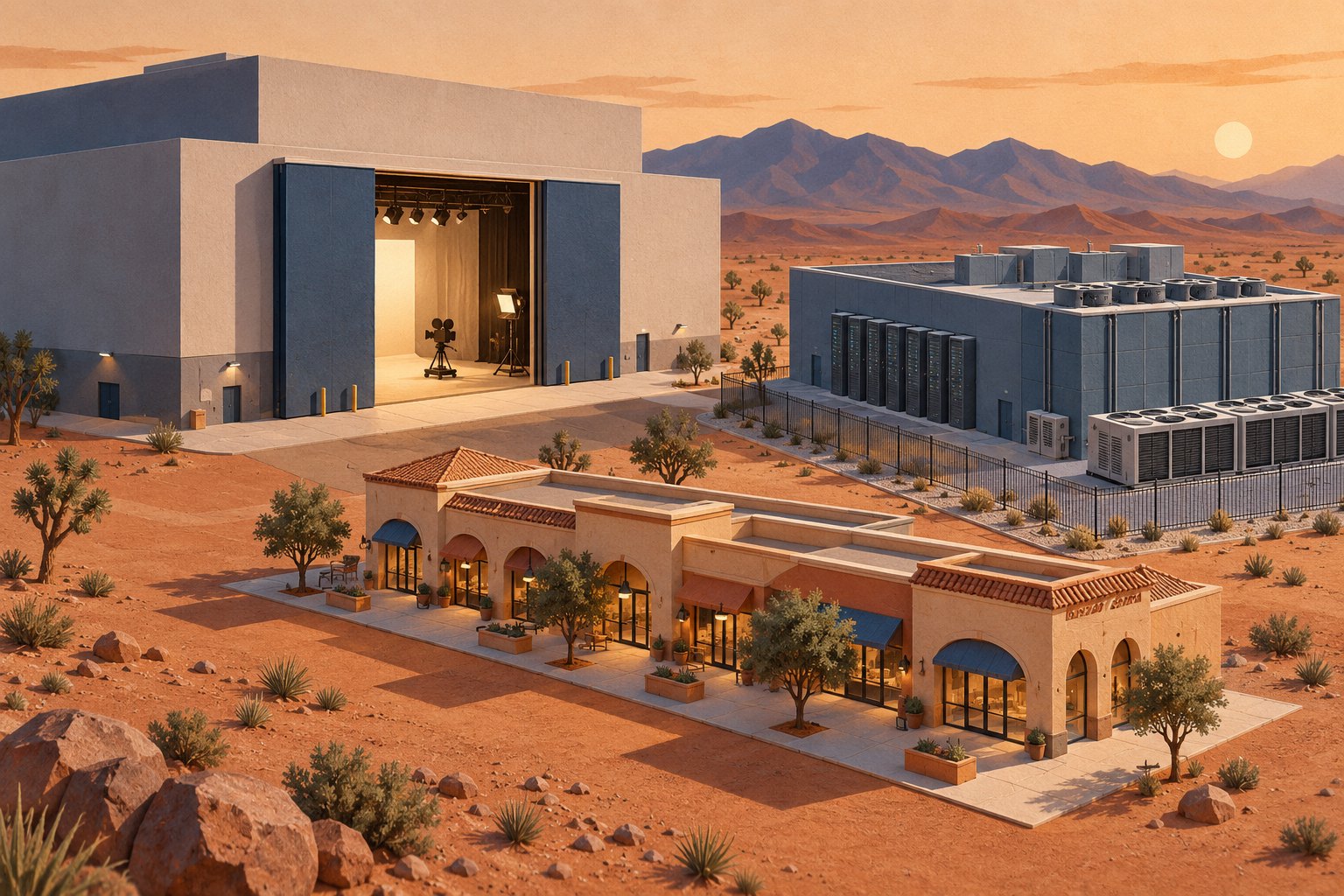
Tonopah’s proposed film studio and retail complex has another substantial component: a large-scale data center. KJZZ reports that all three belong to the development plans. For movie lovers, that combination raises a practical question beneath the excitement of a new production destination: how would the different parts help people make films?
A studio, a shopping destination, and a computing facility can occupy the same development while serving different customers. Their proximity may create opportunities, but it does not explain their working relationship. Our view is that the film component should ultimately be judged by the productions it enables, the people it supports, and the creative choices it makes possible.
What the Tonopah proposal establishes
The central reported development is straightforward: plans for a major film studio and retail complex in Tonopah include a large-scale data center. That makes the proposal relevant to entertainment coverage and to a broader discussion about how different commercial uses fit together.
That basic description does not, by itself, establish when filmmakers could book a stage, what services they could purchase, or which productions would work there. Nor does the presence of a data center alone tell us how much of its activity would serve filmmaking. Those distinctions matter because a development’s components and its eventual operating model are different things.
For readers following the project, the useful approach is to separate three questions: what is planned, what becomes available, and what filmmakers actually use. Each requires its own evidence. A compelling answer to the first cannot stand in for answers to the other two.
A neighboring data center needs a clear filmmaking purpose
The strongest possible case for combining film facilities with computing infrastructure would be practical. Could productions access services that make demanding work easier? Would those services be competitively priced? Could a smaller production use them without committing to a package designed for a much larger customer?
These are questions for the Tonopah proposal, not established benefits. Physical closeness would matter most if it translated into useful access, dependable support, or a simpler working process. A filmmaker needs to understand what can be done, who handles problems, and what the service costs.
Consider a hypothetical independent production deciding where to shoot. An impressive neighboring building would mean little if its services were unavailable to that production. Conversely, a clearly defined service with predictable pricing could be valuable even without a spectacular campus. The meaningful unit of comparison is the work a filmmaker can accomplish.
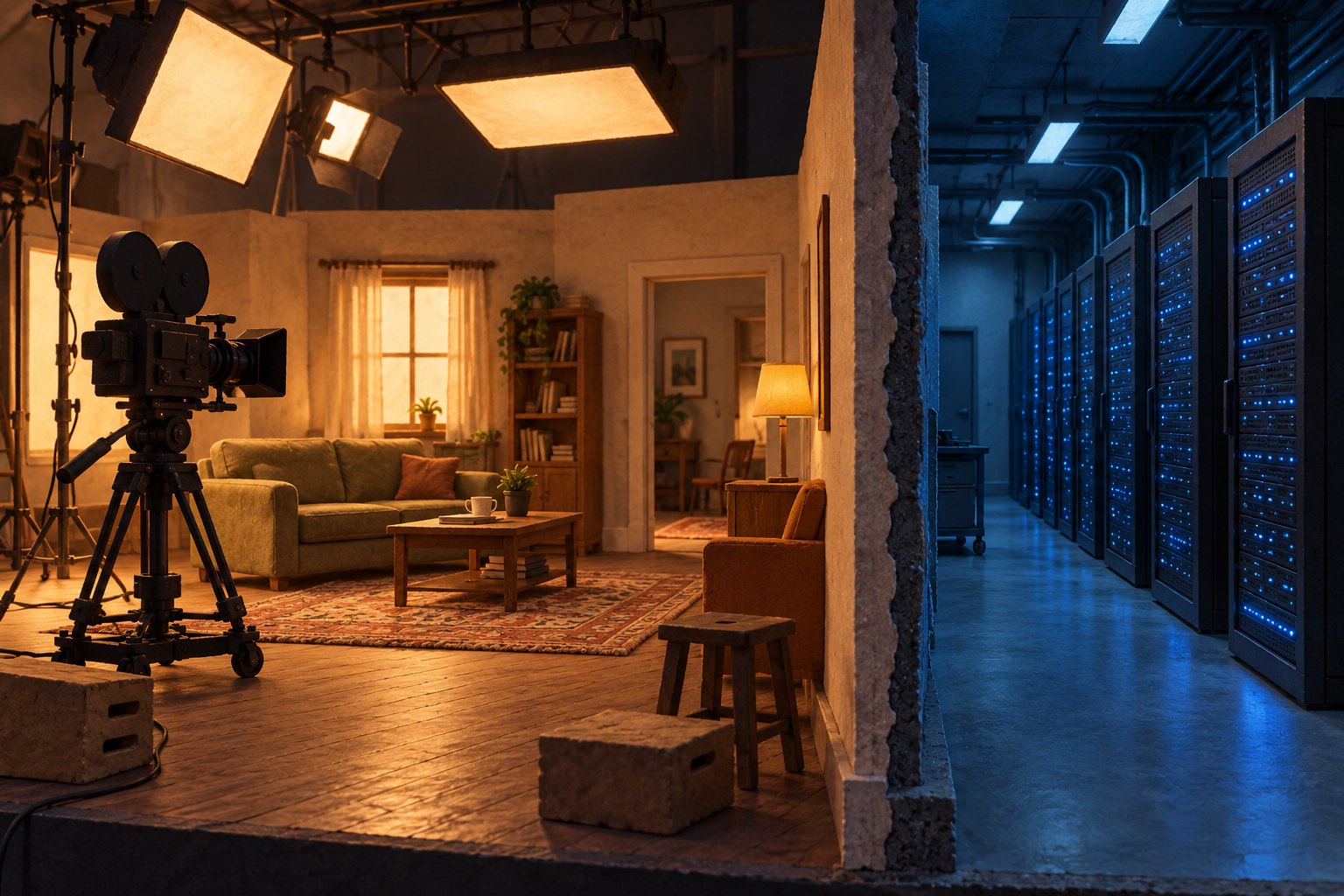
The illustration above represents that relationship conceptually; it does not depict the proposed Tonopah facility. Its dividing wall points to an important distinction: having creative and technical spaces beside one another is only the beginning. The connection between them has to function as a service.
Look at the proposal from the people doing the work
The filmmaker needs usable choices
From a director’s perspective, infrastructure becomes interesting when it expands the choices available within a schedule and budget. A facility might be attractive because it accommodates a difficult set, allows a particular working method, or gives a production room to solve problems. Scale alone cannot tell us whether any of those advantages will exist.
For Tonopah, a persuasive film offering would explain which kinds of productions the studio intends to accommodate. Features, episodic projects, and smaller shoots can have different requirements. An operating plan that identifies its intended users would say more about its cinematic potential than a broad promise of size.
The crew member needs continuity
From a crew member’s perspective, the central question is whether a new production location can become a dependable place to work. A building may be permanent while the projects inside it are temporary. Evaluating its value therefore requires attention to the continuity of production activity, alongside the availability of facilities.
This is one reason our commentary on the practical consequences of a filming pause is relevant here. Production conditions deserve scrutiny in their own right. In Tonopah’s case, readers should look for concrete information about how working productions would be attracted and supported.
The resident needs specific answers
For someone living near a proposed complex, the film identity is only one part of the picture. Access, operating patterns, construction activity, and infrastructure arrangements may be more immediate concerns. These should be investigated through project-specific information, without assuming either benefits or harms from the category of development alone.
Our examination of a host community’s perspective on film production offers a related principle: the people around a production are participants in its practical reality. Tonopah deserves its own assessment, grounded in its own proposal.
Retail adds another test of how the complex would work
The retail component introduces a separate audience: people who might visit the development without working on a movie. That could create opportunities for amenities or public activity, depending on what is eventually offered. It also makes the relationship between public access and production space worth explaining.
A functioning film environment and an appealing visitor destination need not have identical priorities. Productions may need controlled access, while retailers need customers to arrive easily. A convincing plan would show how those uses support one another in everyday operation.
Readers should also avoid assuming that retail next to a studio means tours, access to working sets, or encounters with performers. None of those experiences follows automatically from the reported combination. Any public-facing film attraction would need its own explicit description.
What would make the film ambition convincing?
As the proposal develops, four kinds of information would help readers evaluate its significance for filmmaking:
- A defined studio offering: the spaces and services productions would actually be able to book.
- A clear computing relationship: whether and how film customers would use the data center.
- An operating sequence: which components could function independently and which would depend on others.
- Evidence of production use: identifiable commitments that connect the facilities to filmmaking activity.
These are measures for assessing future information, not claims that particular arrangements already exist. They also allow for a fairer judgment than either embracing the entire proposal on its film branding or dismissing it because it includes a data center.
The cinematic value will come from what gets made
Our editorial judgment is that Tonopah’s combination is worth watching because it brings creative space, commercial activity, and computing infrastructure into one development story. Whether that combination serves cinema well will depend on the connections between those parts.
For audiences, the eventual payoff would be films worth watching. The deeper question is whether the facilities would give filmmakers useful access to space, time, technical support, and skilled collaborators. A substantial studio can provide a setting for that work. Its cultural value emerges when people can use it to put something distinctive on screen.
Original content by this site's editorial team. Published: October 4, 2026 at 18:02:48 PDT (Los Angeles time)