The Stranger, François Ozon’s 2025 adaptation of Albert Camus’s novel, follows a man whose emotional reserve becomes almost as disturbing to society as the murder he commits. Selected for Carroll College’s French film program, this is a story that invites discussion without supplying a reassuring verdict. Its central question is uncomfortable: how do we recognize someone’s humanity without excusing the harm he causes?
Benjamin Voisin plays Meursault, a clerk living in French-colonized Algeria. Rebecca Marder plays Marie, the woman with whom he begins a relationship, while Pierre Lottin plays Raymond, the neighbor whose violence draws him into a dangerous conflict. My reading of the film centers on the friction between these relationships: Meursault may resist conventional explanations, but other people still have to live with his choices.
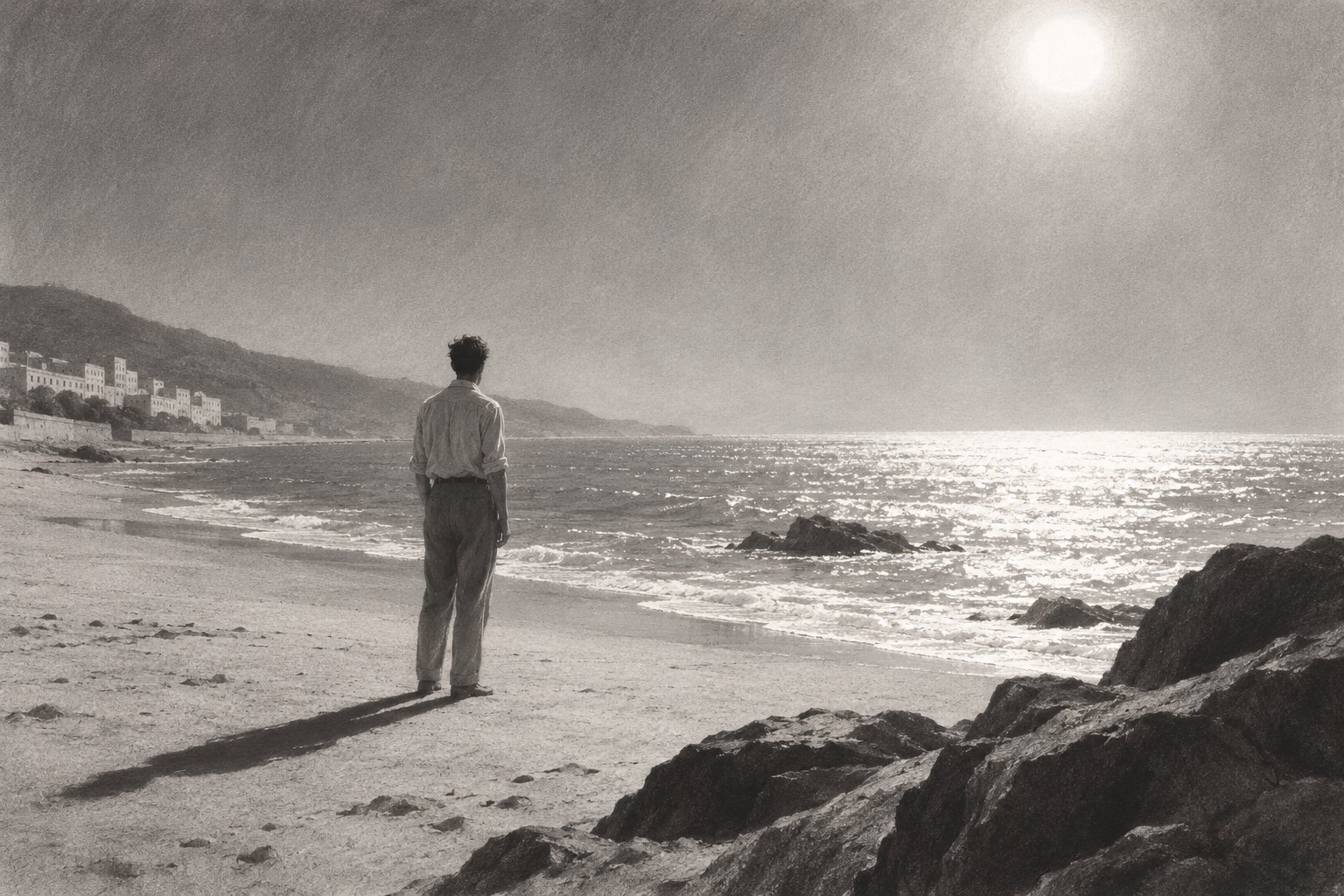
Spoiler warning: The discussion below addresses the murder, trial, and ending. The accompanying images are conceptual illustrations.
Meursault’s first confession changes the story’s emphasis
“I killed an Arab.” Ozon makes this blunt admission Meursault’s first line, bringing the killing into view before the narrative returns to the circumstances surrounding it. The wording matters. A person has died, yet the statement identifies that person through a category rather than a name.
Beginning here changes the audience’s relationship with everything that follows. Meursault’s ordinary routines cannot become an entirely innocent refuge. The viewer already knows where this life will lead, even when its occupant seems unable or unwilling to turn experience into a coherent explanation.
There is a productive danger in such an opening. A confession can sound like honesty, and honesty can become attractive. But accurately stating what happened is only the beginning of moral recognition. Meursault’s refusal to embellish his actions does not necessarily mean he understands their consequences.
The funeral: grief without the expected performance
After his mother dies, Meursault attracts scrutiny because he does not display grief as others expect. The funeral establishes the gap between what people can observe and what they believe those observations prove. An outwardly restrained response becomes evidence of an inward deficiency.
This is where sympathy for Meursault is most defensible. There is no reliable public choreography for bereavement. Tears, solemnity, and the correct words may express genuine feeling, but their absence cannot establish that love never existed. The people judging him make an unjustified leap from behavior to certainty.
The trap for the audience is to make the opposite leap. Being misunderstood at a funeral does not establish innocence in every subsequent encounter. Ozon’s story becomes more demanding when we allow both propositions to remain true: Meursault can be judged unfairly, and he can still be responsible for an appalling act.
Marie wants a relationship that detachment cannot sustain
Meursault reconnects with Marie shortly after the funeral, and their relationship brings physical pleasure into a narrative shadowed by death. The swimming, attraction, and return to ordinary life resist the idea that mourning must suspend every appetite.
From Marie’s perspective, however, the problem is larger than whether her lover observes social conventions. Intimacy involves another person’s expectations. Desire may establish an immediate connection, but it does not settle what either partner can reasonably hope for afterward.
Marder’s character therefore gives the story an essential emotional counterweight. Looking at Meursault through Marie’s situation means asking what his reserve costs someone who wants closeness. His lack of conventional sentiment may be fascinating to an observer; living beside it is a different proposition.
This offers an illuminating comparison with our analysis of intimacy and emotional defenses in Good Will Hunting. Both stories reward attention to the people trying to reach an inaccessible man. Here, though, accessibility cannot simply become the promise that everything will be repaired.
Raymond exposes the consequences of going along
Raymond’s conflict involving a former lover pulls Meursault into a chain of escalating hostility. Their association is crucial because it tests the idea that someone who declines to judge others has somehow escaped moral involvement.
From Raymond’s side, an accommodating neighbor is useful. From Meursault’s side, participation can appear to be another event that happens without requiring much reflection. Yet passivity changes meaning when it enables a violent person to proceed.
The strongest interpretation of this relationship is that indifference has practical effects. Someone need not share every motive of an aggressor to help create the conditions in which aggression continues. Meursault’s detachment is therefore more than a private temperament. It operates within relationships shaped by unequal power.
The beach: sensation cannot explain away responsibility
The murder on the beach brings the film’s physical world and moral crisis together. Ozon and cinematographer Manu Dacosse use black-and-white imagery, and Ozon has described the importance of glare, heat, flesh, and the sea to his interpretation.
That emphasis provides a useful way to understand Meursault: sensation can occupy him more immediately than emotional explanation. The world presses against his body even when its social meanings seem remote.
But a viewer should resist treating atmosphere as an acquittal. Sunlight can help explain how a moment is experienced without becoming a sufficient explanation for killing another person. The distinction is fundamental. If the beach becomes only a beautiful image of existential distress, the victim risks disappearing into the murderer’s experience.
The trial puts emotional conformity on display
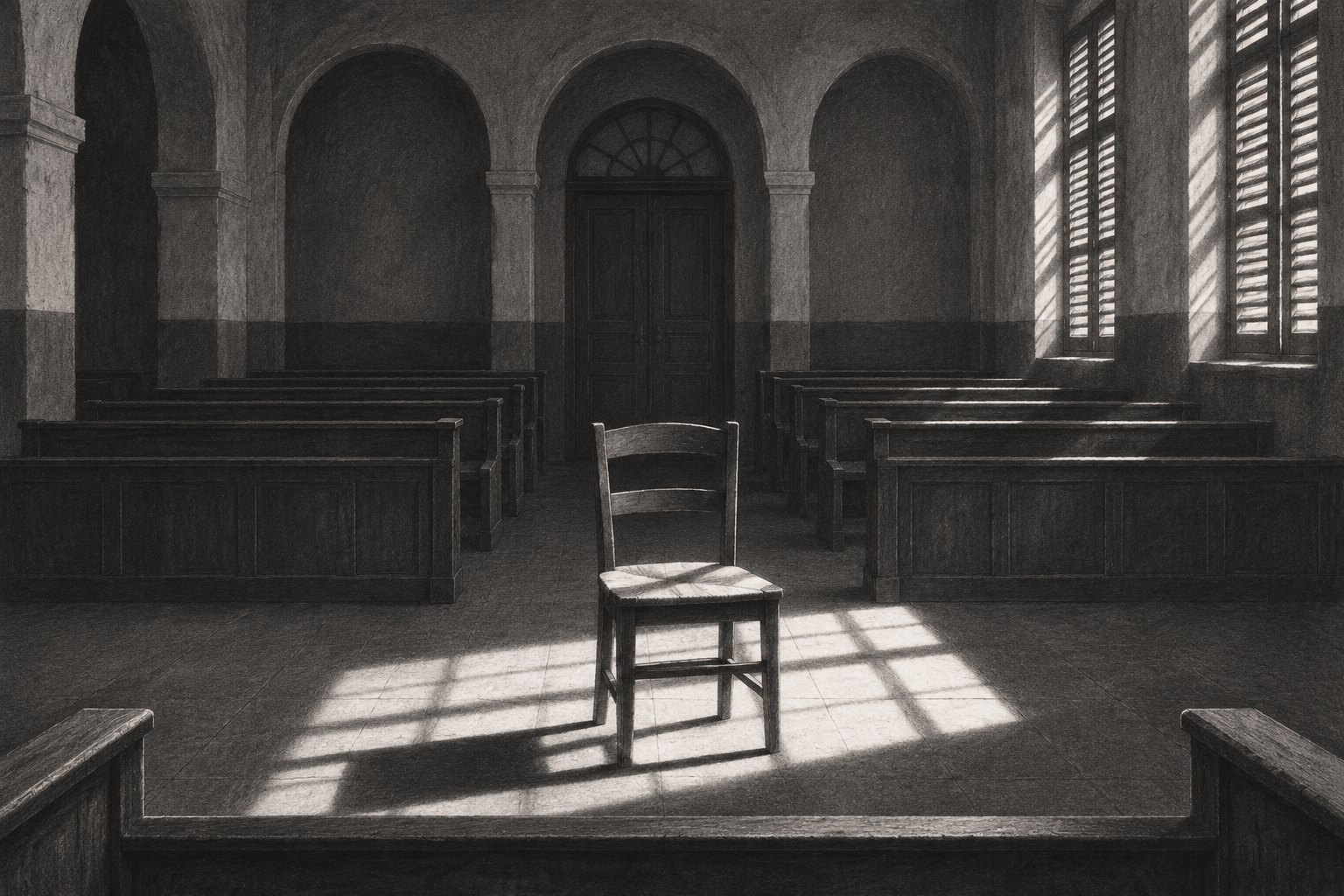
During the trial, Meursault’s response to his mother’s death becomes central to the judgment of his character. The courtroom demands an intelligible person: someone whose feelings, motives, and remorse fit a recognizable pattern.
The resulting distortion is disturbing because a murder trial should concern the killing and the person who died. Instead, emotional nonconformity acquires an enormous explanatory power. Meursault’s failure to provide the expected performance seems to make him especially intolerable.
Yet exposing the court’s distorted priorities should sharpen attention to the victim. It should not turn the accused into the only person worth understanding. Colonial inequality makes that distinction particularly urgent: whose interior life receives sustained examination, and whose death becomes material for someone else’s philosophical drama?
That question also informs our discussion of unequal freedom and responsibility in Drummer Boy. Different historical settings can reveal a similar problem when a central character’s moral journey overshadows people with less power.
The ending asks who gets to remain visible
Meursault’s confrontation with the prison chaplain breaks through his habitual restraint. His resistance becomes forceful as he faces death and rejects the consolations being offered. The ending’s invocation of “shouts of hatred” is especially unsettling: recognition arrives in the imagined form of hostility rather than love.
I read this as a final refusal to make himself acceptable, rather than a universal instruction about how to live. His clarity about his own mortality cannot restore the life he has taken. Self-understanding and restitution remain painfully separate.
Ozon also expands the presence of the victim’s sister and ends by giving the murdered man a name. That shift is central to the adaptation’s meaning. It challenges the audience to carry another person beyond the limits of Meursault’s attention.
The film’s most valuable tension lies here. We can reject a society that mistakes conventional feeling for virtue while demanding more than honesty from an individual who harms others. Meursault’s estrangement deserves examination. The dead man deserves remembrance. A serious reading of The Stranger must make room for both.
Original content by this site's editorial team. Published: November 5, 2026 at 17:54:44 PST (Los Angeles time)