Jalen Hurts should be judged on the opportunities he uses, the mistakes he makes, and the options available to him. Calling him the player holding Philadelphia’s offense back makes a much larger claim: that his limitations explain the offense’s problems better than the circumstances around him. The Eagles–Commanders debate deserves that distinction before it deserves another sweeping verdict.
Bleeding Green Nation’s Eagles–Commanders film-review headline argues that the case against Hurts as the offense’s limiting factor should now be closed. That is an editorial conclusion, not a self-proving fact. My view is narrower: blaming one quarterback for an interconnected offense requires evidence that identifies what he could reasonably have done differently.
This is opinion about the Hurts debate and the standards for evaluating it. Here, film review means football footage, rather than a movie; this article does not offer a possession-by-possession account of the matchup.
What Does “Holding the Offense Back” Actually Mean?
There is a meaningful difference between saying a quarterback played poorly and saying he prevented an offense from succeeding. The first judgment can describe individual decisions. The second compares the offense we see with an imagined version that performs better without him.
That imagined version needs scrutiny. Does it assume better protection, cleaner routes, different calls, or a defense that responds identically to a different player? If those conditions change, the comparison no longer isolates the quarterback. It bundles several possible improvements into one convenient explanation.
For Hurts, a persuasive criticism would identify a usable opportunity and explain how his action squandered it. A persuasive defense would show how an apparent opportunity disappeared before he could reasonably exploit it. Neither argument becomes stronger merely because its author sounds certain.
The question is therefore not whether Hurts can be criticized. Of course he can. It is whether a particular criticism explains the problem it claims to explain.
The Quarterback’s Perspective Changes the Judgment
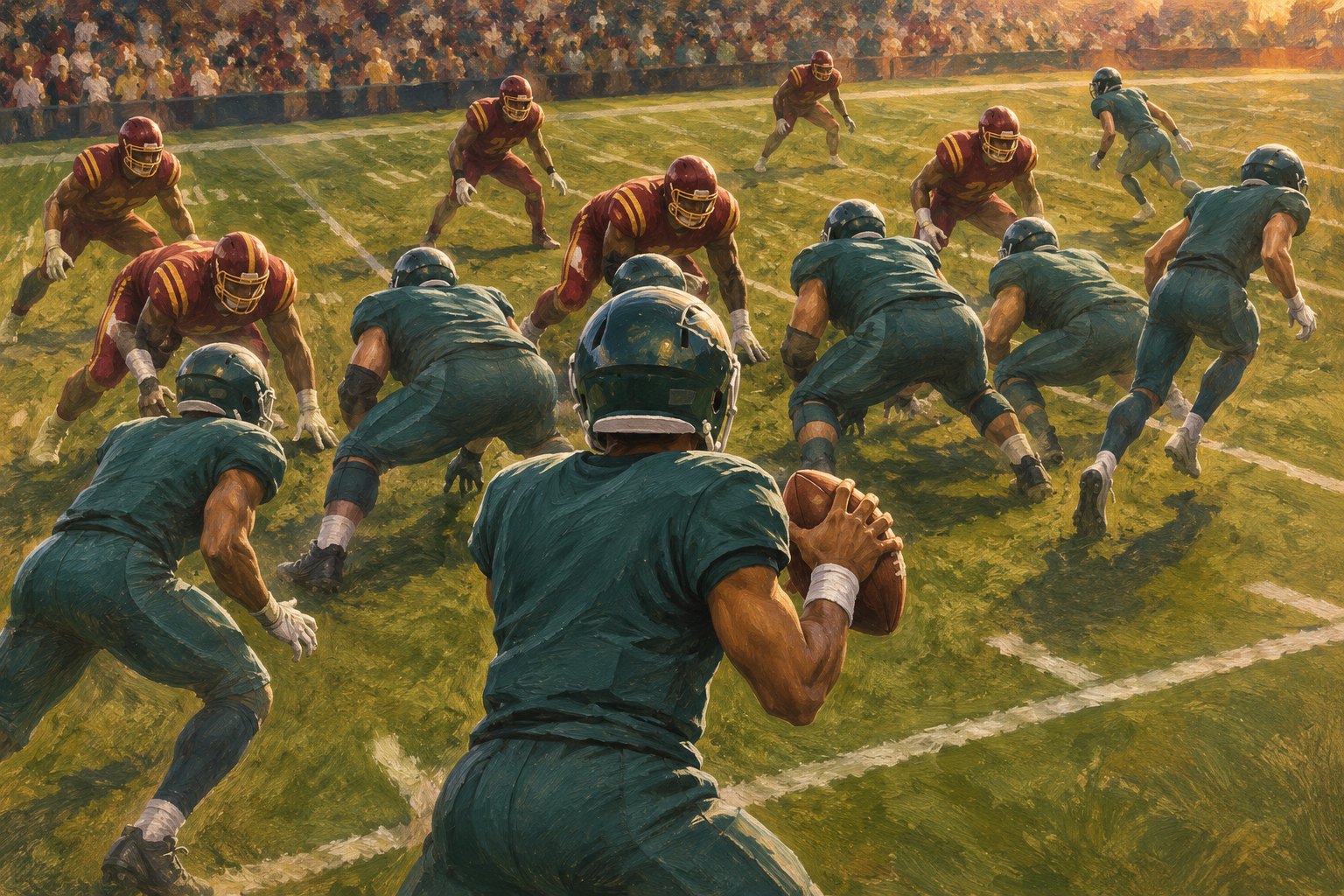
Watching from above gives the audience an advantage that can easily become a trap. We can see a receiver moving into space while also watching pressure develop elsewhere. The quarterback has to gather information in sequence, keep his body ready to throw, and act before the picture changes.
Consider a hypothetical receiver who appears open after the passer has already started moving away from pressure. That image alone does not prove a missed read. The useful questions are when the receiver became available, whether the throwing lane existed, and whether the passer had time to reset. These are evaluation principles, not claims about a particular Eagles–Commanders snap.
The reverse matters, too. Pressure cannot excuse every mistake. A passer may create difficulty by hesitating when an answer is available or moving into a defender’s path. A fair assessment must leave room for that possibility rather than treating context as automatic absolution.
Our discussion of evaluating the decision before the result offers a useful companion principle. In the Hurts debate, the next step is assigning responsibility: establish the available choice before deciding who failed.
An Offense Has More Than One Point of Failure
The quarterback is the most visible decision-maker, but visibility is not the same as complete control. Protection, route spacing, timing, and the play’s intended answer to defensive pressure all affect what a passer can accomplish.
Imagine a passing concept that needs time to develop paired with protection that cannot provide it. Faster decision-making might reduce the damage, but it cannot necessarily produce the intended downfield opportunity. Conversely, sound protection and a well-timed route can create an opening that the quarterback still fails to use.
Those situations may end with the same disappointing result. Their remedies are different. One calls for reconsidering the relationship between design and protection; the other may call for better anticipation or execution from the passer. Labeling both a quarterback problem makes diagnosis less useful.

Personnel fit belongs in this conversation as well. A coach’s responsibility includes choosing tasks that players can execute together. A player’s responsibility includes carrying out those tasks. Recognizing the first does not erase the second; it explains why accountability may belong in more than one place.
Washington Must Remain Part of the Explanation
A Philadelphia-centered argument can accidentally make the Commanders disappear. In that telling, every offensive outcome becomes evidence for or against Hurts, while the opponent serves as background scenery.
That is a poor starting point for evaluating competitive play. Defenders can disguise intentions, close throwing windows, disrupt timing, or win an individual matchup. An unsuccessful offensive play can reflect a defensive success rather than a simple failure of imagination or effort.
This does not establish which defensive actions decided this matchup. It establishes what a responsible explanation needs to consider. Before assigning blame, ask whether Washington forced the offense away from its preferred answer—and whether the offense had a reasonable alternative.
What Would Strengthen Either Side of the Hurts Argument?
A useful standard should be capable of changing the evaluator’s mind. If every negative outcome proves Hurts is the problem and every positive outcome belongs to his teammates, the judgment is predetermined. The same flaw appears when every success belongs to Hurts and every failure belongs elsewhere.
- Evidence against the quarterback: repeated, identifiable opportunities that he can access within the play’s timing but fails to use.
- Evidence against the surrounding structure: recurring situations in which the intended action and the available time do not match, leaving no clearly workable response.
- Evidence for shared responsibility: a difficult situation in which another player’s mistake narrows the options and the quarterback then chooses poorly among those remaining.
- Evidence that warrants uncertainty: footage that shows a breakdown without establishing the assignment or communication that produced it.
These categories are not findings from this game. They are standards for deciding whether a finding is persuasive. Their value is that they allow a mixed verdict, which is often more informative than choosing a single culprit.
The Deeper Issue Is Our Appetite for a Main Character
The Hurts controversy has a familiar narrative attraction: put one recognizable person at the center, then make the surrounding action explain his worth. It creates an easy story to follow. It can also obscure the relationships that actually determine the outcome.
Character-centered criticism works best when it examines those relationships. Our analysis of choice and responsibility in Good Will Hunting approaches a different subject through that lens. The connection is interpretive: understanding a central figure requires attention to the people and pressures around him.
My verdict on the Eagles–Commanders debate is that the sweeping accusation against Hurts asks too much of too little precision. That does not establish his innocence on every play, nor does it settle every question about Philadelphia’s offense. It means the argument must move beyond identifying the most visible person in the frame.
The strongest defense of Hurts is a specific explanation of what the offense allowed him to do. The strongest criticism is a specific explanation of what he could have done better. Anything less may sustain an argument, but it will not explain an offense.
Original content by this site's editorial team. Published: November 5, 2026 at 18:26:33 PST (Los Angeles time)