The Remarried Empress presents an intriguing test for the conversation about Webtoon’s television and movie adaptations in Hollywood: can a screen version preserve a character’s perspective when the machinery of adaptation demands spectacle, speed, and an easily marketed premise? Variety’s coverage connects the title with that broader adaptation discussion. The useful critical question is what filmmakers should carry across—and what needs to change when a reader becomes a viewer.
This is spoiler-free adaptation commentary, not a review of a completed film. The discussion below evaluates creative choices rather than claiming particular scenes, performances, or dialogue appear in a screen version. A title’s inclusion in an industry conversation should not, by itself, be treated as confirmation of a Hollywood movie, a release date, or a specific production arrangement.
Start with the person inside the title
Even before considering plot, The Remarried Empress contains a productive tension. “Remarried” describes a personal relationship through an event that changes its status. “Empress” describes a public identity defined by authority. Read together, the words invite questions about who gets to define a woman’s life: the person living it, the people closest to her, or the institution surrounding her.
That is an interpretation of the title, not a substitute for the story. But it suggests a strong standard for adaptation. Whenever private feeling and public position intersect, the audience needs to understand both. A lavish room may establish power immediately; understanding what it costs someone to remain composed inside that room takes more careful filmmaking.
My preference would be for an adaptation that gives decisions as much attention as their consequences. Watching someone announce a choice can be satisfying. Understanding the alternatives she weighed, the information she lacked, and the risk she accepted gives that announcement emotional weight. Character agency becomes convincing when the audience can follow its development.
A character’s viewpoint is more than screen time
Keeping a protagonist at the center requires more than giving her the most scenes. A film can follow someone constantly while allowing other characters to determine what every moment means. The difference lies in how the camera, editing, and sound organize our attention.
Consider a hypothetical formal gathering. Showing the room first, then an important arrival, then the protagonist’s reaction makes her a witness to an event. Beginning with her attention fixed on a doorway, holding through an uncomfortable wait, and only then revealing the arrival gives the same event a different emotional structure. We experience anticipation before receiving information.
Neither arrangement is automatically better. The point is that adaptation involves choosing whose uncertainty matters. For a title such as The Remarried Empress, that choice deserves particular scrutiny: does the screen invite viewers to understand its central figure, or primarily to admire the image she presents?
This is also why authorship cannot be reduced to casting or direction alone. Our commentary on how collaborators share credit for memorable screen moments offers a useful companion question. A character’s apparent authority may depend on an actor’s stillness, a costume’s restriction, the position of the camera, and the exact moment an editor cuts away.
Translate the reading experience, not just the pictures
A reader can pause over an expression, return to an earlier panel, or move quickly past an exchange. Screen storytelling makes those timing decisions for the audience. That difference means reproducing an illustrated composition cannot, by itself, reproduce its effect.
A revealing glance might need a longer shot than expected. A dramatic visual reveal might work better with restrained sound than an emphatic musical cue. An internal observation might become a small hesitation before a reply. These are possible adaptation techniques, not descriptions of scenes from The Remarried Empress.
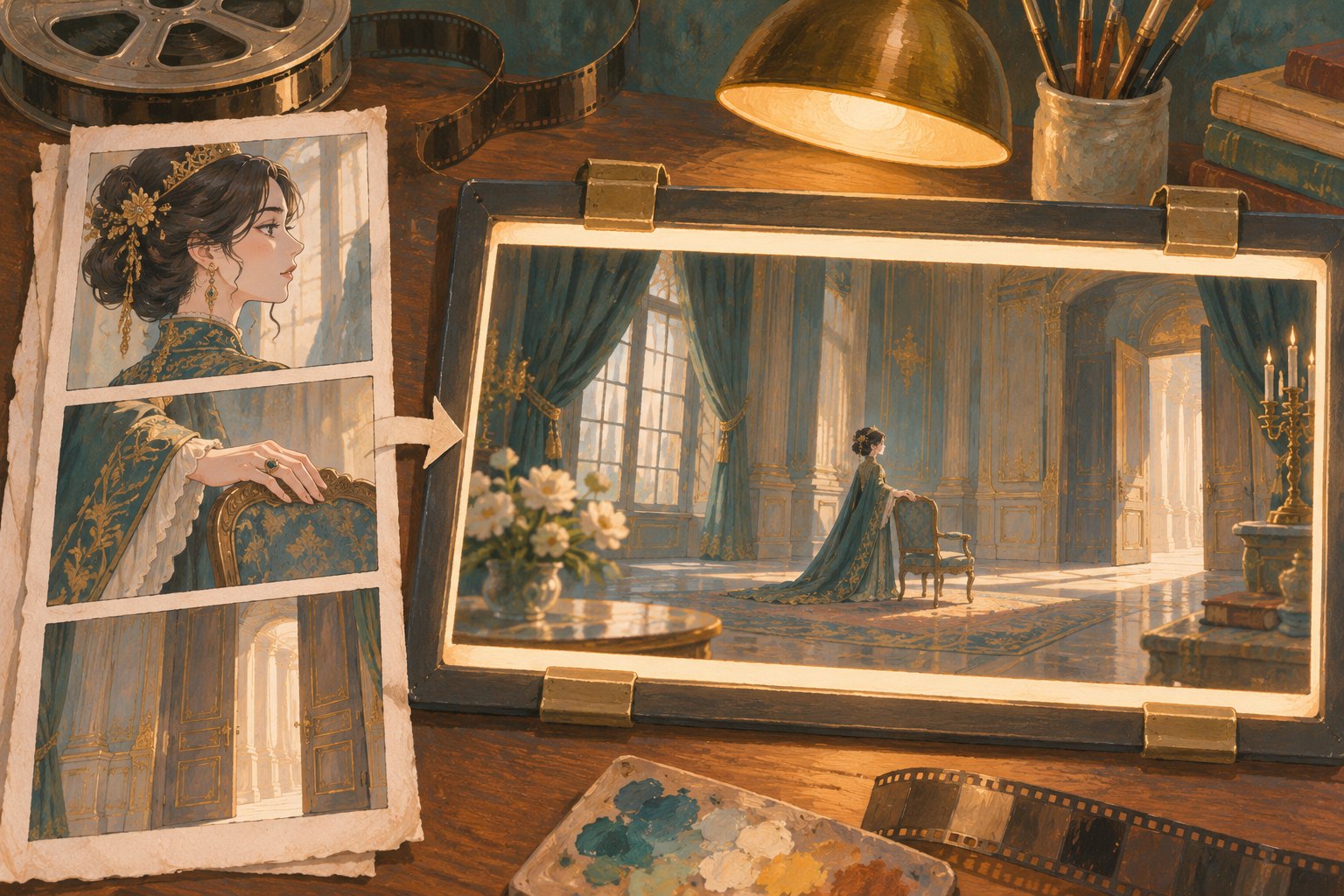
The strongest approach, in my view, asks what a passage makes the reader feel before deciding how closely to reproduce its appearance. Does a pause create dread, embarrassment, desire, or calculation? Each answer suggests a different rhythm. Preserving that emotional function can justify substantial visual changes.
Conversely, apparent faithfulness can become decorative. A recognizable pose surrounded by beautiful production design may satisfy a moment of recognition while leaving a newcomer unsure why it matters. The image earns its place when it changes our understanding of a relationship or decision.
Movies and television need different emotional structures
The film-versus-television question should begin with dramatic shape. What change can feel complete within one sustained viewing experience? Which relationships require repeated encounters before their meaning becomes clear? Those questions are more useful than assuming a longer running time guarantees greater fidelity.
A feature adaptation would need to identify a governing conflict and build toward a meaningful resolution. Compression becomes damaging when it preserves major events but removes the connective tissue that makes them believable. The audience sees a decision, yet has not experienced the pressures that produced it.
A series faces a different danger: postponement. More episodes can provide room for changing loyalties and conflicting interpretations, but they can also repeat the same emotional situation. A confrontation should leave some residue—new knowledge, diminished trust, a practical restriction, or a changed expectation.
That standard connects with our examination of why expanding a screen story should allow its characters to grow. Whatever format an adaptation takes, additional time matters when previous experiences alter subsequent behavior.
Memorable dialogue needs a situation worth remembering
Quotable lines are tempting anchors for adaptation. Yet a declaration is rarely memorable because of wording alone. Its force depends on who can speak freely, who must remain polite, who is listening, and what saying the words makes impossible afterward.
No dialogue is quoted here because a character-focused assessment should not manufacture lines or present unverified wording as canonical. The more useful principle is to preserve the dramatic circumstances that give a line its meaning. A sentence delivered after visible hesitation can express a hard-won decision; the same sentence delivered immediately may sound effortless or merely clever.
Silence deserves equal consideration. Leaving a response unspoken can reveal restraint, fear, or refusal, provided the surrounding scene gives viewers enough evidence to distinguish them. An adaptation should trust performance without making motivation unreadable.
The deeper test: who controls the meaning of a life?
The most compelling interpretive possibility in The Remarried Empress lies in the relationship between personal change and public identity. Its title encourages us to consider how an individual can be described by an institution and a relationship before being understood as a person. An adaptation can explore that tension through the distribution of attention: whose feelings receive time, whose explanations are accepted, and whose choices require justification.
For Hollywood’s discussion of Webtoon adaptations, that offers a sharper creative ambition than simply making illustrated stories look expensive. Preserve the audience’s access to a character’s reasoning. Let spectacle express the pressures around her. Make each major choice change what she can do next. Those are the qualities that would make an adaptation worth discussing after the initial pleasure of recognition has passed.
Original content by this site's editorial team. Published: November 8, 2026 at 01:27:21 PST (Los Angeles time)