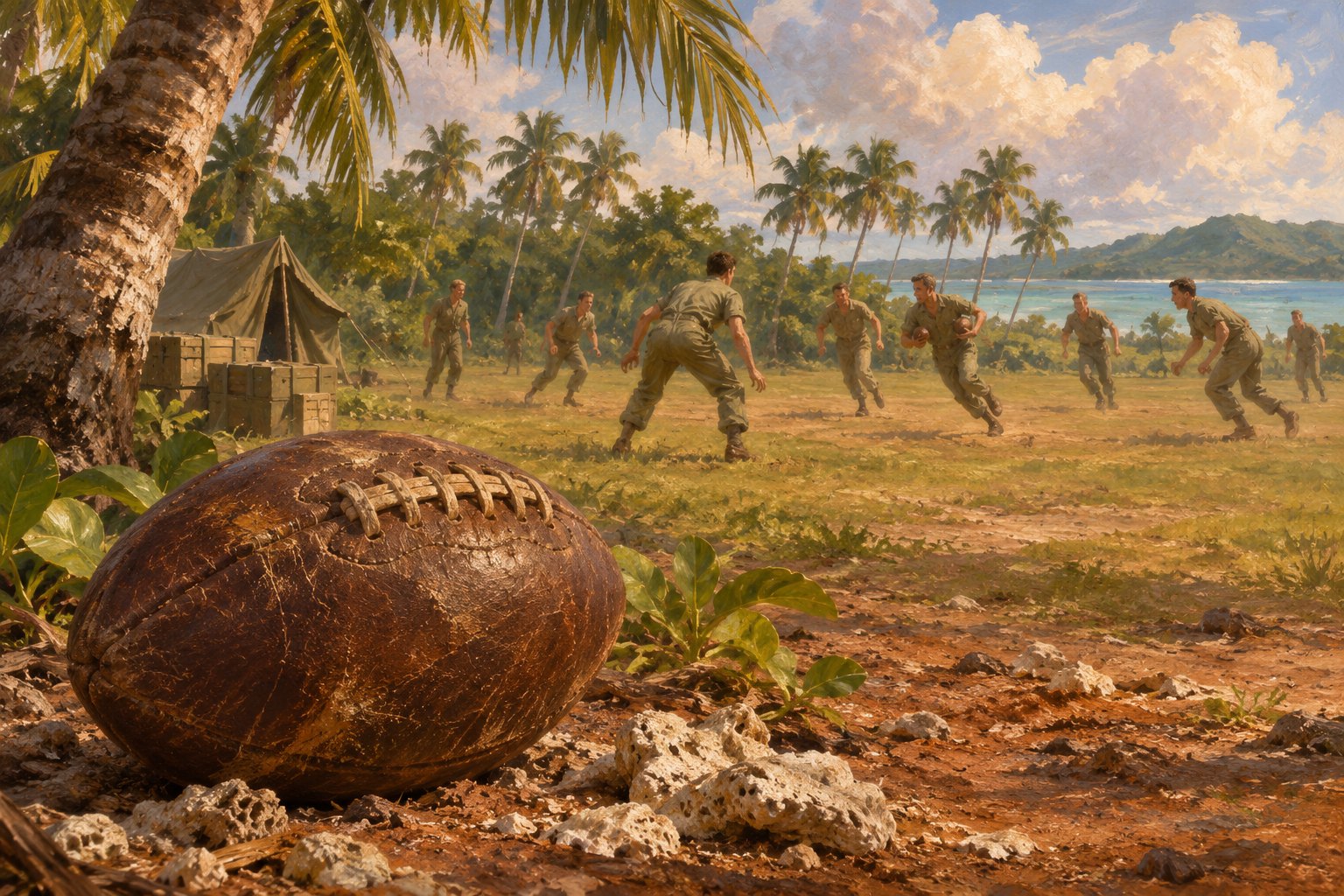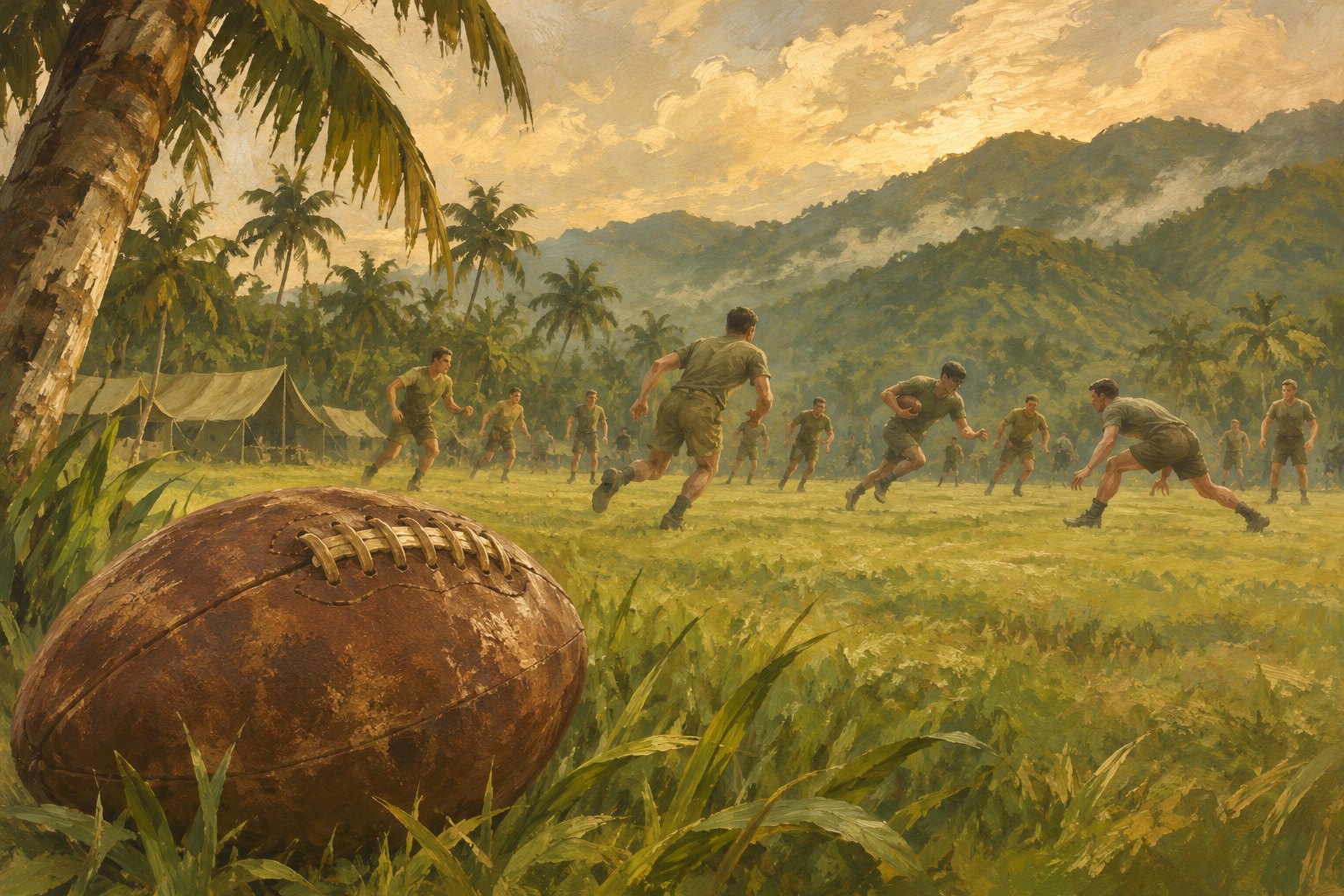
Yes, the Mosquito Bowl really happened: Marines played football on Guadalcanal on Christmas Eve in 1944. But that answer does not authenticate every relationship in Peter Berg’s Netflix drama. One especially revealing alteration concerns Tony Butkovich and Dave Schreiner, whose college rivalry gives their later military companionship a familiar dramatic shape.
The distinction matters because a movie can preserve a historical event while changing the reasons its characters seem to care about it. Here, the most useful question is what happens to our understanding of two real men when a screenplay introduces them through a confrontation that their actual college careers do not support.
Spoilers follow for the rivalry, wartime football game, and principal characters’ fates. This analysis focuses on the adaptation choices established in reporting and filmmaker interviews.
The opening rivalry changes how we meet Tony and Dave
Brian Truitt’s USA TODAY fact check describes the movie’s opening contest between Purdue and Wisconsin: Butkovich scores the decisive touchdown, leaving Schreiner with a defeat that follows them into their military relationship. The historical problem is straightforward. Schreiner’s final Wisconsin season was 1942; Butkovich’s record-setting Purdue season came in 1943. Their careers do not line up for that encounter as presented.
That is more consequential than moving a date on a calendar. The screenplay makes Tony responsible for a humiliation Dave must absorb. It supplies a ready-made explanation for tension, then gives their eventual friendship an obstacle to overcome. Viewers receive a compact emotional history before the men have spent much time together.
As a storytelling choice, the construction is efficient. As characterization, I find it restrictive. Athletic rivals becoming comrades is an immediately recognizable progression, but recognition can become a substitute for discovery. We know the destination of that relationship almost as soon as the grievance appears.
The adjustment also distributes audience sympathy. Tony gets the pleasure of victory and the freedom to needle his opponent. Dave gets injured pride and the burden of appearing unable to move on. Those are dramatic assignments, not neutral biographical details.
Tony’s confidence is more interesting without an invented opponent
Ray Nicholson plays Butkovich, while Tom Francis plays Schreiner. Netflix’s account of Buzz Bissinger’s research describes the real Butkovich as a gifted athlete from a large first-generation American family. That background opens possibilities beyond the familiar portrait of a brash sports star.
For a young athlete, confidence can be both temperament and a practical necessity. Teammates expect certainty; spectators reward visible swagger. My reading of Tony’s dramatic role is that football gives him a public identity he knows how to perform. Military service puts that identity under pressure because the qualities that attract applause cannot guarantee safety.
The rivalry makes this transformation easy to follow, but it can also narrow its meaning. If Tony mainly needs to stop antagonizing Dave, his development becomes a lesson in getting along. The more unsettling question is what remains of a celebrated athlete’s self-understanding when the world stops responding to talent in predictable ways.
That question does not require us to assume what the real Butkovich privately thought. It is a way of examining the screenplay’s emphasis: does athletic confidence reveal a person, or does it merely establish a personality type?
Dave’s letters complicate the wounded-pride storyline
Bissinger’s research offers a different route toward Schreiner. In Netflix’s account, the author describes surviving correspondence that revealed humility, self-criticism, and strong attachments to people at home. Letters from Schreiner’s fiancée, Odette Hendrickson, were also part of that material.
These documents matter because private correspondence and a screen rivalry answer different questions. A rivalry tells us whom a character wants to beat. A letter can suggest whom he worries about disappointing, what he misses, and how he explains himself to someone whose opinion matters.

The illustration above evokes personal archives; it does not reproduce Schreiner’s documents. That distinction parallels the film’s central challenge. An evocative representation can help us imagine a life without becoming evidence of exactly how that life unfolded.
My reservation about the rivalry is therefore less about demanding literal transcription than about competing kinds of intimacy. Hurt pride is legible immediately. Humility and uncertainty require patience. A film that gives the first quality too much explanatory power risks making the quieter qualities seem secondary.
There is a related question in our analysis of character attention in Way of the Warrior Kid: the most forceful dramatic presence can determine whose vulnerability the audience actually notices. Here, competitive friction can crowd out less demonstrative ways of understanding Dave.
The real game does not prove the surrounding scenes
The existence of the Christmas Eve game is secure; its dramatic preparation requires separate scrutiny. USA TODAY describes a film sequence in which a confrontation involving Schreiner leads to him and Bob Bauman being assigned to organize football. Establishing that a game occurred does not independently establish that this particular chain of events caused it.
That is a useful distinction for watching historical drama. An event, the circumstances around it, and the dialogue spoken during it are separate claims. Confirmation of one does not automatically confirm the others.
The same caution applies to memorable speeches. Without an authenticated transcript or accessible scene establishing exact wording, quotation marks would give reconstructed language an authority it has not earned. The characters’ choices can be discussed without inventing their sentences.
Our earlier overview of The Mosquito Bowl’s history and adaptation addresses the broader relationship between the game and its aftermath. The narrower issue here is how a real gathering can become the destination of a partly manufactured personal conflict.
What the rivalry means once the future disappears
The film’s ending brings the deaths of Butkovich, Schreiner, and Bauman together dramatically, while John McLaughry survives. USA TODAY’s reporting distinguishes that concentrated climax from deaths that occurred at different points during the Okinawa campaign.
Emotionally, compression encourages us to experience the men as one group whose story reaches a shared breaking point. Historically, their separate timelines remind us that each had an individual life. Neither distinction is trivial: the first organizes grief, while the second resists allowing a convenient narrative shape to replace biography.
For me, the rivalry is most revealing when its original stakes begin to look inadequate. A football defeat once seems large enough to explain a relationship. Against the prospect of an interrupted life, that grievance loses its claim to importance. The deeper interpretation is not simply that war teaches rivals to become friends. It is that these men deserved enough ordinary time for pride, competition, affection, and reconciliation to unfold without becoming a final statement about who they were.
The real Mosquito Bowl makes the film’s premise credible. The invented college confrontation makes its storytelling easier to recognize. Keeping those facts separate lets us appreciate the drama while leaving room for the men to have been more complicated than its design.
Original content by this site's editorial team. Published: November 26, 2026 at 23:17:45 PST (Los Angeles time)