Way of the Warrior Kid has a worthwhile idea beneath its workout routines: being bad at something today does not establish who you will be tomorrow. That makes it an inviting family drama, particularly for viewers who appreciate an earnest underdog story. Its limitation is that it eventually demands such spectacular evidence of improvement that ordinary progress starts to look insufficient.
The most revealing way to read the film is through its competing relationships with time. Marc wants his humiliation to end. His uncle Jake wants his injured body to recover. Both want to skip the uncomfortable interval between needing change and experiencing it. The movie understands that impatience, even when its storytelling indulges it.
Spoilers follow for character developments and the final act.
Marc needs a different meaning for failure
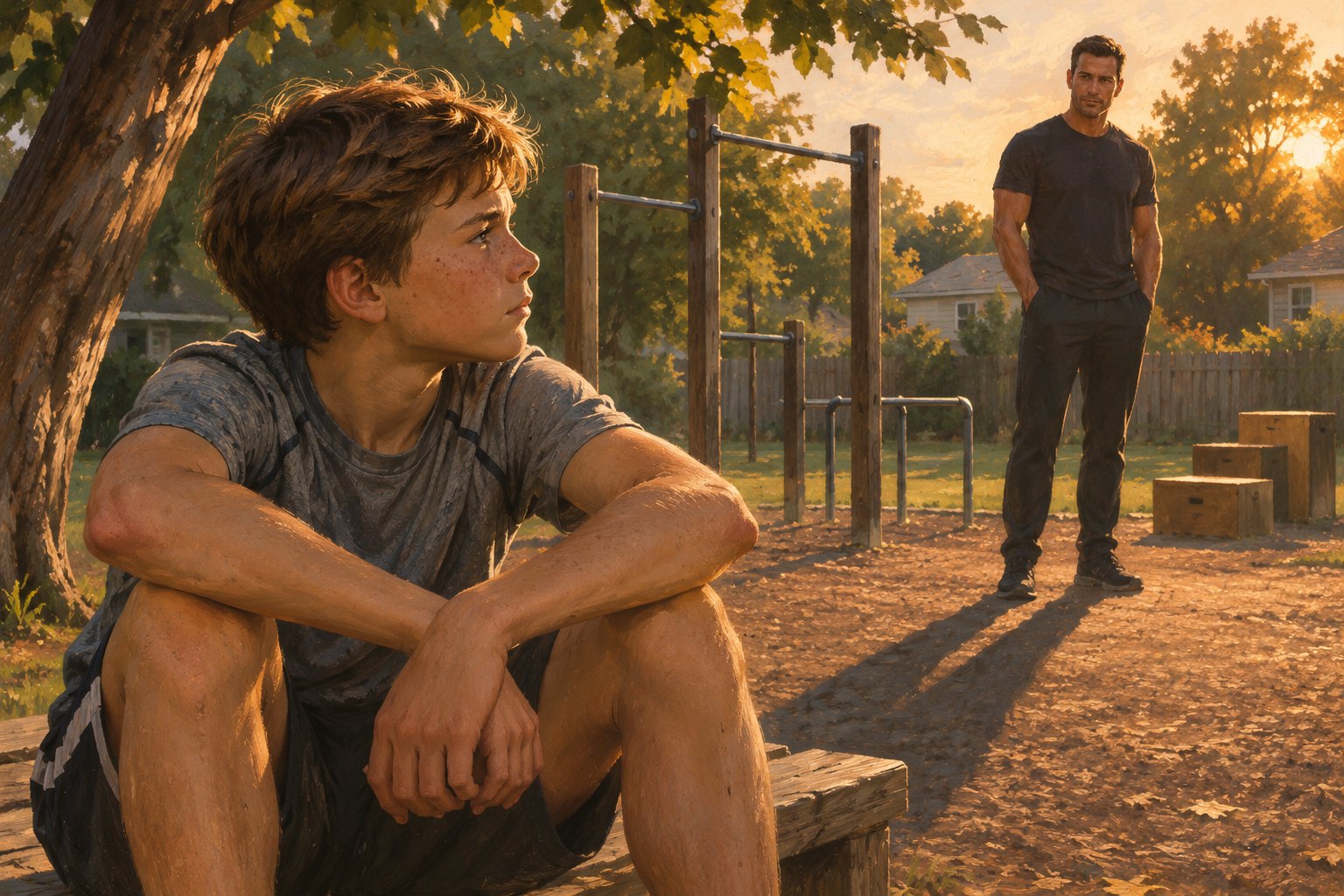
Directed by McG from Will Staples’ adaptation of Jocko Willink’s novel, the film pairs Jude Hill’s bullied Marc with Chris Pratt’s Jake, an injured Navy SEAL spending the summer with Marc and his mother, Sarah, played by Linda Cardellini. Jake’s training program gives the story its structure, but Marc’s relationship with embarrassment supplies its emotional stakes.
A failed pull-up is particularly useful material for this kind of story. It is public, visible, and apparently easy to judge. Either a child gets above the bar or he does not. What that measurement cannot reveal is how much instruction, encouragement, or practice the child has received.
For Marc, failure has become an identity rather than an event. That distinction matters more than the eventual number of repetitions. If every unsuccessful attempt confirms that he is hopeless, trying again becomes emotionally expensive. Avoidance starts to feel sensible.
Jake’s useful intervention is to make performance something that can change through repetition. Our earlier examination of the balance between Marc’s story and his mentor’s presence considered who commands the film’s attention. Here, the more productive question is what Marc learns to notice about himself when nobody is applauding.
A handshake promises more than a fitness plan
“Every good partnership starts with a handshake” is one of Jake’s compact statements of principle. Read generously, it offers Marc something valuable: participation. A partnership implies that the boy contributes to the process instead of simply receiving instructions from an impressive adult.
That is also where the film’s preference for neatly packaged lessons becomes limiting. A handshake can establish trust symbolically; maintaining trust requires listening, adjustment, and room for disagreement. The statement works best as the beginning of a relationship, rather than a complete explanation of one.
The training scenes invite two different responses. Their clear goals make improvement easy to follow, which suits an accessible family film. Yet their very clarity can narrow our understanding of success. Numbers provide satisfying milestones, but a child’s confidence also includes less measurable changes: admitting confusion, recovering from embarrassment, or asking for help before a problem grows.
My reservation is not that the film gives Marc goals. It is that the visible goals can become substitutes for the quieter emotional development they are supposed to support.
Learning to swim means confronting a memory
Marc’s fear of water gives his training a more personal dimension. He remembers nearly drowning as a young child and being rescued by his father, who died before teaching him to swim. The obstacle therefore carries both fear and grief. Learning a skill cannot undo the loss attached to it.
This is where the story’s summer-transformation framework becomes most interesting. From outside, swimming might appear to be another item on a list. From Marc’s perspective, entering the water means returning to an experience that still shapes his expectations of danger.

“Change has to come from you,” Jake tells him during their early training agreement. The line recognizes Marc’s agency, but it needs a compassionate interpretation. Choosing to try does not mean controlling how quickly fear disappears. A meaningful choice can be small, provisional, and repeated the next day.
That distinction gives the swimming material greater depth than a simple conquest-of-fear narrative. Marc does not need to prove that his earlier terror was foolish. He needs experiences that allow him to imagine a different outcome.
Jake’s recovery challenges his own philosophy
Jake’s injury creates a useful contradiction. He can organize effort, demand discipline, and set ambitious targets for his nephew. His own recovery resists that managerial approach. As Zachary Lee’s review describes, medical and military authorities insist that healing requires time; Jake cannot force readiness through determination alone.
That makes patience a more demanding lesson for Jake than another workout. His competence has practical value, but it also gives him somewhere to hide. If a problem can always be converted into a task, he can keep acting without fully accepting uncertainty.
The strongest interpretation of this parallel is that Marc and Jake need different permissions. Marc needs permission to begin before he feels capable. Jake needs permission to remain unfinished despite being capable. Both must stop treating their present limitations as final judgments.
The film’s familiar mentor structure becomes more worthwhile when viewed this way. Its adult has relevant experience without possessing universal answers. For another story about the limits of adult certainty, our analysis of protection and independence in Hexed explores a related family tension.
The climax turns progress into an emergency exam
The final act raises the stakes through a school outing endangered by a forest fire and a bus crash. Marc must apply his developing abilities amid immediate danger. On a structural level, the connection is clear: preparation becomes useful when circumstances stop allowing rehearsal.
But this escalation changes the standard by which his summer is judged. Earlier, an achievement can matter because it contradicts his belief that he cannot improve. During the climax, achievement must help carry an action sequence.
That is an understandable entertainment choice. It supplies urgency and a decisive payoff. It also makes the film’s message less proportionate. A child should not need an extraordinary rescue situation to demonstrate that ordinary persistence was worthwhile.
KSL critic John Clyde finds the film’s family appeal substantial enough to outweigh its heavy-handed moments and exaggerated finale. That is a reasonable response to its sincerity. My reading is more divided: the climax gives the story a forceful conclusion while making its gentler understanding of growth harder to hear.
The lesson worth keeping after the movie ends
Way of the Warrior Kid is most useful when confidence means trusting that another attempt is possible. It is less persuasive when confidence seems to require a dramatic public demonstration.
The deeper connection between Marc and Jake concerns control. Neither can simply command himself into becoming the person he wants to be. Practice matters, but so do assistance, recovery, and circumstances that refuse to follow a schedule.
That leaves the film with a worthwhile idea despite its oversized finish. Marc’s progress matters before the emergency arrives. Jake’s worth survives his inability to hurry his healing. An old-fashioned inspirational movie becomes more generous when its lessons make room for people who are still struggling after the montage ends.
Original content by this site's editorial team. Published: November 26, 2026 at 23:53:56 PST (Los Angeles time)