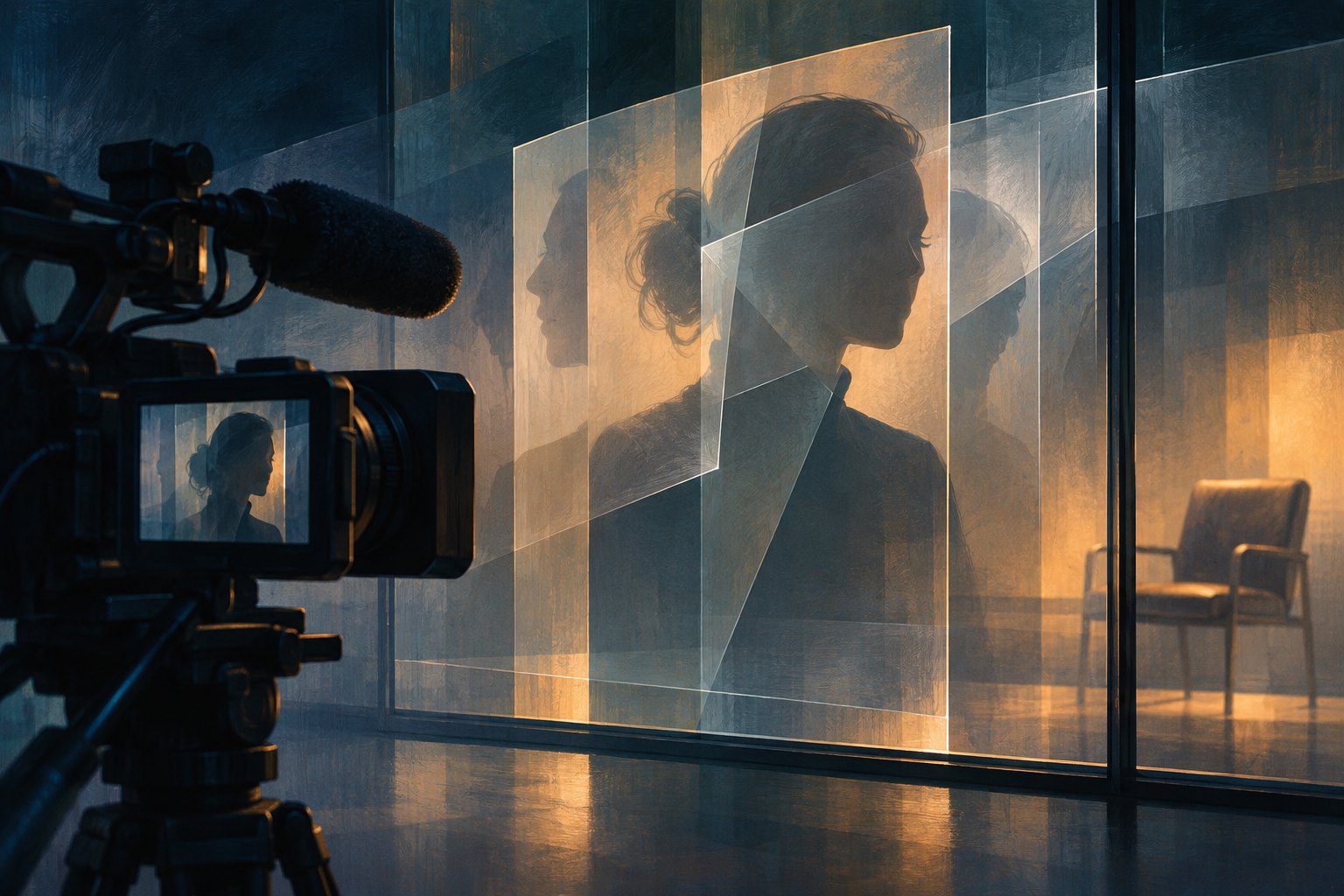
An Elizabeth Holmes documentary presents a particular challenge: looking closely at its central subject can feel like getting closer to the truth. Those experiences can overlap, but proximity alone cannot establish what happened. A face, an explanation, or an uncomfortable silence may deepen our understanding of a person while leaving the evidence about her actions exactly where it was.
That is the subtle danger worth examining. A documentary can make viewers more alert to manipulation and still encourage them to mistake unresolved questions about personality for unresolved questions about events. In my view, the strongest criticism of this kind of portrait begins by separating those two kinds of uncertainty.
This spoiler-free critical essay examines the ethical and cinematic questions surrounding the Elizabeth Holmes documentary; it does not offer a scene-by-scene assessment or attribute unverified dialogue to its participants.
Elizabeth Holmes as a Person and a Screen Subject
A character-focused reading of documentary requires care. Holmes is a real person, not a fictional protagonist whose motivations a screenwriter can eventually reveal. A camera may record what she says and how she behaves during an encounter. It cannot provide unrestricted access to what she believes, remembers, suppresses, or misunderstands.
From her position as a documentary subject, the opportunity to speak carries an obvious possibility: being understood on terms that extend beyond an existing public image. That possibility deserves consideration without becoming a presumption about her intentions. Participation can involve candor, self-protection, performance, or several impulses at once. Viewers cannot settle the balance by studying eye contact.
The useful critical question is therefore specific: what does a moment actually establish? An expression can support an interpretation of the encounter. A statement can establish the account a person chooses to give. Neither automatically verifies the account itself. Keeping those distinctions visible allows a film to explore Holmes as a complicated human being without asking personality to do the work of corroboration.
Intimacy Has Its Own Persuasive Force
Documentary intimacy can be extraordinarily affecting. Time spent watching someone listen, hesitate, or navigate an ordinary interaction creates familiarity. Familiarity, in turn, can make a viewer feel qualified to judge sincerity. That emotional progression is understandable, and it is one reason intimate nonfiction can be so compelling.
But sincerity is a limited finding. Someone can speak with conviction and be mistaken. Someone can appear guarded while telling the truth. A director who leaves space for ambiguity may be respecting the complexity of an encounter; a viewer who treats that ambiguity as a reason to dismiss other evidence is making a separate leap.
For a Holmes portrait, the challenge is especially clear at the level of interpretation. Sympathy may change how we imagine a person's experience. It does not, by itself, change the accuracy of a disputed claim. Likewise, disliking a person's manner provides no shortcut to proving that claim false. A responsible reading must resist both kinds of emotional convenience.
This concern connects with our discussion of personal perspective and the documentary camera in Birds of War: closeness matters because it shapes what viewers are able to understand, while also shaping what remains outside their attention.
The Filmmaker Is Part of the Evidence Problem
Scrutinizing Holmes should not make the filmmaker invisible. The person asking questions also chooses when to persist, when to change direction, and which answers deserve space. Later, editing determines whether an exchange plays as evasive, moving, funny, or unresolved. These decisions are necessary parts of filmmaking, and they deserve the same attentive reading as the subject's behavior.
Consider a hypothetical interview edit. A question is followed by a long pause and a close-up. That sequence may invite us to read the silence as calculation. Preserve more of the surrounding conversation and the pause might feel less significant. Introduce music and it might acquire menace. This example describes an editorial possibility, not a documented sequence in the Holmes film.

The important distinction is between showing uncertainty and producing it. A film can honestly encounter conflicting accounts. It can also arrange material so that an otherwise answerable question feels permanently mysterious. Assessing that difference means looking beyond a director's apparent skepticism to the information the film makes available.
The People Outside the Central Portrait
A documentary organized around Holmes inevitably makes choices about whose experience receives sustained attention. That is a question of narrative emphasis, not a claim that any particular person has been excluded. The central figure may receive the richest emotional treatment simply because the camera spends the most time with her.
For viewers, this creates a useful test: can you describe the stakes for people beyond the main subject as clearly as you can describe her feelings? If the answer is no, identify what is missing. It might be context about a disputed assertion, an independent account, or a clear explanation of consequences. Naming the gap is more useful than vaguely declaring that a documentary feels biased.
Screen time need not be divided equally. Relevant evidence should carry weight according to what it establishes. A brief, well-supported explanation may matter more than an extended personal account. Our examination of whose voices shape a documentary's argument in The Long Game approaches the related question of how participation influences the story an audience receives.
How to Watch Without Treating Everything as Unknowable
A practical approach is to separate three layers while watching: what the film records, what its participants claim, and what its construction encourages you to conclude. These layers interact, but keeping track of them prevents a persuasive sequence from silently becoming proof.
- Identify the claim. Is the question about an observable event, a person's memory, or an interpretation of motive?
- Look for support. Does the film offer corroboration, acknowledge a limitation, or rely primarily on the force of the speaker's presentation?
- Locate the uncertainty. Be precise about what remains unresolved instead of allowing one unanswered question to cloud every other conclusion.
- Revisit your reaction. Ask whether sympathy, irritation, humor, or suspense changed your assessment without adding information.
These questions preserve the pleasure of watching. They make room for surprise and emotional complexity while giving viewers a firmer basis for discussing the film afterward.
The Deeper Issue: Understanding Has Limits, Evidence Still Matters
The most compelling interpretation of the problem surrounding an Elizabeth Holmes documentary concerns the desire for complete understanding. We want a revealing encounter that makes a person's contradictions fall into place. Cinema is exceptionally good at making that resolution feel possible.
My judgment is that documentary earns greater trust when it allows psychological uncertainty to remain bounded. We may never know precisely how someone explains herself to herself. We can still assess particular statements, distinguish stronger evidence from weaker evidence, and recognize the consequences of actions.
A richer portrait should expand our capacity to understand people while sharpening our attention to what can be established. Seeing more becomes valuable when it helps us make those distinctions. Otherwise, the sensation of discovery can leave us with fewer reliable conclusions than we had when the camera started rolling.
Original content by this site's editorial team. Published: November 12, 2026 at 19:52:56 PST (Los Angeles time)