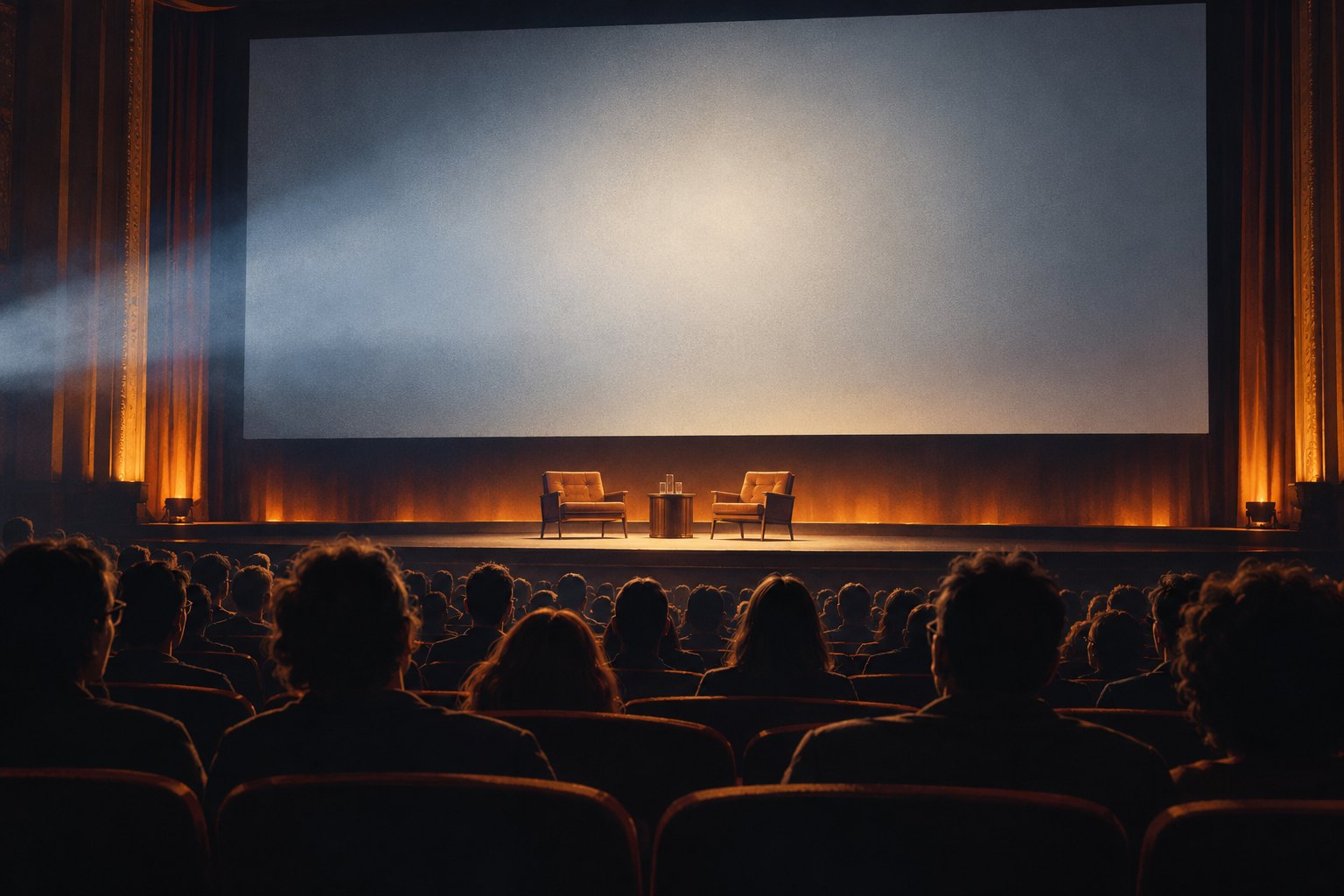
Quentin Tarantino ended his AFI Fest Q&A by showing the audience the first 17 minutes of Cliff Booth, according to Deadline. The immediate attraction is obvious: people attending a conversation also received an opening stretch of the film. The more interesting distinction is the format. An opening lets viewers encounter a story in sequence, with its pauses, transitions, and initial priorities intact.
That makes the presentation worth discussing without pretending it amounts to a complete movie review. The reported screening establishes what Tarantino showed and where he showed it. It does not, by itself, establish the quality of the footage, the audience’s response, or the direction of the remaining story. This is spoiler-free commentary on the presentation and its critical implications, not a firsthand assessment of the scenes.
What the AFI Fest presentation actually establishes
The essential facts are compact: Tarantino concluded a Q&A at AFI Fest by screening the beginning of Cliff Booth, and the excerpt ran 17 minutes. Those details distinguish the event from a conversation consisting entirely of recollections or promises. Attendees were given material they could watch, rather than only descriptions of a project.
For readers following the news, the word first matters as much as the number. This was reported as the beginning of the film, rather than a collection of highlights. The distinction changes the kind of impression an audience can form. Selected highlights emphasize attractions; an opening establishes an order in which the filmmaker wants viewers to discover things.
The announcement alone does not establish a public online release of the excerpt. Nor does showing an opening constitute a screening of the finished feature in its entirety. Keeping those distinctions clear preserves what is genuinely interesting about the event: a specific audience received an introduction to the story at the close of Tarantino’s conversation.
Why an opening offers more than a highlight reel
A trailer can leap between a joke, a confrontation, and an arresting image. An opening sequence has another responsibility: it must teach the audience how to watch. It establishes whether attention belongs to a face, a conversation, a setting, or information deliberately withheld. Even a seemingly uneventful passage can make those choices legible.
Seventeen minutes can give viewers time to notice rhythm. Does a scene continue after its immediate point has landed? Does a cut interrupt someone’s confidence? Does silence leave room for uncertainty? These are useful questions for anyone who eventually sees the footage. They are not descriptions of what happened in the AFI Fest excerpt.
My view is that presenting an opening is a particularly interesting invitation because it exposes connective material. A film’s personality often lives between its conspicuous moments: in the time it spends entering a room, listening to an answer, or allowing an uncomfortable exchange to linger. Those choices can be difficult to communicate through isolated promotional images.

Cliff Booth needs to be understood through choices
A character-focused response to Cliff Booth should begin with behavior. What does the film let us observe about its title character before offering explanations? Whose presence changes his conduct? What does he attend to, and what does he dismiss? These questions move criticism beyond whether a character seems entertaining or commands attention.
There is a meaningful difference between understanding a character’s perspective and accepting it. A film can place viewers close to someone while leaving space to question that person’s judgment. The revealing evidence may come from another character’s reaction, a contradiction between words and actions, or consequences the protagonist would prefer to ignore.
For this film, the useful eventual test is whether Cliff’s decisions create dramatic pressure. A compelling presence can carry an introduction; a sustained narrative asks more. Choices need to alter relationships, expose priorities, or restrict what becomes possible next. That is a standard for evaluating the complete work, not a claim about an unseen plot.
Our discussion of the character challenge facing a new Alien movie approaches a related issue: anticipation becomes more productive when it turns toward human conflict. Here, too, the strongest question concerns what the story asks its central figure to do when familiar behavior stops being sufficient.
Dialogue needs its surrounding scene
Tarantino’s involvement naturally makes dialogue a subject of interest. Yet memorable lines are poor substitutes for examining how a conversation works. A sentence might be funny because it interrupts someone, unsettling because nobody responds, or revealing because its speaker plainly believes something the audience doubts.
No dialogue from the excerpt is quoted here because the reported screening information does not establish its wording. Supplying an appealing line without reliable confirmation would create a false impression of access. More fundamentally, even an accurate quotation can misrepresent a scene when stripped of delivery, timing, and response.
When detailed criticism becomes possible, the better approach will be to connect words with power. Who controls the exchange? Who has to explain themselves? Who can end the conversation? Those questions can reveal character more precisely than collecting isolated sentences designed to be repeated.
The festival setting and the limits of a first impression
Placing footage at the end of a Q&A gives it a distinctive frame. The audience moves from listening to a filmmaker into watching a film. In my reading, that transition is the presentation’s most appealing feature: discussion yields to the work itself, allowing images and sounds to become the focus.
That framing should not be confused with evidence of acclaim. The fact of a screening cannot tell readers whether everyone was impressed, divided, or uncertain. It also cannot establish how an opening’s apparent strengths will develop across a feature. An intriguing question can receive an unsatisfying answer; an initially modest detail can acquire enormous weight later.
Our look at what a Cloud Girl trailer can reveal makes a useful companion to this distinction. Different forms of preview offer different kinds of evidence. The task is to understand that evidence without asking it to support conclusions about material it does not contain.
The deeper question is what the beginning becomes
An opening creates a provisional understanding of a character. The rest of a film can confirm it, complicate it, or make viewers reconsider why they formed it so quickly. That capacity for revision is one of cinema’s richest pleasures. The first impression matters partly because it may prove incomplete.
For Cliff Booth, the eventual critical question is therefore larger than whether 17 minutes make an effective introduction. It is whether the whole story changes the meaning of that introduction. Does later behavior deepen an early impression? Do other people gain enough presence to challenge the central perspective? Does the ending make the beginning worth revisiting?
Tarantino’s AFI Fest presentation gives those questions a concrete starting point. Its significance lies in the opportunity to encounter a beginning. A final judgment belongs to the complete film, where atmosphere, dialogue, and character choices must finally add up to something that lasts.
Original content by this site's editorial team. Published: October 24, 2026 at 07:18:39 PDT (Los Angeles time)