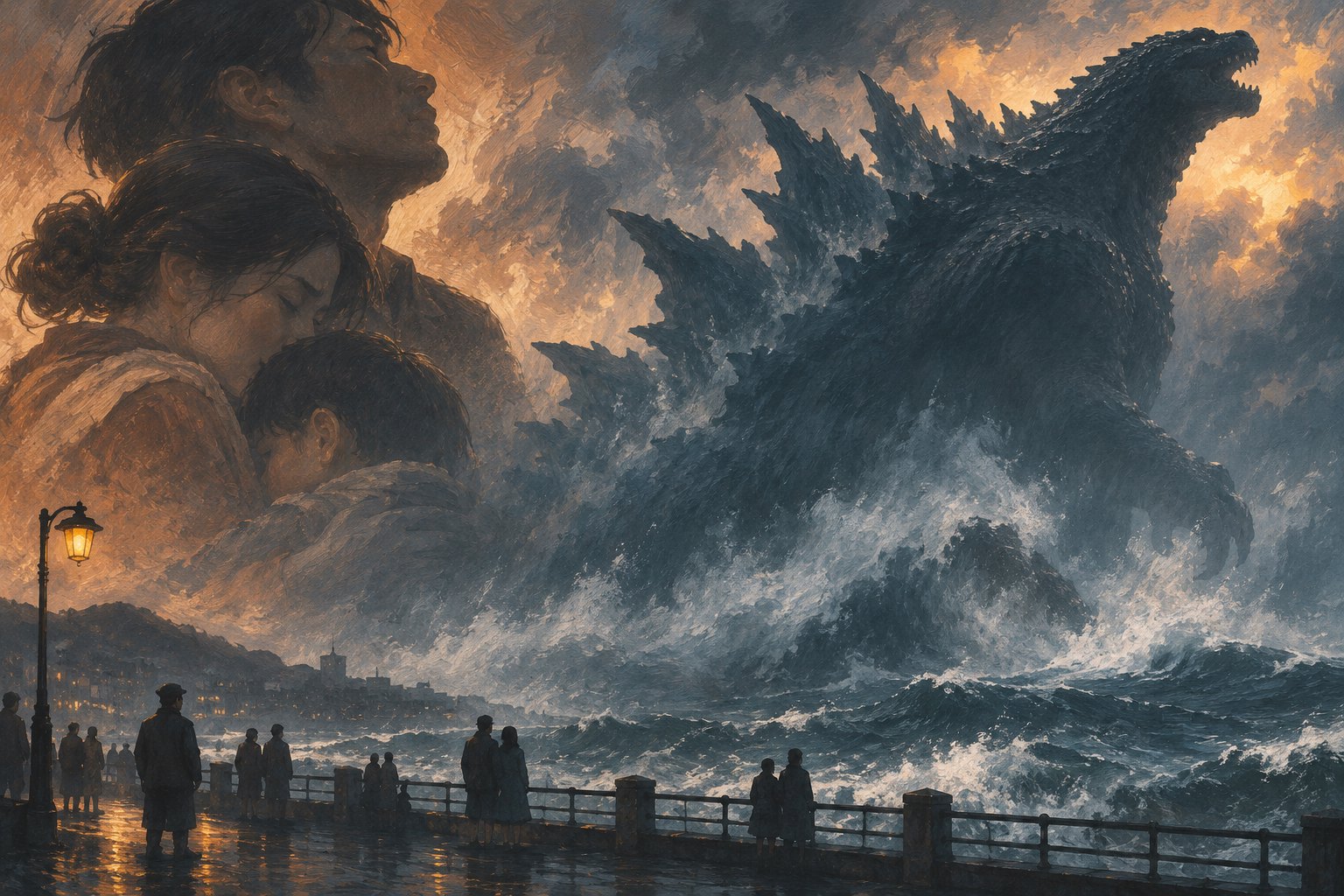
Takashi Yamazaki wanted to see King Ghidorah destroy his hometown on screen. According to Variety’s reporting, the Godzilla Minus Zero director has finally realized that ambition. It is an irresistible filmmaking anecdote: a place associated with belonging becomes the destination for an imagined catastrophe, and the person with the strongest personal connection helps bring the destruction to life.
The interesting question is what that connection adds. A hometown carries meanings that a generic city cannot automatically supply. Its streets belong to someone’s history. Its ordinary buildings have uses beyond filling a frame. Yamazaki’s wish offers a way to think about monster cinema as an encounter between private geography and public entertainment.
This is critical commentary on the reported hometown premise, rather than a scene-by-scene review. It discusses that premise without revealing an ending or attributing unverified dialogue to the film.
Why a Hometown Changes the Meaning of Destruction
A city in a disaster movie can function as an instantly readable collection of targets. Buildings establish height; streets establish distance; collapsing structures demonstrate force. A hometown introduces another measure: recognition. Someone watching may know what belongs around the next corner, or remember a version of that place that no longer exists.
That makes the director’s relationship to the setting especially suggestive. For an unfamiliar viewer, a threatened building may initially be architecture. For someone who knows the area, it may sit within a network of routines, relationships, and memories. The same image can therefore produce two different experiences: astonishment at the spectacle and a strange intimacy with its location.
My reading of Yamazaki’s ambition is that this collision is its most compelling aspect. Imagining a monster in a familiar place brings an impossible creature into a world whose dimensions already make sense. You do not need a technical explanation of its size when you can mentally compare it with a street you have walked.
That interpretation should remain separate from a claim about his motives. The reported wish establishes a personal connection; it does not establish every feeling behind it. Affection, playful imagination, and the pleasure of recognition are useful possibilities to consider, not biographical conclusions.
The Fan’s Wish and the Resident’s Nightmare
There is a productive contradiction at the center of the story. From the filmmaker’s perspective, the destruction represents an ambition fulfilled. From the perspective of anyone living inside such a fictional disaster, it represents the disappearance of safety. Monster movies ask audiences to occupy both positions.
We can enjoy the arrival of a creature while wanting the people in its path to escape. That divided response is part of the form’s appeal. Admiration for a spectacular image does not require indifference to the lives represented within it. The challenge is giving those lives enough specificity to hold our attention once the initial surprise passes.
A character-centered reading therefore begins with a practical question: what does this place allow someone to do? A home provides shelter. A street connects neighbors. A familiar route makes movement predictable. Destruction removes those functions as well as the physical structures. Thinking in those terms gives the catastrophe consequences that extend beyond the moment of impact.
This also sharpens the distinction between an interesting production anecdote and an effective dramatic choice. The director may recognize everything. The audience still needs a reason to care. Personal significance becomes cinematic significance when the film makes a place understandable to people who have never visited it.

Looking at the Town Before Looking at the Monster
The hometown premise suggests a useful viewing approach: pay attention to the environment before treating it as a destruction sequence. Does the setting register as somewhere inhabited? Do people appear to understand its routes and spaces? Does the geography help explain their decisions?
These are questions about storytelling, rather than a checklist of details claimed to appear in Godzilla Minus Zero. An ordinary place can acquire dramatic weight through movement alone. Knowing where a person is trying to go, and why getting there matters, can make a blocked street more consequential than a much larger collapse.
The same principle applies to what remains afterward. A setting becomes memorable when changes to it alter someone’s possibilities. If geography affects choices, the location participates in the story. If it exists only to provide an impressive surface for destruction, the director’s personal attachment may remain largely outside the viewer’s experience.
Our discussion of what makes a major Godzilla Minus Zero effects shot matter considers how spectacle earns dramatic weight. The hometown angle adds a distinct question: how does a filmmaker make a personally meaningful place legible to strangers?
A Personal Connection Is Context, Not a Verdict
Knowing that Yamazaki wanted this image can enrich an audience’s response. It directs attention toward the choice of location and invites curiosity about why particular places enter a filmmaker’s imagination. It cannot, by itself, establish that the finished sequence succeeds.
That distinction matters in film criticism. A moving explanation of how an idea originated is not interchangeable with the experience of watching it. A viewer may appreciate the personal history and still find the resulting scene unclear, remote, or insufficiently developed. Another viewer may respond powerfully without knowing the anecdote at all.
For me, the most useful standard is whether the setting communicates attachment through the film’s own dramatic language. The audience should not have to borrow the director’s memories to understand the stakes. The work needs to create its own relationship between people and place.
That question complements our examination of how Godzilla Minus Zero balances human drama and catastrophe. Here, the emphasis is on whether a location can carry meaning through its role in someone’s life.
The Deeper Appeal of Bringing a Monster Home
Yamazaki’s reported dream is compelling because it puts an intimate claim on an enormous fantasy. A filmmaker can take a creature associated with spectacular destruction and imagine it entering a place that matters personally. The familiar world becomes worthy of the impossible.
There is something generous in that imaginative gesture, even when its fictional outcome is devastation. It grants ordinary geography the scale of myth. A place does not need to be universally recognizable to become the center of a monumental cinematic event.
The strongest interpretation of this hometown connection, however, depends on remembering the people who would inhabit that geography. The fan imagines the astonishing arrival. The resident imagines what might disappear. Holding those perspectives together gives the premise its tension: the fulfillment of one person’s cinematic wish becomes an invitation for everyone else to consider the value of home.
Original content by this site's editorial team. Published: November 8, 2026 at 13:50:37 PST (Los Angeles time)