
The Hunger Games: Sunrise on the Reaping keeps the book’s destination: Haymitch survives long enough to inhabit a world beyond the Games. What changes is how that peace becomes visible. The movie emphasizes a reunion and a reclaimed birthday; Suzanne Collins’ epilogue gives greater attention to the intimate ways Katniss understands her former mentor.
Spoilers follow for the movie, the novel, and the ending of the original Hunger Games story.
What changed from the book’s epilogue?
Business Insider’s comparison identifies three meaningful differences. The movie does not explicitly connect Haymitch’s nickname for Katniss, “sweetheart,” to his memories of Louella. It includes geese but omits Katniss giving him goose eggs. And its public memorial occupies narrative territory served by the book’s shared remembrance project. These are changes in emphasis rather than a reversal of the ending. [Business Insider’s ending comparison](https://www.aol.com/articles/ending-hunger-games-sunrise-reaping-191401000.html)
My reading is that the adaptation makes reconciliation immediately legible while leaving some of its emotional mechanisms unexplained. Familiar faces can communicate affection within seconds. A gift chosen because someone has listened carefully communicates something more particular: affection shaped by knowledge.
That distinction matters when the person receiving care is Haymitch. An ending about his survival needs more than reassurance that other people like him. It needs some sense that they can recognize the life he carries beneath his abrasive defenses.
Haymitch’s victory makes the epilogue necessary
The story’s cruelty extends beyond the arena. Haymitch survives, but Snow retaliates by having his mother and brother killed in a fire and Lenore Dove poisoned. His return home therefore destroys the ordinary future that winning was supposed to protect. The movie subsequently returns to the meadow and ultimately to a memory of young Haymitch with Lenore Dove. [Francis Lawrence’s discussion of the film and its ending](https://tollbit.forbes.com/sites/oliviasingh/2026/11/20/sunrise-on-the-reaping-director-helps-hunger-games-return-to-form-for-that-epilogue-reunion/)
Through Haymitch’s perspective, this makes the word “victor” almost unbearable. A competition promises a finish line; political punishment refuses to recognize one. His survival becomes another opportunity for the Capitol to exercise control.
The epilogue consequently has a difficult job. It must offer relief without suggesting that the years between catastrophe and peace were merely a waiting room. A future worth living cannot retrospectively make the suffering necessary or fair.
This is also why the franchise’s treatment of vulnerable individuals matters more than the scale of its spectacle, a question explored in our analysis of what another Hunger Games movie needs to preserve.
A birthday becomes an act of reclamation
The film brings back Woody Harrelson, Jennifer Lawrence, and Josh Hutcherson as Haymitch, Katniss, and Peeta. Its flash-forward places them at the former reaping site, where Katniss and Peeta celebrate Haymitch’s birthday. That date once belonged to the machinery of the Games. Now it can belong to him. USA Today’s account also connects this moment to Lenore Dove’s hope for a morning without a reaping. [USA Today’s report on the reunion](https://www.aol.com/articles/inside-jennifer-lawrence-josh-hutchersons-131521000.html)
“Happy birthday” becomes an unusually consequential greeting in this setting. It recognizes a person where the state once selected bodies. The ritual is modest, but its modesty is the point: nobody needs to perform bravery, win an audience, or justify being alive.
For Peeta and Katniss, standing beside Haymitch also changes the terms of their relationship. The mentor is no longer responsible for preparing them for an ordeal. They can offer companionship without requiring expertise or protection in return.
As a dramatic choice, the reunion earns its place through that reversal. Its value is not exhausted by recognizing the actors. The characters finally have permission to meet without an approaching emergency.
The goose eggs make care practical
In the novel, Katniss’s gift follows Haymitch sharing his history. Its connection to Lenore Dove makes it an act of attentive care. The movie retains the birds but leaves that exchange unstated.
What makes the gift powerful, in my view, is its refusal to explain grief away. Eggs require a future: waiting, tending, watching something develop. They offer a small responsibility that does not resemble the Capitol’s demands.
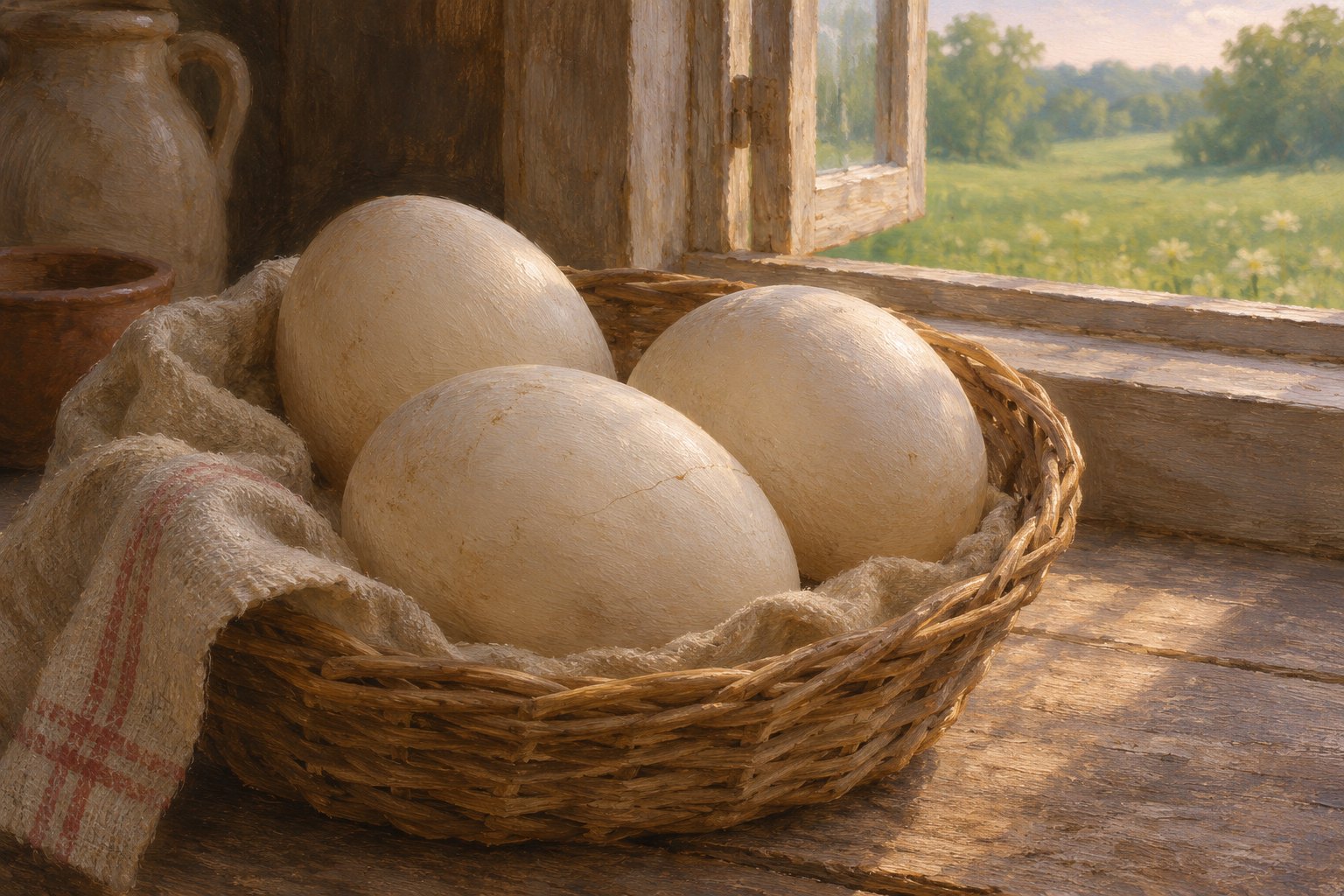
There is a useful distinction between an image of peace and an action that helps someone practice it. A meadow can symbolize freedom beautifully. A carefully chosen gift shows another person helping make that freedom habitable.
The omission therefore costs Katniss a specific expression of understanding. The audience can still infer warmth between them, but inference is broader than evidence. A hug says that someone matters. A gift rooted in their history says that their memories have been heard.
“Sweetheart” carries more than sarcasm
The novel’s Louella connection similarly changes how a familiar word lands. “Sweetheart” can sound like Haymitch keeping emotional distance through teasing. Its earlier association allows tenderness and mourning to occupy the same syllables.
That is an economical form of characterization: the language remains familiar while the reader’s understanding deepens. It does not require Haymitch to become suddenly eloquent about his feelings.
The larger critical lesson is to pay attention to repeated gestures and phrases before treating them as personality decoration. Our discussion of character vulnerability in Jaws and Die Hard approaches a related question: recognizable behavior matters most when it reveals what a person fears or needs.
The final callback turns mourning toward the future
Haymitch’s “Nevermore” invokes Edgar Allan Poe’s The Raven, a literary connection reinforced by Lenore Dove’s name. The film places the word after the reunion at the former reaping site. [Looper’s account of the closing sequence](https://www.looper.com/2312932/the-hunger-games-sunrise-on-the-reaping-ending-explained/)
Read in that context, the callback holds two meanings together. Loss remains irreversible, but repetition is not inevitable. Haymitch cannot recover the people taken from him; the world can nevertheless stop producing the same catastrophe.
That is the ending’s strongest idea. Peace does not demand that he stop remembering Lenore Dove. It creates room for remembrance without another compulsory sacrifice approaching.
The film’s conclusion is persuasive as a public release from terror. The book’s smaller exchanges provide a more precise account of private recovery. For me, the adaptation loses something valuable by compressing those exchanges, even as its birthday reunion finds a clear emotional purpose. Haymitch’s deepest victory is the possibility of being cared for when he no longer has to help anyone survive an arena.
Original content by this site's editorial team. Published: November 24, 2026 at 03:28:29 PST (Los Angeles time)