GTA 6’s movie and TV references invite an enjoyable game of recognition, with Jaws and Die Hard among the Hollywood classics named in Variety’s coverage of Rockstar’s tributes. Those two titles also suggest a more interesting conversation than a checklist of familiar images. Both films make spectacular danger feel personal by trapping a resourceful, frightened man somewhere he cannot control.
The reporting establishes the connection to those films; it does not, by itself, establish which individual shots, dialogue exchanges, or gameplay situations reproduce them. This article examines what makes those cinematic touchstones meaningful, rather than presenting an exhaustive Easter egg guide or claiming firsthand knowledge of specific GTA 6 encounters.
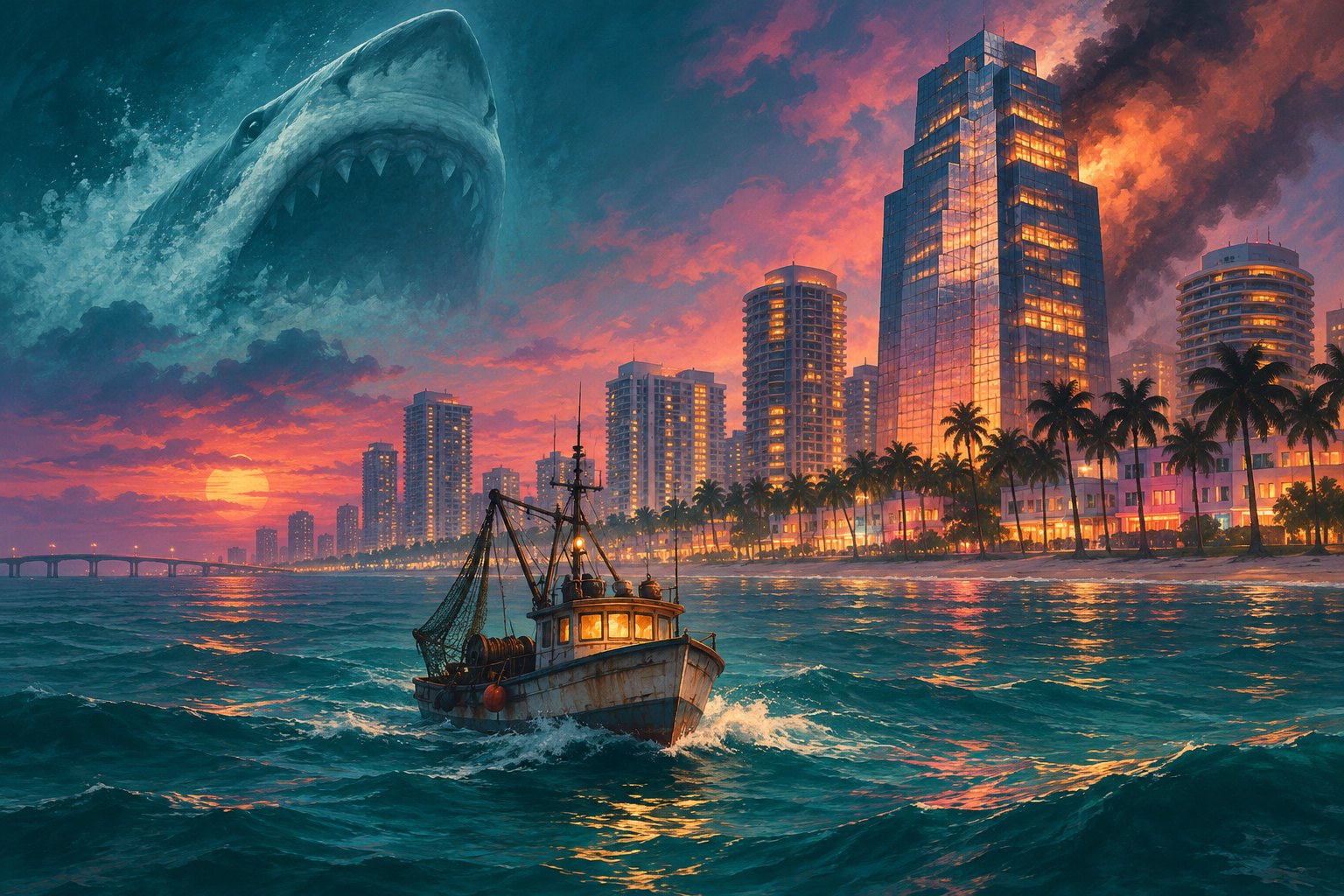
Spoiler note: The discussion below includes character and story details from Jaws and Die Hard. The illustrations are conceptual artwork, not game screenshots or film stills.
Jaws: The Reference Matters Because Brody Is Afraid
A shark, a boat, and an expanse of water provide an instantly recognizable visual vocabulary. But Steven Spielberg’s Jaws gets its emotional force from Chief Martin Brody’s relationship to that environment. He carries the responsibility of protecting people while confronting a danger that exposes the limits of his authority.
On land, Brody must navigate competing demands. Public safety runs into the town’s economic dependence on its beaches. At sea, his badge cannot make the water safer or turn him into an experienced shark hunter. Joining Quint and Hooper means accepting that responsibility may require entering a situation for which he feels profoundly unprepared.
That is why “You’re gonna need a bigger boat” remains such an effective line. It is funny because it sounds practical and understated. It is frightening because Brody has just understood the scale of the problem. The sentence briefly punctures the assumption that determination and equipment will be enough.
In my reading, Brody’s uncertainty is the film’s greatest asset. Viewers do not need a detailed understanding of sharks to recognize the feeling of discovering that a task exceeds their abilities. His fear gives the spectacle a human scale.
Three Men, Three Different Ideas of Competence
Brody, Hooper, and Quint approach danger through different kinds of experience. Brody brings civic responsibility, Hooper scientific knowledge, and Quint practical expertise sharpened by personal history. Their friction keeps the hunt from becoming a simple demonstration of professional skill.
The boat consequently becomes more than transportation. It is a small social world where confidence, knowledge, and authority compete. The audience watches the men assess one another while trying to assess a threat they cannot consistently see.
A meaningful Jaws homage could draw on that imbalance between apparent competence and actual control. A shark image alone delivers recognition. A sequence that makes a capable character feel out of their depth can carry the film’s underlying dramatic idea. That distinction is a critical lens for considering GTA 6’s reported tribute, not a description of a verified mission.
Die Hard: A Building Becomes a Test of Character
John McTiernan’s Die Hard builds a different trap. John McClane arrives in Los Angeles hoping to reconnect with his estranged wife, Holly. When armed criminals take over the office tower where her Christmas party is being held, his already uncomfortable visit becomes a struggle to survive and help the hostages.
McClane’s personal circumstances matter because he enters the story with something unresolved. He is not simply a professional arriving to fix someone else’s emergency. His relationship has exposed weaknesses that physical courage cannot automatically repair.
The building then makes every practical decision consequential. Floors, corridors, service spaces, and windows determine what McClane can see and where he can move. Architecture becomes an active source of suspense: being close to someone does not necessarily mean being able to reach them.

Bruce Willis’s performance makes resourcefulness look physically expensive. McClane’s vulnerability helps sell his ingenuity; improvisation matters because there is no comfortable margin for error. My judgment is that this remains the film’s strongest lesson for action storytelling: a clever escape becomes more satisfying when the audience understands why the easier options have disappeared.
The Wisecracks Are Part of the Pressure
“Welcome to the party, pal!” works as more than a detachable action-movie catchphrase. McClane’s sarcasm expresses frustration and defiance. His humor is one way of insisting that he still has some agency inside a situation designed to strip it away.
That distinction matters when evaluating a tribute. Borrowing a wisecrack can reproduce the sound of Die Hard. Giving a character a reason to make that joke can reproduce something of its emotional effect. The humor should emerge from the danger and the personality responding to it.
The same principle underlies our discussion of the character stakes that a Hunger Games continuation needs to preserve: recognizable spectacle stays compelling when it remains attached to a particular person’s needs.
How to Read GTA 6’s References Without Overstating Them
For readers exploring GTA 6’s Hollywood connections, three distinctions help keep observation useful. They also prevent a familiar-looking setting from becoming an unsupported claim about creative intent.
- A visual resemblance: A location, costume, or composition recalls another work. The similarity may be suggestive without establishing a deliberate tribute.
- A specific allusion: A distinctive combination of details points toward a particular film or television series. The strength of the comparison depends on the details.
- A structural influence: A scene borrows a dramatic pattern, such as restricted movement, unequal knowledge, or a character improvising under pressure. This is often an interpretive argument rather than a confirmed production fact.
These categories can overlap. What matters is explaining the evidence and identifying where interpretation begins. A skyline cannot establish a specific television reference on its own, just as a dangerous stretch of water does not automatically establish a Jaws quotation.
Recognition also should not be a prerequisite for enjoyment. As our analysis of why a recognizable cameo needs dramatic purpose argues, familiarity should enrich a scene that already works. A newcomer deserves tension, humor, and intelligible stakes without needing to pass a film-history quiz.
The Deeper Connection: Spectacle That Reduces Control
The most productive connection between Jaws and Die Hard is their treatment of control. One places its protagonist on open water; the other confines him inside a tower. Despite those opposite environments, both steadily reveal how little authority their heroes possess over the spaces around them.
Brody must act despite fear. McClane must improvise despite isolation. Their appeal comes from the gap between what the situation demands and what they can confidently deliver. Neither film needs its hero to feel comfortable for the audience to feel exhilarated.
That offers a demanding standard for GTA 6’s reported Hollywood tributes. An Easter egg can reward memory in an instant. A deeper homage makes a familiar cinematic idea useful again: uncertainty changes a decision, a joke reveals strain, or an impressive location becomes an obstacle. For me, that is where recognition becomes worthwhile criticism—and where borrowing from the movies can produce something more affecting than a knowing wink.
Original content by this site's editorial team. Published: November 23, 2026 at 21:03:59 PST (Los Angeles time)