
The Hunger Games: Sunrise on the Reaping places Joseph Zada in a role with an unusually difficult emotional assignment: making Haymitch Abernathy matter before audiences recognize the wounded mentor he becomes. The encouraging assessment from Movies We Texted About identifies Zada as central to that achievement. Its account emphasizes the younger Haymitch’s warmth and the accumulating losses that reshape him. That suggests a compelling way into this story: consider what caring costs him, rather than treating his suffering as an explanation for a familiar personality. [Movies We Texted About’s review](https://movieswetextedabout.com/the-hunger-games-sunrise-on-the-reaping-movie-review-joseph-zada-gives-haymitch-the-story-he-deserved/)
Scope and spoilers: This is character analysis informed by published film reviews, not a firsthand screening review. It discusses the premise, Haymitch’s relationships, and the story’s broad trajectory. Judgments about individual performances are attributed; the interpretation is our own.
Haymitch deserves a life before he becomes a lesson
An origin story can accidentally turn its protagonist into evidence. Every smile becomes something destined to disappear; every friendship becomes preparation for grief. Viewers stop meeting a person and begin assembling an explanation. Haymitch is especially vulnerable to that treatment because audiences already associate him with the consequences of surviving the Games.
The more interesting approach is to allow his younger self to possess values that matter in the present. Love, humor, and attachment should have significance beyond demonstrating what the Capitol will destroy. Otherwise, the audience experiences his life primarily from the perspective of its eventual loss.
This is why the reported warmth in Zada’s interpretation matters. A sympathetic performance needs more than visible pain. It needs something that pain interrupts: an appetite for ordinary life, an assumption that another person can be trusted, a reason to imagine tomorrow. Those qualities give tragedy its scale without requiring the film to make every moment ominous.
Our earlier discussion of how Haymitch’s origin story might turn familiarity into feeling considered the challenge of revisiting a known character. Here, the narrower question is whose experience receives priority: the young man living through events, or the audience waiting for him to resemble his older self.
Joseph Zada’s challenge goes beyond resemblance
Playing an established character invites viewers to look for recognizable gestures. That can be pleasurable, but resemblance alone cannot sustain an emotional argument. An actor must also make the character’s decisions understandable before those decisions become part of franchise history.
The distinction is between recognition and identification. Recognition lets us say that this could become Haymitch. Identification asks us to understand what this Haymitch wants now, with the limited knowledge available to him. The second is harder because the audience knows more about his future than he does.
For that reason, praise of Zada is most useful when it concerns the person he establishes, rather than how neatly he connects two performances. The critical standard should be whether a viewer unfamiliar with the older Haymitch could care about this young man’s choices. A prequel gains emotional independence when its protagonist remains interesting without the reassurance of recognition.
That question also connects with our examination of established screen identities and the opportunities casting creates. A familiar role gives an actor immediate attention. What makes the opportunity worthwhile is the possibility of revealing a person audiences have not already decided they understand.
Protecting another tribute challenges the Games’ logic
The Associated Press describes Haymitch as affectionate toward his girlfriend, protective of vulnerable tributes, and capable of violence when cornered. It also reports a scheme to undermine the arena. These details establish competing pressures: preserving relationships, staying alive, and resisting the machinery that makes those goals collide. [The Associated Press review](https://apnews.com/article/e1f9922aada47bc9a13aee7710b2a3ba)
My reading is that protection carries particular weight in this setting. The Games encourage participants to interpret another person’s survival as a threat to their own. Helping someone therefore means accepting a responsibility the competition is designed to make irrational.
That does not automatically make every alliance selfless. Cooperation can be practical, fearful, temporary, or uneven. Its moral interest comes from that uncertainty. A person can need assistance and distrust it at the same time; someone offering help can act generously without possessing a clean plan for what comes next.
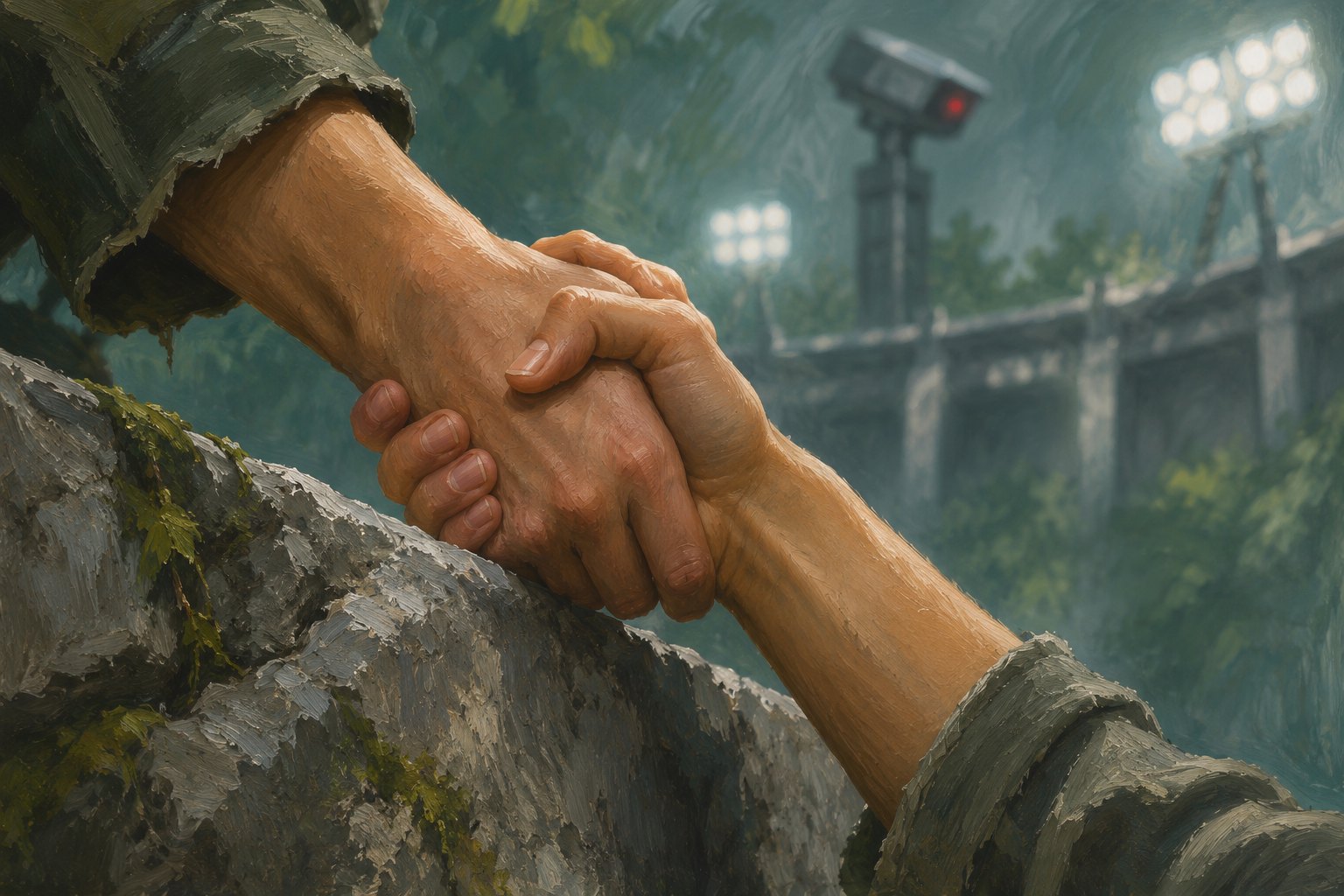
For a character-centered reading, these tensions deserve as much attention as tactical ingenuity. The crucial question is not simply whether Haymitch can recognize danger. It is whether danger changes whom he considers worth protecting. That is where a survival story can reveal an ethical struggle instead of merely displaying endurance.
Snow’s words turn spectacle into ownership
Two brief lines attributed to Snow in the Associated Press review sharpen the political stakes: “These are MY games” and “Defiance is dangerous. Public defiance is intolerable.”
The possessive language matters. The first statement treats the competition as property. The second distinguishes disobedience from disobedience that other people can witness. Together, they suggest that authority depends on controlling the meaning of events as well as their outcome.
From Haymitch’s perspective, that creates a frightening imbalance. Resourcefulness may help him navigate an immediate threat, but it does not give him control over how his actions are presented. A clever choice can be recast as insolence. An act of solidarity can become something power needs to punish.
This is also why spectacle deserves scrutiny beyond its visual excitement. An audience inside Panem can be shown the same action that we interpret as courage and be encouraged to read it differently. The political contest includes the right to explain what happened.
Survival cannot settle the moral account
The deepest interpretive distinction here is between survival and victory. Survival describes a physical outcome. Victory carries a judgment: that something has been achieved, settled, or deserved. Confusing the two allows the institution responsible for suffering to present continued existence as a generous reward.
Haymitch’s story challenges that accounting. Returning alive cannot retroactively make the conditions of participation acceptable. Nor does resilience prove that the harm was necessary to produce strength. A person’s ability to continue is evidence of that person’s effort, not an argument in favor of what was done to them.
That reading also changes how we approach the older mentor. His damage should not be treated as the only authentic thing about him, with youthful warmth dismissed as a stage he outgrew. The capacity to care can remain meaningful even when its expression becomes guarded, abrasive, or difficult to recognize.
The promise identified in the response to Zada is therefore more substantial than a convincing younger version of a beloved character. It is the possibility of seeing Haymitch’s compassion as part of his intelligence: a way of recognizing what the Games try to erase. The most valuable question this story raises is whether survival can preserve an obligation to others—and how much a system built on isolation fears that obligation.
Original content by this site's editorial team. Published: November 17, 2026 at 08:15:49 PST (Los Angeles time)