
Cliff Booth’s first reactions are generating excitement around Brad Pitt, David Fincher, and Quentin Tarantino. The enthusiasm offers an encouraging early signal, but it also invites a more specific question: what makes this apparently relaxed character so effective at producing tension? The answer lies partly in the distance between what Cliff notices and what an audience fears. Variety’s early-reaction coverage establishes the positive reception, rather than a settled critical consensus. [Variety’s first-reaction report](https://au.variety.com/2026/film/news/cliff-booth-first-reactions-brad-pitt-fincher-tarantino-42668/)
The most revealing starting point is the Spahn Ranch passage in Once Upon a Time in Hollywood. It demonstrates how a character can anchor suspense without displaying much anxiety himself. Looking closely at that sequence gives the current excitement a sharper focus: whether another film can preserve the uncertainty that makes watching Cliff more interesting than simply admiring him.
Spoiler warning: The following analysis discusses the original film’s ranch sequence. It does not assess unverified scenes, dialogue, or Easter eggs from the new film.
Cliff’s confidence changes the audience’s job
Many suspense protagonists teach us how frightened to feel. Their hesitation, hurried breathing, and startled reactions supply emotional instructions. Cliff complicates that relationship. Pitt’s unhurried delivery often suggests that a situation remains manageable even when the surroundings encourage us to expect trouble.
My reading is that this disagreement does much of the dramatic work. We watch the environment because Cliff does not explain it for us. A pause might indicate that he has spotted a threat, or simply that he sees no reason to hurry. His composure keeps both possibilities alive.
This is a more precise question than whether the character remains cool. Our earlier discussion of Cliff Booth’s appeal beyond Hollywood cool considers his broader attraction. Here, the important issue is how that attraction influences our judgment while a scene unfolds.
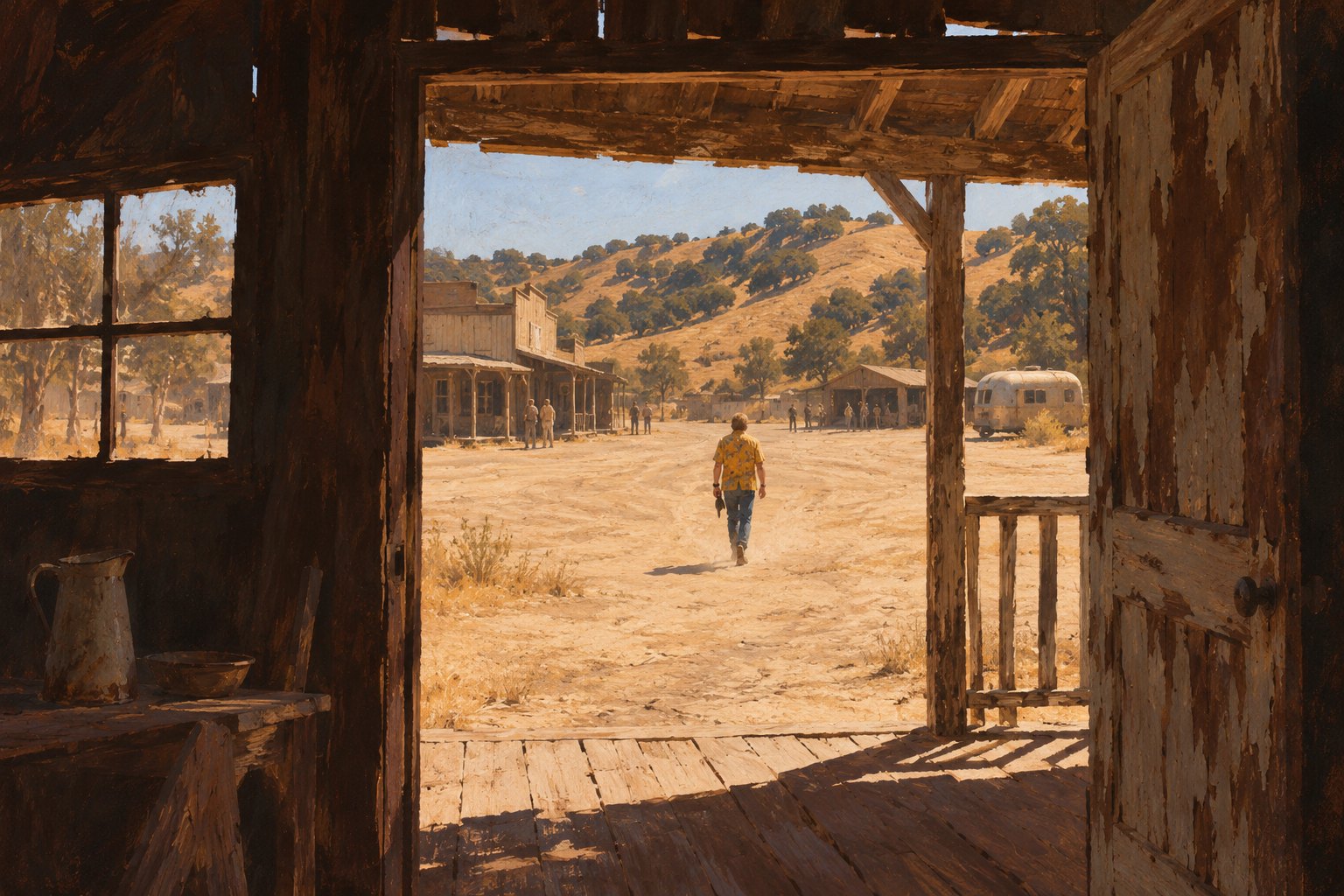
At Spahn Ranch, an ordinary concern becomes an investigation
Cliff’s visit develops around a concrete objective: he wants to check on George Spahn, someone he remembers from working at the ranch. Squeaky resists his intrusion. George, when Cliff reaches him, does not provide the uncomplicated confirmation of danger that the encounter seems to promise.
Cliff explains his purpose directly: “I just want to make sure you’re okay.” Later, asked whether he now believes everything is all right, he answers, “Not exactly.” Those brief lines define the sequence’s movement from concern to unresolved suspicion. The film’s dialogue transcript preserves both exchanges. [Original-film dialogue transcript](https://www.springfieldspringfield.co.uk/movie_script.php?movie=once-upon-a-time-in-hollywood)
From Cliff’s perspective, the task has a practical shape. Reach the person, speak to him, assess the answer. He does not need to solve every mystery surrounding the ranch before deciding that a welfare check is necessary. That limited objective makes him credible: his behavior follows an immediate responsibility rather than an audience’s appetite for revelations.
For viewers, however, each obstacle acquires a larger significance. We wonder why access is being controlled. We scrutinize the people who watch him. The sequence creates tension by making a simple errand feel increasingly difficult to complete.
George refuses the role Cliff expects him to play
The encounter becomes especially interesting when considered from George’s position. Cliff arrives with concern, but concern does not automatically grant someone authority over another person’s life. George has his own irritations, attachments, and priorities. He is not merely a clue waiting to confirm the visitor’s theory.
That resistance prevents the scene from becoming a tidy rescue fantasy. Cliff may have good reason to investigate, yet the person he approaches does not owe him a reassuringly grateful response. The mismatch introduces an awkward human texture into the suspense.
Squeaky also functions as more than a warning sign. Within the confrontation, she controls access and challenges Cliff’s right to demand it. Their exchange becomes a contest over who gets to define the situation. Is he an old colleague checking on someone, an intrusive stranger, or a threat to the household’s control? Each interpretation changes the emotional meaning of the same doorway.
For me, this is the passage’s strongest achievement. It allows the audience to feel alarm without turning every person into a simple instrument of that alarm. Suspense survives the conversation because speaking to George answers one question while leaving the larger atmosphere unsettled.
Competence can reassure us too quickly
Cliff’s ability to take charge makes him satisfying to follow. It also creates a critical trap. When a character acts decisively, viewers can begin treating that decisiveness as proof that his understanding is complete.
The ranch sequence offers a useful distinction between getting access and gaining certainty. Cliff succeeds in reaching George. That success does not mean he has understood every relationship around him. Physical confidence and interpretive accuracy are separate qualities, even when a charismatic performance encourages us to merge them.
This distinction matters to a character-centered film review. Asking whether Cliff can handle trouble produces one kind of story. Asking whether he correctly understands the trouble produces another. The latter leaves room for surprise without requiring the film to pretend that an established, capable character has suddenly become helpless.
It also expands the character beyond his partnership with Rick Dalton. Our examination of what Rick Dalton’s presence means for Cliff explores that relationship. At the ranch, Cliff must make judgments without Rick supplying the immediate social context.
What the Fincher–Tarantino excitement should make us watch for
The names surrounding the new film naturally encourage expectations about style. A more useful viewing question concerns perspective: how much will we know alongside Cliff, and how often will the film let us recognize something he cannot?
This is a criterion for evaluating the film, not a claim about its unseen execution. A camera can make a quiet character feel trustworthy by staying close to his observations. It can make the same character unsettling by showing the reactions he overlooks. Editing can turn a pause into comfort, suspicion, or a joke.
Early enthusiasm cannot tell every reader how those choices will work over an entire feature. What it can do is renew interest in a character whose apparent simplicity supports complicated audience responses. Pitt’s ease is valuable because a filmmaker can place pressure around it.
The deeper tension is our desire to trust him
Cliff’s most interesting effect is the permission he seems to offer viewers: relax, somebody competent is here. The ranch passage tests that permission. We want his composure to settle the atmosphere, but the atmosphere refuses to become fully legible.
That is why “Not exactly” carries such weight. It leaves room between having acted and having understood. The character can complete an immediate task while the audience continues to sit with uncertainty.
The most demanding standard for another Cliff Booth film is therefore emotional as much as technical. Can it make his company pleasurable while keeping our trust active and questioning? The original’s ranch sequence shows how much drama lives in that space. Cliff holds our attention because following him feels reassuring—even when reassurance is precisely what the scene withholds.
Original content by this site's editorial team. Published: November 17, 2026 at 05:19:41 PST (Los Angeles time)