Mockingjay makes a persuasive case for being one movie because Katniss Everdeen’s final transformation belongs to one continuous dramatic movement. She agrees to become the rebellion’s symbol, discovers the human cost of that role, and ultimately turns against the leadership expecting to inherit her loyalty. Dividing that movement gives individual moments room to breathe, but weakens the connection between her early compromises and final refusal.
The Hollywood Reporter has reported producer Nina Jacobson’s reconsideration of the split, describing her view that she and director Francis Lawrence would approach Mockingjay as a single film given another chance. That is a retrospective judgment, not an announcement of a replacement version. The critical question is what a different structure might have done for the story already on screen.
Spoilers follow for both Mockingjay films, including their endings.
Katniss’s real conflict begins behind the camera
The strongest argument for Part 1 is that it allows Katniss to be uncomfortable, exhausted, and politically inconvenient. Jennifer Lawrence makes the distance between the woman and her revolutionary image palpable. Katniss can respond fiercely to suffering, but she cannot reliably manufacture that response on command.
Her unsuccessful attempt to perform a prepared propaganda speech is therefore essential. The rebellion wants something authentic that it can also control. Katniss’s awkwardness exposes the contradiction: the qualities that make her valuable as a symbol also make her difficult to manage.
The visit to District 8 solves the filmmakers’ problem within the story. Faced with actual wounded people and the destruction of their hospital, Katniss no longer needs instructions about what to feel. Her warning, “If we burn, you burn with us,” becomes powerful because its anger has an immediate human cause.
Yet the cameras remain present. Her sincerity does not prevent anyone from using it. In my reading, that is the first film’s sharpest insight: a truthful emotion can become political material without becoming a false emotion. Katniss means every word, while other people decide how those words will circulate.

What the two-film structure gets right
The extra space gives the rebellion a texture beyond military progress. Underground routines, uncomfortable conversations, and broadcasts make political power feel administrative as well as violent. Katniss has escaped the arena, but other people still organize her movements and define her public meaning.
Peeta’s televised appearances make that confinement painfully personal. The person Katniss wants to protect is also an image she must interpret. She watches for evidence of coercion and distress while others assess the political damage of what he says. The difference reveals how little room wartime strategy leaves for individual vulnerability.
This is why simply removing every quiet scene would be a mistake. The same distinction matters in our discussion of vulnerability beneath heroic storytelling: spectacle becomes more meaningful when the person inside it remains visible.
My objection to the split is therefore structural rather than a complaint that too little happens. Several of Part 1’s most valuable scenes would deserve protection in any shorter adaptation. The problem is how much dramatic weight they must carry before the story reaches its decisive moral confrontation.
Peeta’s rescue is a devastating reversal, but an incomplete ending
Peeta’s rescue appears to offer the emotional release Katniss has been seeking. Instead, his conditioning turns their reunion into an attack. The Capitol has reached inside a relationship that previously offered refuge.
As a reversal, it is horrifying. As the climax of a self-contained movie, it leaves the central emotional problem newly opened. Katniss gets Peeta back physically while discovering that their shared history no longer guarantees recognition or safety.
Josh Hutcherson’s performance matters because Peeta’s familiar gentleness cannot simply return on cue. His recovery requires the people around him to distinguish the person from the damage done to him. Ending one film close to that rupture emphasizes the shock; continuing through it would emphasize the difficult work afterward.
Later, “Real or not real?” becomes more than a memorable exchange. It is a practical way to rebuild trust without pretending certainty already exists. Our analysis of memory and love in Eternal Sunshine of the Spotless Mind considers a related question: what can a relationship depend on when memory itself becomes unreliable?
Gale and Coin bring the same moral problem closer
Gale’s importance extends beyond the romantic triangle. His readiness to consider ruthless tactics forces Katniss to confront the difference between sharing an enemy and sharing a moral boundary. The films become most unsettling when someone she loves can explain a terrible idea coherently.
The later bombing that kills Prim makes that distance unbearable. The crucial issue is not a simplistic claim that Gale personally kills her. It is Katniss’s recognition that the logic associated with his weapons planning can place her sister among the expendable.
Coin develops the political version of that problem. Julianne Moore’s controlled performance makes authority appear reasonable, measured, and procedural. Coin rarely needs Snow’s theatrical menace to suggest that people can be reduced to their usefulness.
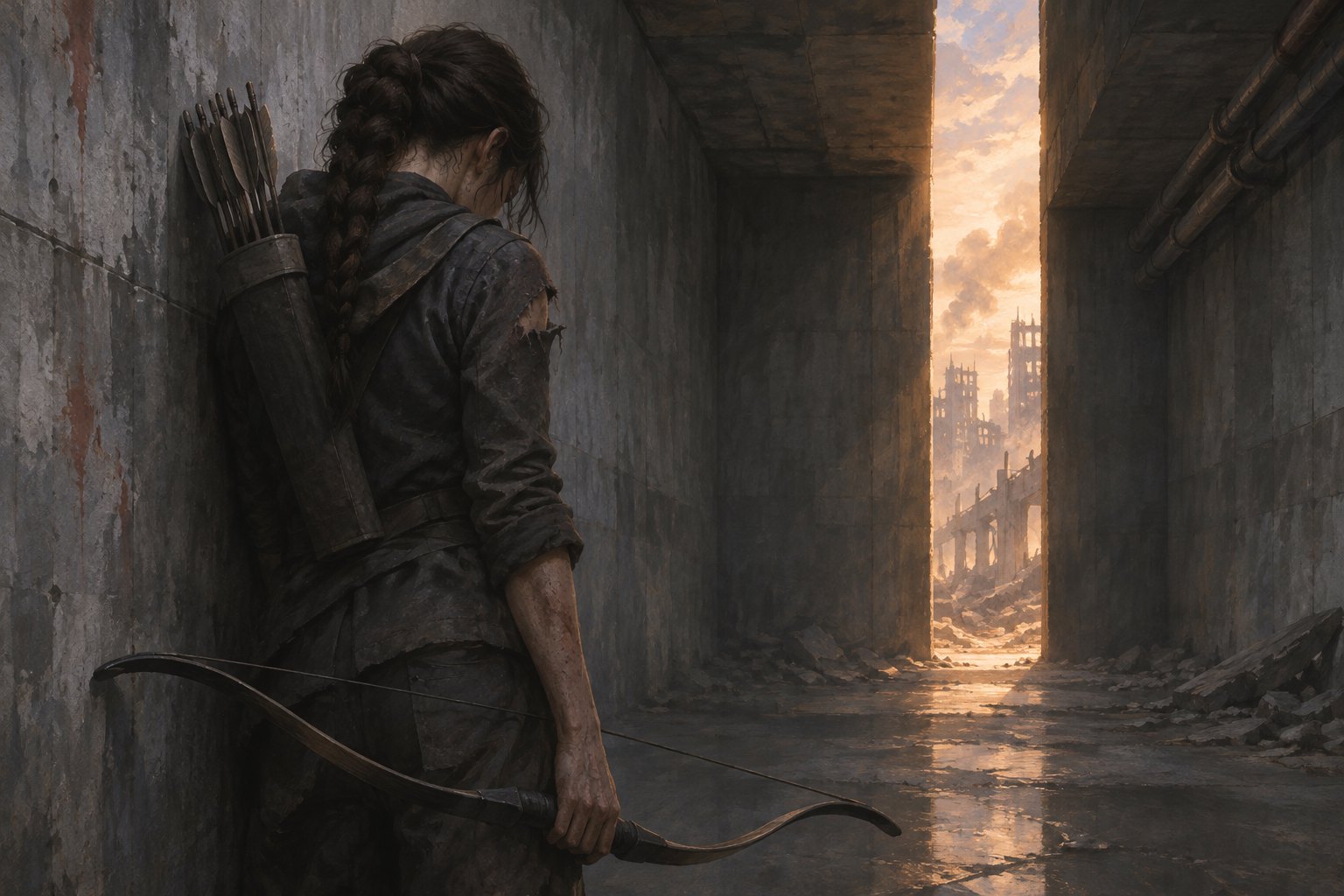
After Snow’s defeat, Coin proposes another Hunger Games using Capitol children. Whatever uncertainty remains around individual wartime claims, this proposal makes her willingness to reproduce the old system explicit. Katniss’s arrow turns toward Coin because removing one ruler has not removed the temptation to govern through punishment.
Placed in a single film, that choice could answer the propaganda scenes with greater immediacy. The woman who struggled to deliver someone else’s scripted message finally performs an action her handlers cannot incorporate into their intended ceremony.
One movie would need a new shape, not just fewer scenes
A stronger single-film adaptation would organize its momentum around Katniss’s changing understanding of the rebellion. Becoming its symbol, confronting Peeta’s conditioning, and recognizing Coin’s ambitions would form successive stages of the same conflict.
My preferred approach would compress repeated briefings and some stages of the Capitol journey before sacrificing the scenes that establish emotional consequences. More action is not automatically more momentum. A sequence earns its place when it changes what Katniss understands, what she wants, or what she is prepared to accept.
There would still be a cost. Less room could flatten supporting characters or make Peeta’s recovery feel convenient. No hypothetical edit proves itself merely by being shorter. But the finished pair repeatedly makes the audience wait for ideas that gain their full force only when brought together.
The ending matters because victory cannot restore Prim
The most important movement after the political climax is Katniss’s return to grief. Her breakdown when she encounters Buttercup gives an ordinary domestic presence more emotional force than another speech could provide. The cat belongs to a life whose central person is missing.
That moment completes the devastating reversal of Katniss’s original purpose: she entered the Games to protect Prim, and surviving the revolution cannot fulfill that promise retroactively. Political victory and personal restoration remain separate things.
Peeta’s eventual question, “You love me. Real or not real?” receives the answer “Real.” Its modest scale is the point. After a story filled with public images and compulsory roles, the ending finds value in an intimate truth that does not need an audience.
For me, Jacobson’s reconsideration identifies a real weakness without erasing the films’ achievements. Mockingjay contains an unusually bitter conclusion to a blockbuster heroine’s journey: Katniss wins her freedom partly by refusing the victory others have scripted for her. One movie might have made that refusal feel less like a final twist and more like the destination of every uneasy compromise that came before it.
Original content by this site's editorial team. Published: November 28, 2026 at 11:18:29 PST (Los Angeles time)