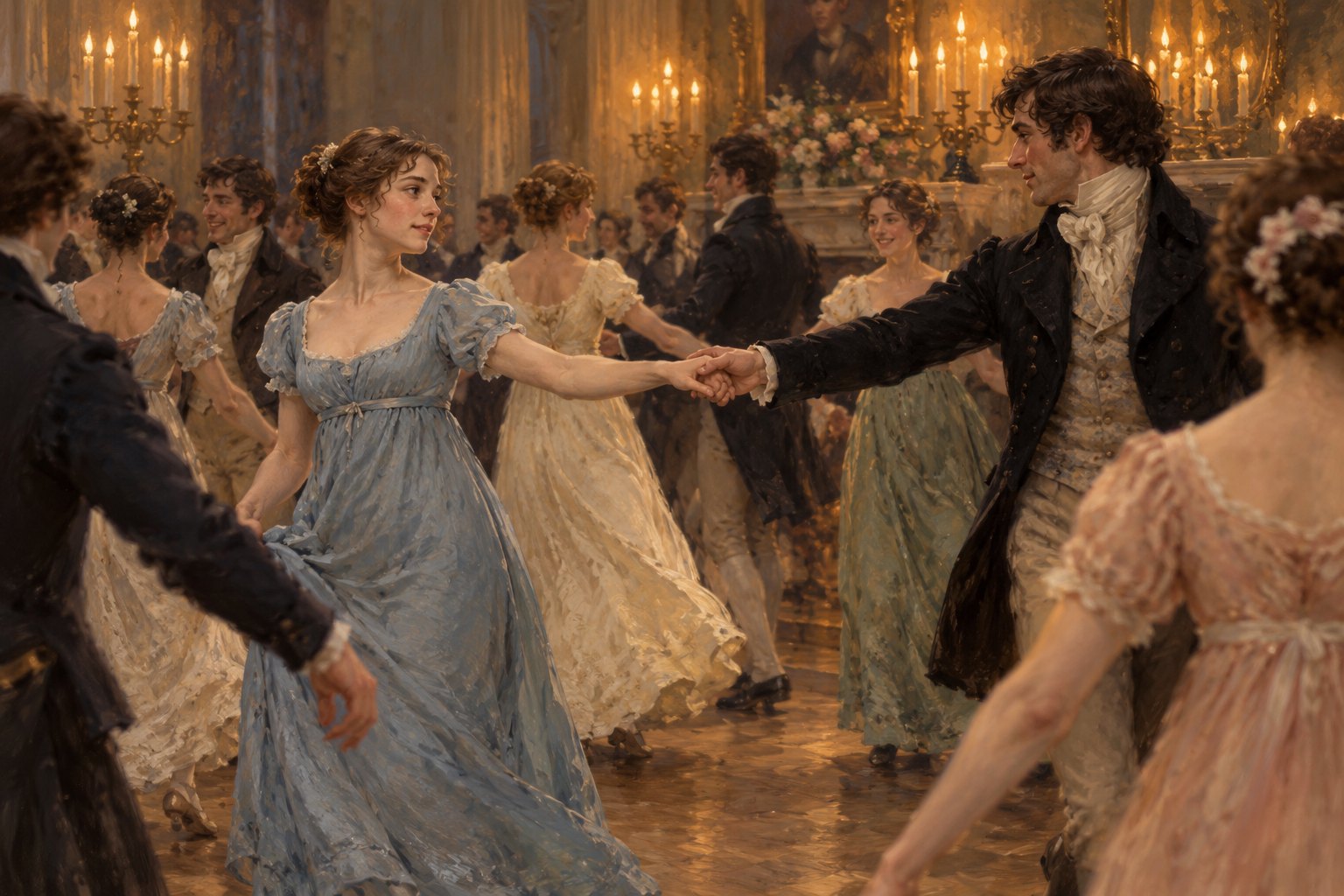
Sense and Sensibility offers an intriguing answer to the question facing any new Jane Austen adaptation: what can another film reveal about people audiences already know? In Georgia Oakley’s version, one useful answer lies in the contrast between dancing and waiting. A dance gives desire somewhere to go. Waiting leaves it circling inside the person who feels it.
That contrast provides a distinct way into the adaptation, directed by Oakley from Diana Reid’s screenplay, with Daisy Edgar-Jones as Elinor Dashwood and Esmé Creed-Miles as Marianne. Beyond the familiar opposition between restraint and emotional abandon, it raises a practical question: how much freedom does either woman actually have to act?
Spoiler notice: This character-focused analysis discusses the film’s romantic circumstances and dance sequences. It draws on reported scenes and the filmmakers’ descriptions of their choices.
A dance floor offers freedom with conditions
Oakley’s film includes a country dance and a larger London ball. In her interview with TheWrap, the director explained that dancing creates an unusual opportunity for men and women to touch and interact with a freedom otherwise restricted by convention. She also described Elinor and Edward’s dance as carrying the sadness of a possible farewell.
Those details make the dancing more than an attractive interruption to the plot. For Elinor, the ritual creates a temporary permission slip. She can participate in an encounter whose outward form is entirely acceptable while its inward meaning remains intensely personal.
The emotional contradiction is compelling. A room full of people can offer a couple a kind of privacy, because everyone recognizes the dance and nobody needs to acknowledge what it means to its participants. The same rules that limit intimacy briefly make it possible.
My reading is that this is where the adaptation’s physical approach becomes especially useful. Elinor’s restraint need not be interpreted as an absence of desire. A person can follow every prescribed movement while wanting something the surrounding society will not readily permit. The dance gives that contradiction a visible shape.
It also changes how we understand romantic suspense. The question becomes less whether two people will recognize their attraction than whether they can carry anything from this exceptional moment back into ordinary life.
Elinor and Edward: attraction cannot settle the future
George MacKay plays Edward Ferrars, the reserved young man toward whom Elinor’s affection develops. Their mutual caution is central to the romantic situation described in published accounts of the film. Yet caution has several possible meanings: consideration, fear, uncertainty, or an attempt to avoid making a promise one cannot keep.
From Elinor’s perspective, that ambiguity is exhausting. Another person’s gentleness may encourage hope without providing reliable information. A meaningful encounter can be emotionally unmistakable and practically inconclusive.
This is why Oakley’s description of their dance as something approaching a farewell matters. It asks us to consider pleasure that already contains an awareness of its limits. Elinor does not need to misunderstand the situation for it to hurt. Understanding can make the experience more painful.
There is a valuable distinction here between self-control and control over circumstances. Elinor possesses the former; it cannot guarantee the latter. Her discipline can govern what she reveals, but it cannot determine what Edward is able to offer.
Our broader review of the Dashwood sisters’ contrasting responses to heartbreak approaches the film through their relationship. Looking specifically at Elinor’s limited opportunities for action reveals another dimension: composure can be a way of enduring uncertainty rather than resolving it.
Marianne wants an experience large enough to trust
Marianne supplies a different response to uncertainty. One line reported from the film makes her position explicit: “If I were to fall, I would rather it be from a great height.” It is an appealing declaration because it refuses the idea that safety should determine the size of a life.
It is also a dangerous principle for judging other people. The intensity of an experience tells Marianne something about her own feelings. It cannot, by itself, tell her whether another person deserves them.
Frank Dillane’s Willoughby and Herbert Nordrum’s Colonel Brandon occupy opposing positions in her romantic world. The contrast invites a question more interesting than which man appears exciting: what kinds of evidence does Marianne recognize as evidence of love?
If emotional force becomes the measure of sincerity, steadiness risks looking inadequate before it has been understood. Conversely, someone who produces an overwhelming feeling may receive trust that has not yet been earned. This is an interpretation of Marianne’s romantic predicament, rather than a claim that passion itself is her mistake.
The phrase “great height” also contains the possibility of a fall that will be difficult to survive. Marianne imagines magnitude as a virtue. The story asks what happens when the consequences become equally large.
Waiting turns absence into an emotional event
Oakley has described the opening image of a woman lying in a field waiting for a letter, with the duration of that wait left uncertain. Her explanation emphasizes the long stretches of time through which the characters must live before news arrives.

The interpretive value of that image lies in its unresolved duration. A beautiful landscape cannot answer a question. Open space does not necessarily give the person inside it greater freedom. Someone can see a long way and still have no useful knowledge of what is coming.
Waiting also gives imagination time to work against its owner. Silence might indicate delay, indifference, difficulty, or betrayal. Until something happens, the waiting person must live among competing explanations.
For Marianne, the temptation is to let feeling supply certainty. For Elinor, the challenge is to tolerate uncertainty without letting it become visible to everyone else. Neither response makes the missing information arrive sooner.
The resulting suspense belongs to ordinary human vulnerability: another person has the power to change your understanding of your life, and you cannot compel them to speak. That makes the arrival of news potentially as dramatic as a confrontation.
The deeper question is who gets to act
Read together, the dancing and waiting suggest a useful interpretation of this Sense and Sensibility. Its romantic world distributes opportunities unevenly. Some circumstances allow expression; others require endurance. The characters’ temperaments matter, but temperament alone does not explain their difficulties.
This also gives a new adaptation a meaningful reason to exist. Familiar story beats can acquire different significance when attention shifts toward the experience of living between them. Our discussion of why familiar characters need more than recognition raises a related adaptation problem: recognition must lead to emotional understanding.
Here, the strongest critical possibility is that freedom can be brief, conditional, and still deeply felt. A dance can matter even when it settles nothing. Restraint can contain enormous longing. Passion can express courage while remaining vulnerable to error.
That is the distinction worth carrying out of this version of Austen’s story. Feeling intensely and choosing freely are different achievements. Elinor and Marianne must negotiate the distance between them—and the time spent crossing that distance is part of the drama.
Original content by this site's editorial team. Published: October 18, 2026 at 05:12:55 PDT (Los Angeles time)