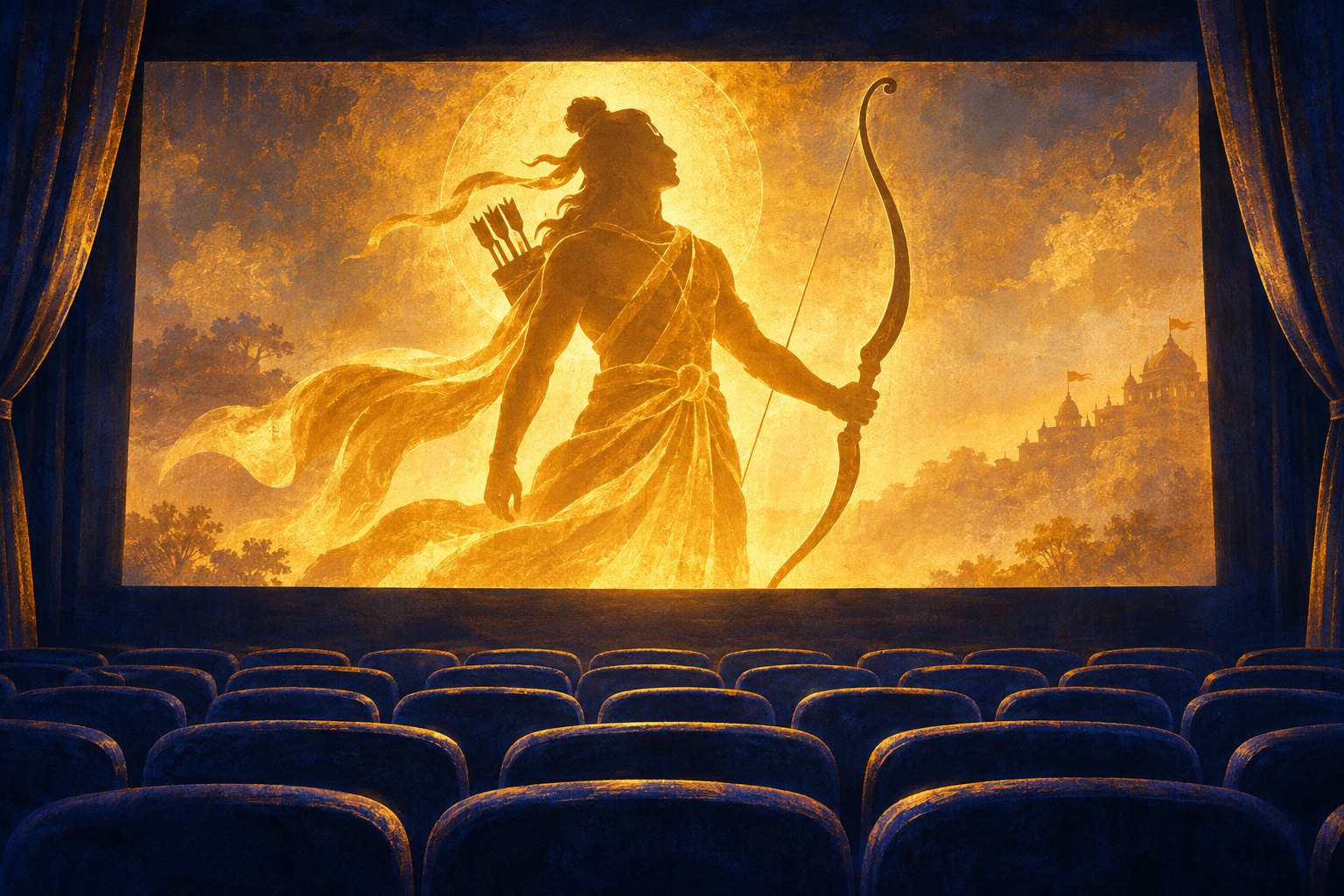
Ramayana brings an unusually demanding question to blockbuster cinema: how do you make a Hindu god a movie star without letting stardom become the whole meaning of the character? The Economist’s description of the project as India’s biggest film puts scale at the center of its public identity. Yet the more interesting critical issue is intimacy—whether an audience can feel close to a sacred figure whom the screen also asks it to admire.
This is a spoiler-free critical essay about that artistic challenge, not a verdict based on a screening. It makes no claims about specific performances, scenes, dialogue, or the ending. Those distinctions matter particularly here: familiarity with a sacred story cannot establish what a particular adaptation actually puts onscreen.
What changes when divinity meets stardom?
A movie star’s entrance organizes attention. Framing, lighting, music, and the reactions of other characters can tell viewers that a person matters before that person has done anything. Sacred imagery can also organize attention around an exceptional presence. Bringing these visual languages together creates an obvious cinematic opportunity, but their apparent compatibility deserves scrutiny.
Celebrity encourages us to watch an individual. Religious devotion can connect an individual image to obligations, beliefs, and a world beyond the visible figure. A film can draw on both kinds of attention, although neither guarantees the other. An impressive image may create excitement without communicating the values that give its subject significance.
For Ramayana, the useful question is therefore what the star image helps viewers understand. Does it direct attention toward responsibility, restraint, or relationships? Or could admiration become an end in itself? These are questions about adaptation and dramatic emphasis, not assumptions about what this film succeeds or fails to do.
Reading Rama through responsibility
A character-centered approach begins with the difference between possessing authority and exercising it. A figure may command respect within a story, but the audience still needs to understand what that authority requires. Drama emerges when an obligation becomes specific: someone must listen, decide, act, or accept a consequence.
Applied to Rama, that approach would look beyond the grandeur of his presentation to the legibility of his commitments. What does a scene allow the viewer to understand about his attention to others? How does a decision register with the people affected by it? The important evidence would be in the film’s actual choices, including gestures and silences as much as speeches.
A divine protagonist need not be rewritten as an ordinary, insecure contemporary hero to sustain interest. Nor must reverence eliminate emotional movement. Certainty about a principle can coexist with the difficulty of fulfilling it. My critical preference is for filmmaking that makes the weight of an action perceptible, even when the character’s moral standing is never in doubt.
That is also why a recognizable performer cannot carry every part of the characterization. As our discussion of star presence and character perspective in Connector considers, casting can invite attention before there is enough evidence to judge what the finished movie does with it.
The people around an icon need an inner life
One revealing way to assess a central character is to examine how much independent existence the film grants everyone nearby. Supporting characters can function as witnesses to greatness, but if witnessing becomes their only purpose, the dramatic world grows narrow. Their admiration tells us how to respond while giving us fewer relationships to interpret.
A richer approach allows other figures to bring their own priorities into a scene. Agreement then has meaning because it follows understanding. Loyalty becomes more affecting when the audience can perceive the person choosing it. Disagreement, where the adaptation includes it, can clarify the stakes without automatically becoming a rejection of the central figure’s significance.
For viewers, the practical test is simple: after a conversation ends, can you describe what each participant wanted? If only the central figure’s purpose is clear, the scene may have established hierarchy more effectively than relationship. That can be an intentional formal choice, but it produces a different emotional experience from shared dramatic space.

Scale matters when it changes our understanding
The description of Ramayana as India’s biggest film invites expectations of magnitude. It should not, by itself, be treated as a verified budget figure, a box-office result, or a measure of artistic achievement. For criticism, the productive issue is what scale allows a filmmaker to express.
A vast environment can make a responsibility feel overwhelming. Distance between figures can reveal separation. A close view after an expansive composition can shift attention from public importance to private experience. These are possibilities of cinematic form, rather than descriptions of particular shots in Ramayana.
My standard for spectacle is whether it changes the meaning of what we are watching. If an image gives us a clearer sense of a character’s situation, its size serves the drama. If it repeatedly announces importance without developing that understanding, grandeur risks becoming monotonous. The distinction depends on context, not on whether an image is elaborate.
The same attention to context informs our essay on how a final image can shape character interpretation in La Bola Negra. Production ambition becomes critically interesting when it has consequences for the story viewers experience.
Reverence and critical attention can coexist
A film about a Hindu god will encounter viewers with different relationships to its subject. Some may approach through devotion, some through cultural familiarity, and others through curiosity about the movie itself. No single response can stand in for all those experiences.
Criticism should be precise about what it evaluates. A judgment about pacing concerns how a film organizes time. A judgment about characterization concerns what the adaptation makes available to the viewer. Neither needs to become a verdict on religious belief. Equally, a critic should not assume that a devotional response is merely a failure to notice cinematic technique.
The strongest conversation about Ramayana would allow both formal analysis and personal significance to remain visible. It would ask how the film produces its effects while recognizing that an image can mean more to a viewer than its immediate narrative function.
The deeper question is what admiration asks of us
Turning a god into a screen star can make sacred storytelling newly immediate: a face, a voice, and a gesture offer concrete points of attention. It can also concentrate that attention so strongly on presence that the meaning of conduct becomes harder to see. That tension is the most compelling interpretive question raised by Ramayana’s blockbuster identity.
For me, the most rewarding outcome would be a film in which admiration leads toward understanding—where viewers leave thinking about the responsibilities embodied by the central figure as well as the force of his image. A memorable entrance can establish greatness in seconds. Making that greatness emotionally and ethically intelligible is the more demanding work of cinema.
Original content by this site's editorial team. Published: November 12, 2026 at 18:42:26 PST (Los Angeles time)