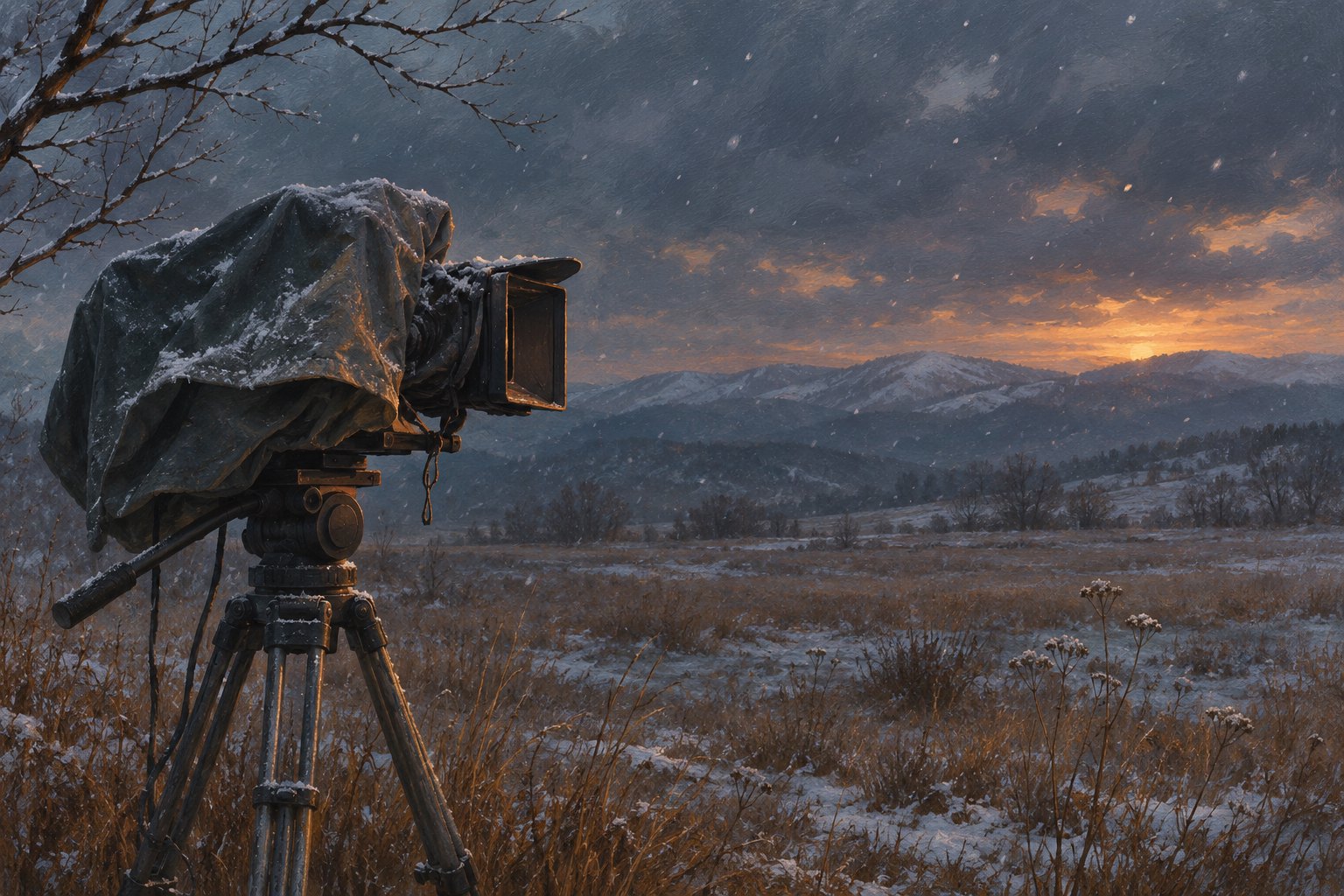
La Bola Negra faced a particularly cinematic obstacle on its way toward Cannes: the filmmakers needed snow, and the deadline would not wait. According to Variety’s reporting, the pressure to finish the film collided with a weather-dependent ending that almost could not be shot. The immediate appeal of that story is obvious—a production racing against conditions beyond its control—but its more interesting implication concerns the ending itself. What makes a particular image important enough to keep waiting for?
That question deserves attention without turning a production anecdote into an automatic endorsement. A difficult shoot does not guarantee a powerful scene. Still, the reported predicament offers a useful way to think about how movies arrive at their final moments, and why the physical setting of an ending can matter as much as the events it depicts.
This is spoiler-free production commentary, not a review of the completed film. The discussion below distinguishes the reported scheduling problem from broader critical interpretation; it does not reconstruct the ending or attribute unverified dialogue to its characters.
What the snow delay actually tells us
The essential reported facts are limited but consequential: La Bola Negra was being finished with Cannes in view, and waiting for snow nearly prevented the ending from being filmed. That establishes a conflict between a production timetable and a condition needed for the planned sequence. It does not establish how long the filmmakers waited, which alternatives they considered, or precisely how the eventual images were achieved.
Those distinctions matter because behind-the-scenes stories often acquire extra details as they circulate. It would be easy to imagine an exhausted crew, an emergency location change, or a last-minute technical rescue. Without confirmation, those remain imagined scenes. The genuine tension here requires no embellishment: the team’s ability to capture its intended conclusion was uncertain while time was running out.
Nor does a Cannes deadline, by itself, explain the artistic quality of the result. Festival context can help us understand the pressure surrounding a film, but criticism still has to return to the screen. Our discussion of how to look beyond a film’s festival pedigree explores that same distinction between the circumstances of presentation and the experience of watching.
Why an ending’s environment can be essential
A screenplay can describe a character’s final action in a few sentences. Onscreen, that action also has a temperature, a texture, a distance from the camera, and a relationship to the surrounding space. An embrace in a crowded room does not register like an embrace in an empty landscape. The event may be identical; its emotional proportions change.
Snow offers filmmakers a particularly forceful visual tool. It can reduce the number of colors in a frame, make a figure more conspicuous, or erase distinctions between familiar surfaces. Footprints can give movement a visible history. Falling flakes can make the air itself seem active. These are possibilities of the medium, not claims about what happens in La Bola Negra.
The reported wait therefore raises a reasonable critical possibility: the desired conditions may have been integral to the sequence’s expressive design. That is an inference, not confirmation of the filmmakers’ motives. We cannot conclude that snow symbolizes innocence, grief, oblivion, or renewal in this particular film simply because those associations are available.
In fact, assigning a meaning too early can flatten the experience. A landscape becomes dramatically specific through the person encountering it. The useful question is what the weather allows us to perceive about that person—vulnerability, distance, determination, exposure—that a different environment might communicate differently.
Start with the characters when judging the final image
A character-centered reading of any ending begins before the concluding scene. What has the person wanted? What have they misunderstood? Which choices have narrowed or expanded their possibilities? A striking final setting becomes meaningful when it changes our understanding of those questions.
For La Bola Negra, the production story directs attention toward a practical viewing test: does the conclusion draw its emotional force from the journeys that precede it? An image can be beautiful in isolation and still feel detached from the people whose story it closes. Conversely, a restrained image can become devastating because earlier scenes have taught us how to read it.
Three questions can help keep that judgment grounded:
- Does the final setting reveal something about a character that earlier dialogue or actions have prepared us to recognize?
- Does the sequence leave room for performance, or does its visual scale overwhelm the human encounter?
- Would a change in the environment alter the emotional meaning, rather than merely the appearance, of the scene?
These questions do not presume the answers. They offer a way to evaluate the artistic stakes behind the reported delay without pretending that the delay itself proves those stakes were fulfilled.
The deadline continues beyond the shoot
Capturing an ending and finishing a film are different milestones. In filmmaking generally, footage still has to find its place through editing, sound work, color decisions, and technical delivery. A late scene can affect the rhythm of the passage before it: a pause may need more space, an earlier image may gain importance, or a transition may need to carry a different emotional weight.
That does not establish which pressures affected La Bola Negra after its weather problem. It explains why the reported combination of an unfinished ending and a Cannes target is consequential. The challenge is potentially larger than obtaining one attractive shot. A conclusion must belong to the film around it.
There is also a distinction between preserving an intention and refusing a useful adaptation. Waiting can protect an essential artistic choice. Changing the plan can sometimes produce a better one. Without a verified account of the alternatives, it would be unfair to praise or criticize the filmmakers’ decision-making in those terms. The eventual sequence has to provide the evidence.
How the production story can influence a review
Knowing that a scene was difficult to obtain can make an audience watch it more generously. We start admiring persistence before deciding whether the moment moves us. That response is understandable, but it can blur two different achievements: accomplishing a demanding piece of work and making that work dramatically effective.
The distinction also applies to a film’s final moments more broadly. As our commentary on giving a character’s ending attention beyond production circumstances considers, the story surrounding completion can become so prominent that it overshadows the story being completed.
My critical preference is to make two assessments. First, consider what the scene communicates without its production history: the performances, the pacing, the relationship between bodies and space. Then consider what the production history adds. That order allows knowledge of the work to deepen appreciation while preserving an independent judgment of the result.
The deeper question behind waiting for snow
The most compelling interpretation of this production dilemma concerns the distance between artistic intention and material reality. Films create worlds, but they are made within one. A festival calendar can demand completion; a landscape cannot be instructed to cooperate on the same schedule.
For viewers, the value of the La Bola Negra story is the attention it brings to an easily overlooked fact: an ending is made from physical choices as well as narrative ones. Light, weather, duration, and space help determine how we understand the people onscreen. The strongest reason to care about the snow is ultimately whether it helps those people’s stories reach an emotionally persuasive conclusion. That judgment belongs to the finished film.
Original content by this site's editorial team. Published: November 12, 2026 at 15:43:59 PST (Los Angeles time)