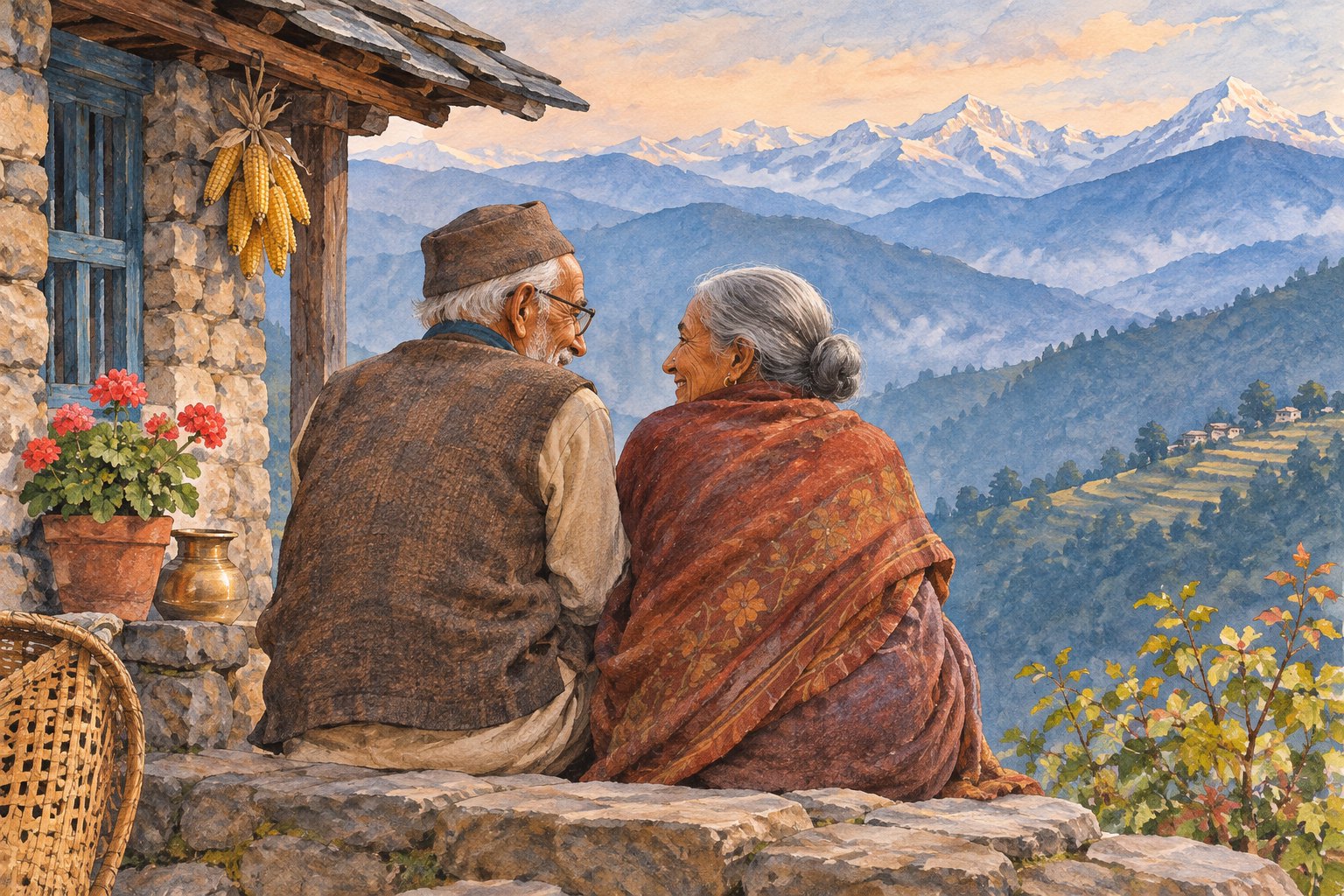
Pyre makes an elderly couple’s love the center of a story about what happens when a community disappears around them. Director Vinod Kapri’s Indian drama has attracted renewed attention following 18 reported awards and an emotional reception among cinema audiences, according to BBC reporting. Its most compelling question, however, is painfully intimate: when two people have become each other’s remaining support, how can either prepare the other for being alone?
Padam Singh and Tulsi live in the Kumaon Himalayas, holding on to their marriage and the possibility of their son’s return. Their circumstances give the title its terrible weight. A funeral pyre becomes something they must think about while they are still living, still arguing, and still hoping.
Spoiler note: This character-focused analysis discusses the story’s reported premise, the arriving letter, and the funeral-pyre preparations. It leaves the ending undisclosed and draws on published reporting and Kapri’s interviews. The accompanying artwork consists of conceptual illustrations.
A marriage that still has room for disagreement
It would be easy to turn Padam and Tulsi into a reassuring image of lifelong devotion. Their bickering complicates that picture in a useful way. Affection does not erase irritation, and familiarity does not require constant gentleness. A person can be indispensable and exasperating at the same time.
That distinction matters when considering the characters. Their arguments give them identities beyond the sympathetic category of abandoned parents. They remain two people sharing space, habits, and expectations. Reading every disagreement as evidence of a failing relationship would miss how ordinary friction can coexist with profound dependence.
In his interview with Silhouette, Kapri describes the couple’s daily disagreements as part of the rhythm he wanted to preserve. My reading is that this approach protects the marriage from becoming an illustration of virtue. The emotional question concerns how these particular people continue living together under pressure, with neither required to become faultlessly patient.
For Padam, companionship carries the prospect of responsibility that may outlast his strength. For Tulsi, the same relationship contains the possibility of a future she might have to face alone. Their fears overlap without becoming identical. Keeping both perspectives in view gives the love story its moral complexity.
Waiting turns the future into a daily obligation
BBC reporting describes a marriage of 65 years and a 28-year wait for their son, Hariya, who left for work in Mumbai. A letter announcing his intended visit changes the shape of that waiting. Hope acquires a date.
That is a small event with considerable dramatic force. An indefinite absence can become part of a household’s routines. An expected arrival asks the household to imagine itself differently. Suddenly, there is a reason to measure the days against something other than survival.
From the parents’ perspective, the letter also carries a burden. Believing in a return means accepting renewed vulnerability. The longer a promise has been deferred, the more difficult it becomes to distinguish endurance from the fear of admitting that life may never change.
It would be too simple to treat their hope as foolish. Waiting can preserve a relationship across distance, even when that relationship has become painfully unequal. The sharper question is what happens when hope becomes the only available plan for receiving help. Affection may sustain the couple emotionally; it cannot guarantee another person’s presence.
The mountains mean something different to those who must stay
One line quoted in BBC coverage distills the tension between scenic beauty and everyday possibility: “There’s nothing here – just mountains.” The statement is striking because the landscape may offer a viewer so much to admire.
For someone seeking work, beauty does not necessarily provide a future. For an older resident, the same terrain may contain a lifetime of belonging while making practical assistance harder to reach. These perspectives can be true simultaneously. Leaving need not mean indifference, and staying need not mean contentment.
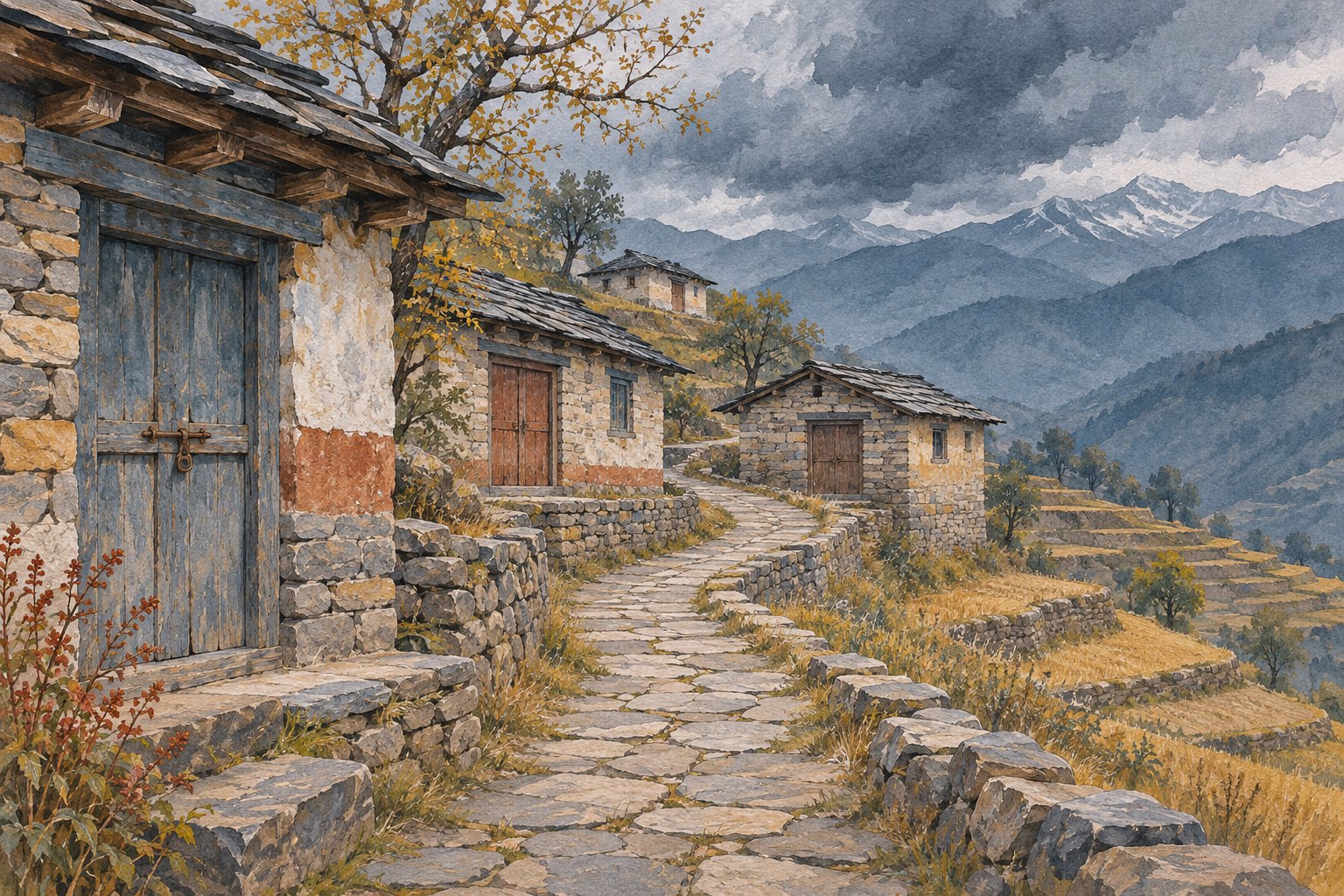
Kapri told Silhouette that he and cinematographer Manas Bhattacharya wanted the mountains to participate in the storytelling. He described a restrained approach that sometimes lets characters move through an uninterrupted shot. That intention offers a useful way to understand the film’s relationship to space: distance has consequences for bodies, labor, and access to other people.
My interpretation is that the setting makes loneliness materially visible. An empty village means fewer people available to notice an illness, answer a call, or share an urgent task. The issue extends beyond the sadness of missing familiar faces.
This is also why cultural specificity matters. As our discussion of how cinema connects cultures through particular lives argues, recognition becomes richer when viewers attend to the circumstances that shape an emotion. Padam and Tulsi’s loneliness belongs to a place, a household, and a changing community.
Why the funeral pyres are an act of care
The title becomes concrete when Padam prepares two funeral pyres outside the house. BBC reporting connects this decision to the villagers’ departures and a warning about the absence of “four people to carry your body.” The practical language is what makes the warning so disturbing.
Death ordinarily activates obligations among the living. Here, Padam must anticipate a moment when the people needed to fulfill those obligations may be gone. Preparation becomes a response to the disappearance of communal support.
Read through his perspective, building the pyres can express an attempt to remain useful. He cannot control who leaves, when his son returns, or which spouse survives the other. He can undertake a task. That limited capacity for action gives the gesture its tragic dignity.
From Tulsi’s perspective, however, preparation cannot resolve the central fear. Arranging what happens after death does not answer how a survivor will live. The two pyres bring the couple together symbolically while exposing the possibility that one person must endure the separation.
This is where I find the story’s strongest idea: care includes thinking about burdens that the person you love may eventually carry without you. Such foresight can be tender and frightening in the same instant.
What the awards can—and cannot—tell viewers
The reported 18 awards explain some of the attention surrounding Pyre. They do not establish that every viewer will respond identically, or that emotional audience reactions amount to verified commercial success. The useful distinction is between recognition, reception, and revenue.
Kapri’s account of the film emphasizes everyday duration and the experience of waiting. Readers drawn to intimate dramas about aging, family separation, and difficult obligations have a clear reason to investigate it. Those subjects also warrant patience: reducing the couple to an inspirational lesson would flatten the tensions that make their situation compelling.
Our essay on watching closely without reducing people to symbols develops a related principle. Sympathy becomes more useful when it makes us attentive to individual choices and constraints.
The deeper question: who helps love endure?
The most persuasive interpretation of Pyre is that lifelong devotion carries practical responsibilities as well as emotional meaning. Padam and Tulsi can remain attached to each other while needing a wider circle of support. Their marriage cannot replace an entire community.
That makes the film’s central situation more unsettling than a simple celebration of growing old together. Love gives the couple reasons to persist, but persistence still requires people, assistance, and shared obligations. The question that remains is whether those around them will recognize that need while there is still time to respond.
Original content by this site's editorial team. Published: November 6, 2026 at 19:43:42 PST (Los Angeles time)