Liv Zander’s The Heartstring Duet is getting a film treatment at Sony Pictures, according to Deadline. For readers looking for news of a screen adaptation, that is the central development: the book series has a reported connection to a major film studio. It also introduces a creative question that matters beyond the announcement itself. What will the adaptation preserve about the experience of reading Zander’s work, and how will it make that experience accessible to someone encountering the story for the first time?
Those questions belong to adaptation analysis, rather than a verdict on a finished movie. The reported news does not provide a basis here for evaluating performances, describing screen scenes, or quoting dialogue. This is a spoiler-free look at what the project would need to accomplish, with prospective creative judgments kept separate from established information.
What the Sony news establishes—and what remains open
The essential reported facts are straightforward: the property is The Heartstring Duet, its author is Liv Zander, and Sony Pictures is the studio named in connection with its film treatment. That gives readers a meaningful starting point without settling the shape of the eventual adaptation.
A film treatment announcement should not be read as a release calendar. A theatrical opening date, a filming schedule, a cast, and a completed screenplay are distinct pieces of information requiring their own confirmation. Likewise, the series title does not establish whether the screen version would be one movie or multiple installments. There is no reason to turn that uncertainty into a prediction.
For prospective viewers, the most useful next details would be the intended format and the creative team’s approach. Those would begin to explain whether this project is being conceived around a complete dramatic arc, a continuing story, or some other structure. Until then, expectations should remain attached to the reported adaptation news rather than an imagined production.
The first adaptation decision is where the story ends
With a book series moving toward film, structure deserves attention before casting speculation takes over. A screen story needs to establish its conflicts, develop them, and deliver an ending that feels earned within the time available. The relevant question for The Heartstring Duet is how its literary structure would translate into that experience.
If material is compressed, the danger is losing the intermediate decisions that make a later development believable. A movie can retain major events while weakening the connections between them. Viewers then understand what happened but struggle to understand why a character chose it. That is a problem of dramatic causality, not simply a complaint that a favorite passage disappeared.
If the material is divided across films, each installment would still need a purposeful stopping point. An unresolved situation can be compelling when something significant has changed. It becomes frustrating when the ending feels like an interruption. My preference would be for an adaptation whose first complete viewing offers an emotional payoff, whatever possibilities remain afterward.
Character perspective must become something we can see
Prose can give readers direct access to a character’s interpretation of events. Film has to decide how much of that access to preserve through dialogue or narration, and how much to translate into performance, framing, and editing. For a Zander adaptation, the precise solution would depend on the books and screenplay; no particular narrative technique should be assumed from the announcement.
The practical challenge is to distinguish intention from behavior. A character may understand an action one way while another person experiences it differently. Cinema can hold those competing interpretations in the same scene: an actor’s hesitation, a reaction held a moment longer, or a change in physical distance can complicate the words being spoken.
Our discussion of perspective in the planned Medusa movie considers a related adaptation issue: deciding whose experience organizes a story changes what the audience notices. Here, too, choosing a point of view would be a substantive creative decision, not merely a matter of camera placement.
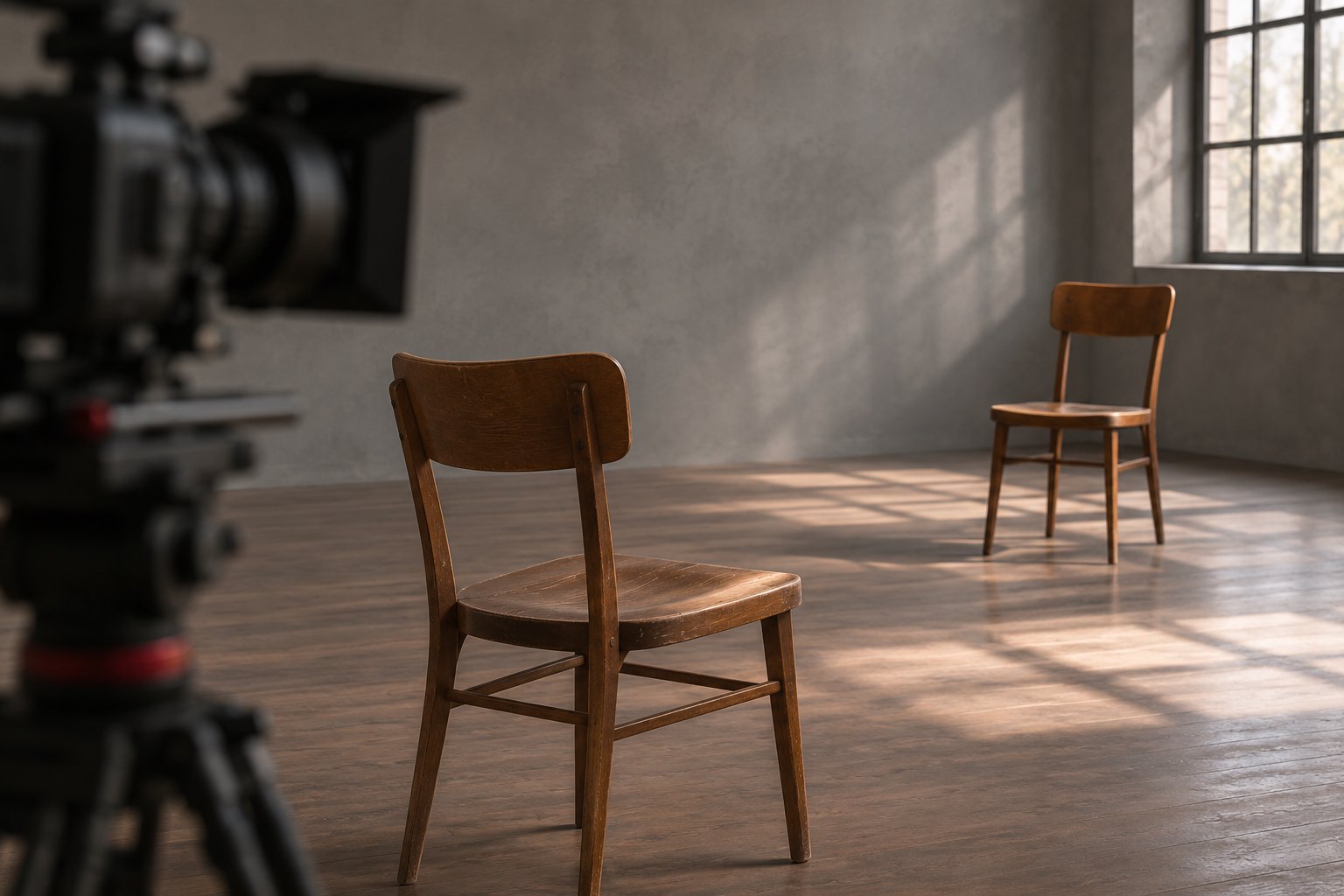
This conceptual rehearsal image illustrates that translation into physical space; it is not a production still. Even an arrangement of chairs suggests distance and orientation. With performers present, blocking could make those relationships legible before a line is delivered. The goal would be to let audiences perceive a character’s position without explaining every thought aloud.
Faithfulness is more than retaining recognizable dialogue
Memorable lines can become a flash point when books reach the screen. Readers may hear a familiar sentence and immediately recognize the story they value. But a quotation carries more than its wording: its force depends on who says it, what precedes it, and what the listener understands at that moment.
No dialogue is quoted here because there is no verified screenplay or finished-film dialogue to assess. The useful critical standard is whether any retained line performs the same dramatic work in its new context. Moving a sentence earlier, giving it to someone else, or changing the surrounding reaction can alter its meaning even when every word remains intact.
Conversely, an adaptation might express a literary passage effectively without speaking it. A choice followed by a consequence can communicate something that a paragraph explains internally. The test should be whether the screen version preserves the relevant motive, uncertainty, or emotional shift. Literal reproduction is one possible method, not a guarantee of fidelity.
New viewers need the reasons behind the turning points
The film would have to address two audiences at once: readers bringing prior knowledge and viewers bringing none. Existing readers can sometimes supply motivation from memory. A newcomer cannot be expected to fill those gaps, and a successful adaptation should make its central choices understandable within the film itself.
That does not require exhaustive exposition. It requires establishing enough context for a decision to carry weight. Before a major turn, viewers should have some sense of what a character wants, what alternatives exist, and what the choice might cost. Without those foundations, an intense scene can feel dramatically unearned.
This connects with our analysis of personal stakes in I Play Rocky: an outcome gains force when the audience understands what pursuing it means to the people involved. For The Heartstring Duet, the eventual film would need to establish those stakes through its own scenes, rather than relying on recognition of the title.
What would make this adaptation worth watching?
My measure of success would be a film that gives its characters room to make consequential choices and gives viewers enough evidence to interpret them. Visual atmosphere, recognizable passages, and strong casting could all contribute. Their value would depend on how they serve the dramatic progression.
The deeper promise of adapting The Heartstring Duet lies in interpretation. A screen version would make decisions about emphasis, duration, perspective, and silence that reading leaves partly to the individual. Those decisions could reveal something compelling about the material, provided they emerge from a careful understanding of it.
For now, Sony’s reported involvement makes this a project to follow. The meaningful critical verdict must wait for the work itself. What matters next is whether the adaptation develops a clear dramatic identity: a story readers can recognize and new viewers can experience fully, with its emotional meaning earned on screen.
Original content by this site's editorial team. Published: November 6, 2026 at 17:17:49 PST (Los Angeles time)