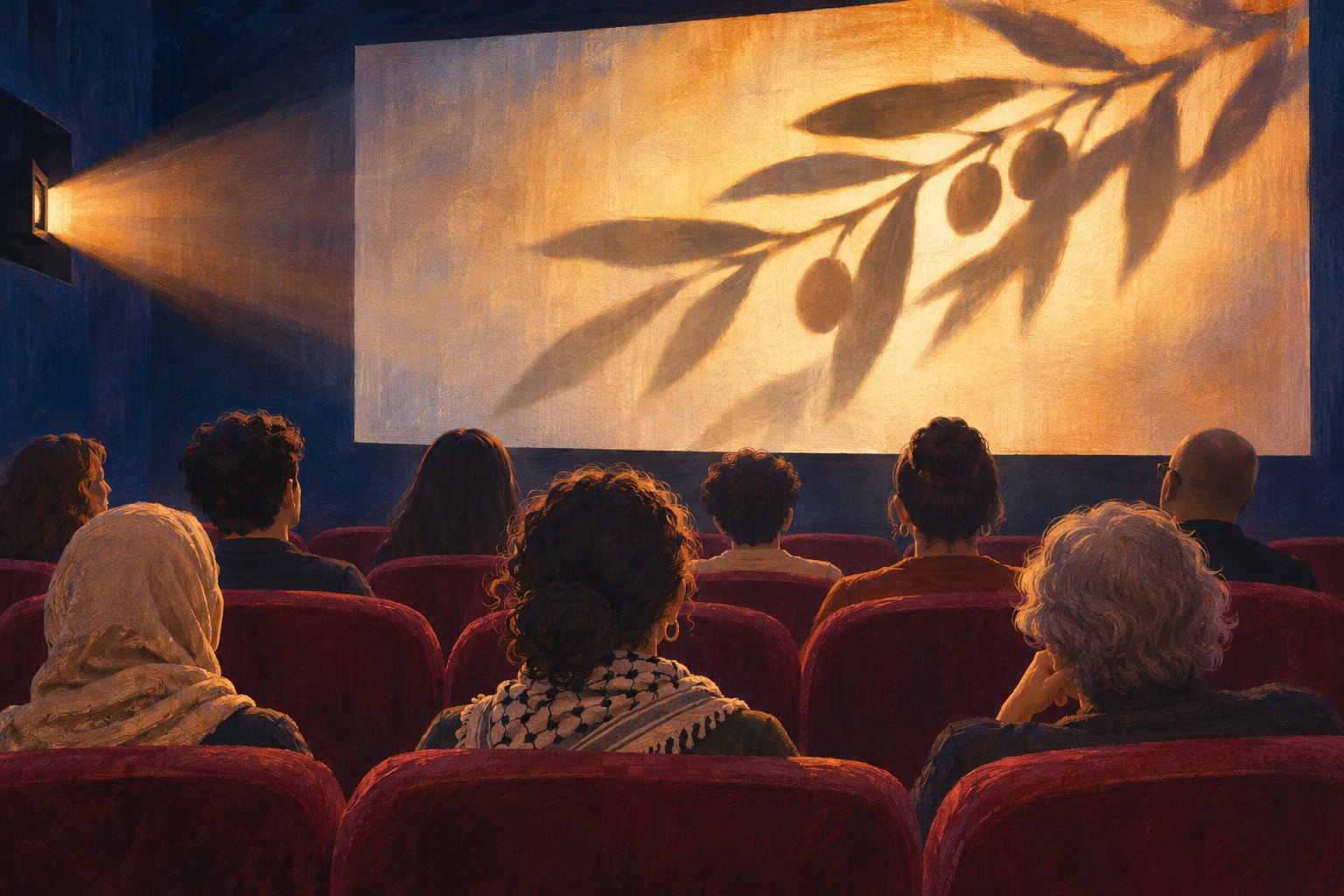
Witness Palestine Film Festival is marking its fifteenth year, according to Rochester Beacon. For moviegoers, that milestone offers an occasion to consider what sustained attention to Palestinian cinema can make possible: encounters with individual lives, distinctive artistic decisions, and stories that deserve more time than a passing headline allows.
An anniversary establishes longevity; it does not automatically establish the quality of a program or its individual films. The most useful critical response is to take both the subject and the filmmaking seriously. A movie can address an urgent injustice and still invite questions about structure, perspective, performance, and evidence. Those questions are part of respectful engagement.
This is spoiler-free festival commentary, rather than a review of a particular selection. It makes no claims about this edition’s individual films, screening arrangements, or guest appearances.
Fifteen Years, and the Value of Returning
A recurring festival has a possibility that a single screening cannot fully offer: audiences can return, reconsider, and discover differences between filmmakers. My view is that this is the most meaningful way to understand the anniversary. The value of continued exhibition lies partly in creating room for more than one encounter with a place and its people.
That distinction matters when approaching Palestinian stories. No fictional protagonist, documentary participant, or director should have to represent an entire population. A festival audience can recognize a shared historical concern while remaining attentive to differences in generation, temperament, geography, and artistic approach. Agreement about a subject’s importance need not produce identical judgments about every film.
The fifteenth-year milestone therefore invites a demanding expectation: let the work remain particular. A film’s significance should emerge through what its images and sounds actually reveal. An anniversary can bring viewers into the room; the films still deserve to be evaluated on their own terms.
Begin With the Person Inside the Frame
For character-centered viewing, start with a straightforward question: what does this person want at this moment? Then ask what limits their choices and what they understand that the audience does not. These questions help connect a film’s larger circumstances to its immediate dramatic experience.
In fiction, look for the relationship between an action and its cost. A decision becomes dramatically revealing when we understand the alternatives available to the character. If a film withholds those alternatives, consider whether that restriction places us inside the character’s uncertainty or merely prevents us from assessing the scene.
In nonfiction, the person on screen has a life beyond the edited account. Hesitation, contradiction, humor, and changes of mind deserve attention. A participant’s refusal to explain something can also be meaningful, although viewers should resist claiming to know the private reason behind that refusal.
My critical preference is for films that give people room to exceed their immediate narrative function. Someone introduced as a witness, parent, or neighbor should be allowed an individuality that complicates the label. This is also central to our discussion of participant agency and trust in documentary filmmaking: access to a person is only the beginning of responsible representation.
Notice How a Film Directs Your Attention
Subject matter can dominate the conversation after a politically engaged film. Yet form determines how we encounter that subject. A close-up, an extended silence, a voice-over, or a sudden cut each gives the viewer a different position in relation to the person being filmed.
Pay particular attention to duration. When a shot continues after its immediate information has registered, what becomes visible? Perhaps a gesture changes the emotional meaning; perhaps the continued observation becomes intrusive. Neither interpretation follows automatically from the length of the shot. The surrounding sequence matters.
Sound deserves the same scrutiny. Music can deepen a scene, but it can also narrow the emotional response available to us. Ask what you heard before the score entered and whether the added music clarifies a relationship or supplies a feeling the images have not earned.
These are accessible questions, not specialist hurdles. They help explain why two films about related experiences can feel radically different. Our commentary on the relationship between photography, film, and video similarly considers how framing and presentation shape the attention an image receives.
Archival Images Need Their Context
If a film uses archival material, pause mentally over the transition between past and present. What identifies the older footage? Who recorded it, when was it made, and how does the current film explain its relationship to the story? An emotionally persuasive connection between two images is not necessarily a demonstrated historical connection.

Family photographs raise a related question of scale. A portrait can preserve a relationship, an occasion, or a carefully chosen appearance. Its meaning grows through context, including what someone remembers about it. Viewers should distinguish what the photograph visibly contains from what narration tells them and what they themselves infer.
This distinction does not diminish memory. It allows memory to retain its human qualities, including uncertainty. A film that acknowledges an unidentified face or a disputed recollection may give the audience a more substantial encounter with the past than one that turns every image into a perfectly resolved explanation.
Carry Better Questions Into the Discussion
For audiences approaching Witness Palestine Film Festival through its anniversary coverage, a useful post-screening conversation can begin with concrete observations. Start with a moment you can describe before moving toward a general judgment about the film.
- Whose experience organized the story? Identify who received time to speak, act, or remain silent.
- What changed your understanding? Name a specific image, exchange, or edit and explain its effect.
- What kind of claim did the film make? Separate personal recollection, documented information, and artistic interpretation.
- Where did uncertainty remain? Consider whether an unresolved question strengthened the work or exposed a gap.
- What belongs to your response? Distinguish what moved or frustrated you from what the film establishes.
The same care applies to memorable dialogue. Before repeating a line, verify its wording and preserve the context around it. Who speaks, who listens, and what happens afterward can matter as much as the sentence itself. A quotation should illuminate a person’s situation rather than turn that person into a convenient slogan.
The Deeper Meaning of Witnessing
My interpretation of this anniversary centers on the word witness. In cinema, witnessing involves more than receiving an image. It asks the viewer to consider how that image reached the screen, whose experience it conveys, and what remains outside its boundaries.
There is an ethical challenge here for criticism, too. Emotional intensity should not exempt a film from careful evaluation, and formal analysis should not become a way of evading the lives depicted. The strongest response holds those responsibilities together: attention to people and attention to the choices through which we encounter them.
As Witness Palestine Film Festival marks fifteen years, that is a worthwhile standard for its audience to carry forward. Watch closely enough to remember a person’s particularity. Discuss precisely enough to distinguish observation from assumption. Let the encounter continue beyond the screening without pretending that one film has made another life completely knowable.
Original content by this site's editorial team. Published: November 6, 2026 at 14:17:09 PST (Los Angeles time)