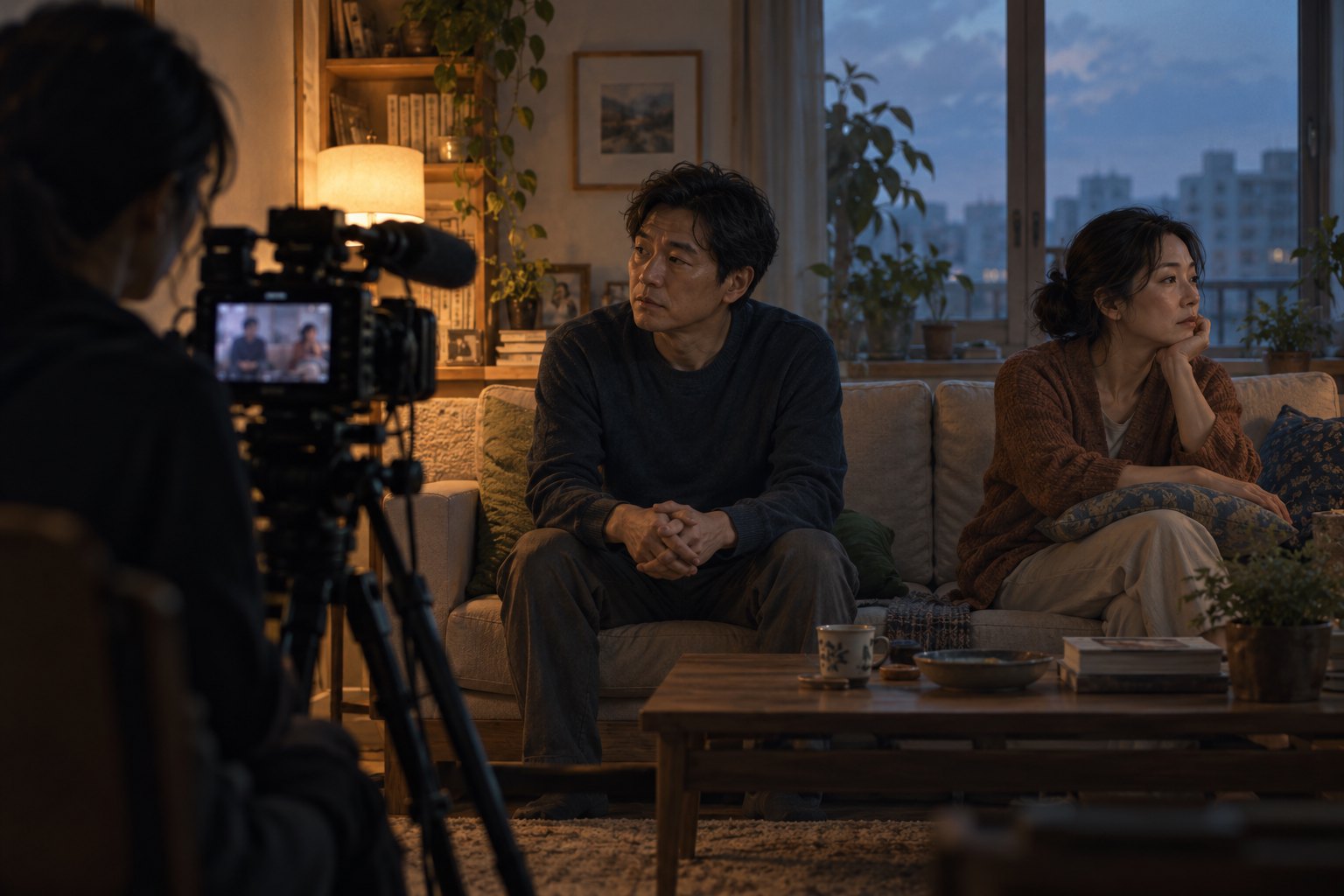
Possible Love is the Lee Chang-dong film behind the intriguing premise of a couple allowing a filmmaker into their lives, only to discover that observation can become involvement. Its central encounter brings a household strained by unemployment into contact with a wealthy documentary director and her husband. The question is immediately personal: what happens when someone offers to understand your marriage while also needing something from it?
Netflix’s official synopsis identifies the four central characters: Mi-ok, played by Jeon Do-yeon; her laid-off husband Ho-seok, played by Sul Kyung-gu; documentary filmmaker Ye-ji, played by Cho Yeo-jeong; and Ye-ji’s husband Sang-woo, played by Zo In-sung. A funeral brings their lives together, and Mi-ok’s willingness to participate in the documentary develops into a complicated attachment to the other couple. [Official film synopsis](https://media.netflix.com/en/only-on-netflix/82106490)
Spoilers follow, including discussion of the ending. This is a character-focused critical reading of documented scenes and Lee’s account of the film, rather than a firsthand assessment of its performances or visual execution.
Mi-ok wants more than an audience for her hardship
Mi-ok provides the most revealing entry into this story because being filmed does not mean only being exposed. It can also mean being invited to speak. Keith Harris’s account describes her becoming animated before Ye-ji’s camera, displaying humor and an awareness of the distance between their lives.
Her remark about the affluent couple’s home captures that mixture: “This is like a house from a novel I haven’t read.” The line, quoted in Harris’s review, makes unfamiliar luxury briefly manageable through wit. Mi-ok can recognize that she is outside this world without surrendering the ability to describe it. [Keith Harris’s review](https://racketmn.com/my-favorite-new-movie-is-about-a-couple-who-invite-a-filmmaker-into-their-home-then-things-get-complicated-no-not-that-movie)
My reading is that her humor complicates any simple account of victimhood. Admiration, embarrassment, curiosity, and self-respect can occupy the same sentence. A person may want access to another life while remaining sharply aware of its condescension.
That distinction also matters in our reading of companionship and judgment in Wicker: wanting a different kind of happiness does not make a woman incapable of understanding her circumstances.
Ho-seok’s resistance makes consent the first conflict
Peter Travers describes an early confrontation in which Ye-ji records a disagreement between Ho-seok and Mi-ok without permission. Ho-seok’s unemployment and drinking already place pressure on their relationship; the camera introduces another person’s claim on that distress. [Peter Travers’s account of the opening](https://www.thetraverstake.com/possible-love/)
Consider the encounter from Ho-seok’s position. A private failure of composure becomes potentially useful material for a stranger. His anger may be difficult for his family, but the filmmaker’s interest does not automatically make her intervention legitimate. Several obligations coexist: responsibility toward a spouse, care for someone in distress, and respect for the person being recorded.
This is where the premise becomes more substantial than a story about an intrusive guest. The filmmaker can see an illuminating moment precisely where the subject experiences humiliation. The same footage might support a worthy public argument and still represent a personal violation. Understanding one side does not settle the other.
Ye-ji’s good intentions cannot answer every objection
“I’m trying to love these people—I’m a documentary filmmaker.” Travers quotes Ye-ji’s declaration, a revealing connection between affection and professional identity. Does filmmaking demonstrate her care, or does calling it care help authorize the filmmaking?
Lee’s interview with Netflix makes clear that this contradiction belongs near the film’s center. He credits co-writer Oh Jung-mi with introducing the documentarian into the story, allowing his concern about labor to intersect with his own responsibilities as a filmmaker. He also describes Ye-ji’s attachment to her subjects as genuine while acknowledging her ambition. [Lee Chang-dong’s interview](https://www.netflix.com/tudum/articles/lee-chang-dong-directs-possible-love-interview)
That combination is more interesting than a simple portrait of hypocrisy. Sincerity can survive alongside self-interest. Ye-ji may believe in the relationship and still benefit from its unequal terms. The important test is what happens when another person’s needs interrupt the story she hopes to tell.
For viewers, this offers a useful question to carry through the film: who gets to decide when an encounter has ended? A camera operator can stop recording. A subject cannot necessarily stop the consequences of having been recorded.
Sang-woo and the unequal comfort of hospitality
The official synopsis describes Mi-ok’s attraction to Sang-woo as uneasy, placing desire inside the collision between the couples’ circumstances. That uncertainty matters. Attraction need not be reducible to money, yet money changes the setting in which attraction becomes possible.
Hospitality can make inequality temporarily feel like intimacy. Guests share a table, a view, and an afternoon with their hosts, but participation does not create ownership or lasting security. A generous invitation may be sincerely offered while leaving the host’s authority intact.
This is the interpretive lens I find most useful for Sang-woo: notice the difference between being welcoming and accepting another person as an equal. Charm concerns how an interaction feels. Equality concerns what each person can refuse, request, or risk. A relationship can possess the first while remaining uncertain about the second.

The home remains more than a filming location
Mi-ok and Ho-seok also have a young son, Cheol. His presence prevents the marriage from becoming merely a contest among four adults. Whatever the grown-ups believe they are pursuing, they inhabit a family life with consequences beyond their own explanations.
A house is especially charged territory for this kind of story. It contains habits that have never needed an audience: where someone sits, when conversation stops, what a partner notices without asking. Filming those habits changes their status. Familiar behavior becomes evidence, available for interpretation by people who do not have to live with it.
Our analysis of domestic space in Poltergeist examines a very different intrusion, but the connection is useful: a home’s emotional meaning depends on who can enter it and what the residents can still control.
The ending makes possibility a modest promise
Yonhap’s account describes Mi-ok and Ho-seok returning home and, eventually, sharing soju in the moonlight, recalling their courtship. The conclusion brings attention back to the couple’s capacity to inhabit an ordinary moment together. [Yonhap’s discussion of the ending](https://en.yna.co.kr/view/AEN20260922005700315)
I read that return as a limited opening rather than proof that everything has been repaired. Tenderness cannot erase unemployment, resentment, or the effects of unequal power. It can, however, allow two people to encounter each other without immediately demanding a performance, explanation, or useful story.
The title becomes meaningful on that smaller scale. Possible love need not promise rescue or perfect understanding. It may begin with recognizing that another person exceeds every account we make of them—including the compassionate account. For a film about a camera entering a marriage, that is a demanding final idea: intimacy requires attention, but attention alone does not grant possession.
Original content by this site's editorial team. Published: October 30, 2026 at 00:30:00 PDT (Los Angeles time)