Oye, We’re From Here Too brings a question of belonging into familiar American surroundings: what does it mean to call a place home when other people still perceive you as an outsider? Co-directed by Middle Tennessee State University geography professor Jim Chaney and Guadalajara-based filmmaker Arturo Garibay, the approximately 15-minute documentary focuses on Latinos born or raised from early childhood in the United States, particularly around Nashville. MTSU News reports that it received the Nashville Area Hispanic Chamber of Commerce Best Hispanic Film Award at the Nashville Film Festival. [MTSU News reporting](https://mtsunews.com/2026/11/09/mtsu-professors-award-winning-film-takes-latino-stories-beyond-borders/)
That premise deserves attention beyond the award. It places Latino identity inside the everyday life of the contemporary South, asking audiences to consider belonging from the perspective of people whose roots are already there. This is a spoiler-free critical introduction to the film’s documented approach, rather than a screening-based verdict; specific scenes, dialogue, and the effectiveness of the finished edit cannot be assessed here.
A collective portrait with people at its center
The filmmakers’ project description presents a documentary assembled around personal anecdotes and reflections. Chaney’s director statement identifies its focus as 1.5-generation Latinos, who immigrated as children, and second-generation Latinos, whose parents immigrated. It connects the project to interviews, focus groups, and participant observation concerning identity and belonging. [Filmmakers’ project description](https://filmfreeway.com/OYEWEREFROMHERETOO)
For a character-centered reading, that collective structure matters. A conventional narrative often asks us to follow one protagonist toward a decisive choice. A documentary built around multiple perspectives invites a different kind of attention: we listen for the places where experiences overlap, but also for the moments when one person complicates another person’s understanding.
The distinction is especially important here. Being born in a country and arriving there as a child are related circumstances, but they are not identical biographies. Neither category tells us everything about someone’s family, language, friendships, or private ambitions. The useful viewing question is whether individual voices remain distinguishable within the larger portrait.
My critical standard would be specificity. A collective account becomes persuasive when its people can disagree, hesitate, or describe the same place differently. Agreement alone can communicate a position; differences can reveal lives.
The title makes belonging a starting point
The most immediately available expression of the film’s perspective is its title. Oye, We’re From Here Too begins with an appeal for attention and follows it with a statement of presence. Read as language, it does not describe a future ambition to belong. It asserts an existing connection.
The small word too carries particular weight. It suggests inclusion without demanding that somebody else surrender their own attachment to home. Yet it also implies an audience that needs reminding. There is an imbalance built into that exchange: some people can treat their local identity as obvious, while others must explain it.
This is an interpretation of the title, not a quotation from an unverified scene. Its force lies in the way it changes the question. Instead of asking how newcomers might eventually fit into a community, it asks who gets recognized as part of a community they already inhabit.
That shift gives viewers a useful way to approach the people behind the documentary’s accounts. Their experiences need not become applications for approval. They can be understood as descriptions of home, offered by people with their own authority to describe it.
What listening requires from a documentary
Translating research into cinema creates an artistic responsibility. Interviews contain context, detours, and contradictions. A short film must select. Every selection helps establish which experiences seem central and which relationships the audience will notice.
Research can give a production depth, but depth of research and expressive filmmaking are separate achievements. The critical question is how the film turns accumulated knowledge into an encounter with particular perspectives. Does a reflection have enough room to develop? Can uncertainty remain unresolved? Does the larger argument emerge from the voices, or seem imposed upon them?

These are questions to bring to a screening, not claims about techniques observed in the finished film. They also help distinguish respectful representation from simple agreement with a subject. A documentary can share its participants’ concerns while still allowing their personalities and conflicting feelings to exceed its central argument.
Our discussion of how festival conversations can deepen a viewing offers a related approach: start with what a film actually presents, then examine how another viewer understood it. For this documentary, that would mean discussing particular voices before making broad statements about Latino identity.
Why Nashville changes the frame
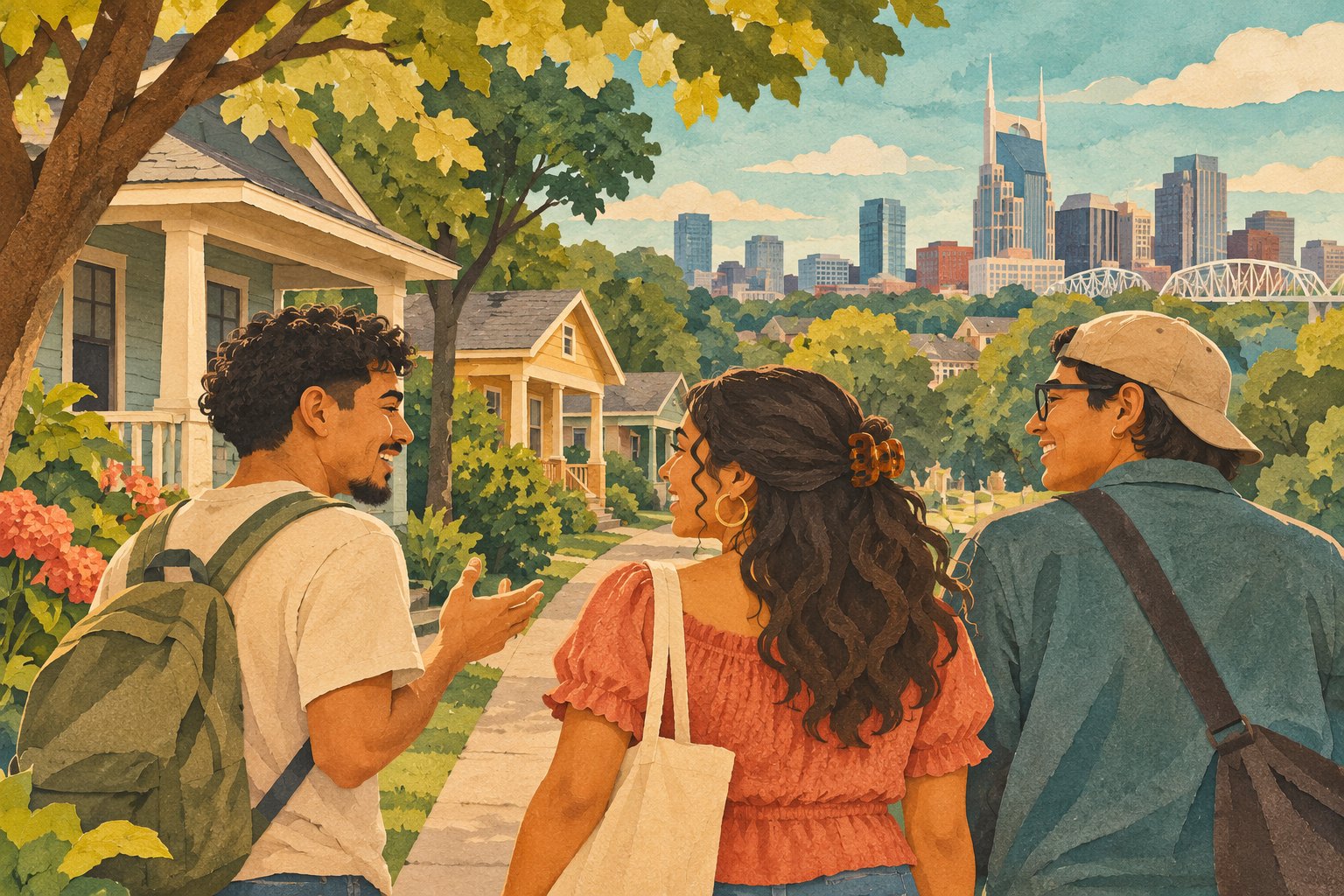
The Nashville-area focus is more than a location label. In interpreting this premise, place should be understood as something people experience through habits and relationships. A hometown can mean the route to school, the friends who recognize you, or the ordinary places that hold family memories. Those examples describe the idea of belonging; they are not a list of scenes in the film.
From that perspective, cultural inheritance and local attachment need not cancel each other out. Someone can feel connected to a parent’s background while also considering a Tennessee neighborhood unquestionably home. A useful film analysis should leave room for those attachments to coexist without insisting that every person resolve them in the same way.
The danger for an audience is to interpret every difference as evidence of permanent displacement. A person’s uncertainty in one setting does not automatically make their entire life an identity crisis. Watching carefully means attending to confidence, familiarity, and pleasure as seriously as exclusion or conflict.
What the award establishes—and what remains to judge
The Nashville Film Festival’s official winners announcement independently confirms the film’s Best Hispanic Film Award. That is a concrete recognition, rather than a generic promotional description. [Festival award announcement](https://nashvillefilmfestival.org/2026-festival-award-winners-announcement/)
An award gives viewers a reason to investigate a film. It cannot tell them whether a particular transition feels rushed, whether an image changes their understanding of a voice, or whether the conclusion earns its emotional weight. Those judgments require the work itself.
The short format makes those questions especially interesting. Fifteen minutes can concentrate attention, but it also demands selection. The appropriate measure is not whether the film encompasses every Latino experience. It is whether the experiences it chooses become clear and memorable without being presented as universal.
For viewers approaching an unfamiliar short, our guide to discovering films through curiosity about their characters provides a useful habit: begin with the people and their concerns, then consider how the filmmaking shapes your response.
A deeper reading: being seen as already at home
The most compelling possibility in Oye, We’re From Here Too is a change in the audience’s position. Its title invites viewers to stop imagining belonging solely as something granted from outside. Home can also be a lived relationship that exists before an observer chooses to acknowledge it.
That interpretation gives the project a meaningful critical frame without awarding it achievements that have not been assessed. The question to carry into a screening is precise: do these individual perspectives change who we imagine when we picture Nashville? If they do, the recognition that matters most may occur in an audience’s understanding of a familiar place.
Original content by this site's editorial team. Published: November 9, 2026 at 10:57:44 PST (Los Angeles time)