Oregon Ducks football and the Michigan Wolverines are the subjects of Addicted To Quack’s 2026 Duck Tape film review. Here, film review means examining football footage: how players move, what the camera reveals, and whether an explanation accounts for the action. Readers looking for a theatrical release, fictional characters, or a movie ending should approach this as sports analysis.
The useful question is how to watch that analysis critically. A replay can reveal an important detail while still leaving the larger explanation uncertain. This companion offers a method for examining Oregon–Michigan footage; it does not assign player grades, reconstruct unverified plays, or present a verdict on the review’s individual conclusions.
Start With the Situation, Then Follow the Ball
Before deciding whether an Oregon or Michigan player made a good choice, establish the problem the offense faced. Down, distance, field position, and the clock give a play its purpose. A short completion can accomplish exactly what an offense needs in one situation and leave it in trouble in another. The distance gained is evidence, but it is not the entire evaluation.
Begin each replay before the snap. Notice where the receivers stand, how closely defenders align, and whether anyone moves. Then watch once at normal speed. That first uninterrupted viewing preserves something slow motion can erase: how little time the players have to recognize a change and respond.
My preferred approach is to describe the visible action before naming its cause. A defender reaching the quarterback is observable. A particular blocker missing an assignment is a more demanding claim. Keeping those statements separate makes the eventual explanation stronger.
The Quarterback’s Perspective: Timing Before Blame
A quarterback attracts attention because the ball makes his decisions visible. Other players’ decisions shape which choices remain available. When examining either side of the Oregon–Michigan matchup, follow the relationship between the quarterback’s drop, the protection, and the receivers’ movement.
Pause near the moment the quarterback begins his throwing motion. Is a receiver creating space then, or does that opening appear later? Is the quarterback able to step into the throw? Does the camera show the relevant defenders? An apparently open receiver in a later freeze-frame does not establish that the same opportunity existed when the decision had to be made.
There is also a limit to interpreting posture. A head turn may suggest where a quarterback is looking, but it does not reveal his complete thought process. Footage supports observations about movement and timing more readily than claims about confidence, fear, or intention. Treat those psychological explanations cautiously unless a player’s own account supports them.
Watch the Players Who Never Touch the Ball
For a second viewing, choose someone outside the immediate action. Follow a blocker through the entire play, or watch a receiver whose route takes him away from the eventual pass. This changes the apparent center of the scene. What first looked like an individual achievement may depend on several less conspicuous actions.
On running plays, watch how the available space changes. Does an opening exist immediately, develop after contact, or close before the runner arrives? On passing plays, examine whether the pocket remains usable long enough for the developing routes. Avoid reducing every protection question to whether a sack occurred.
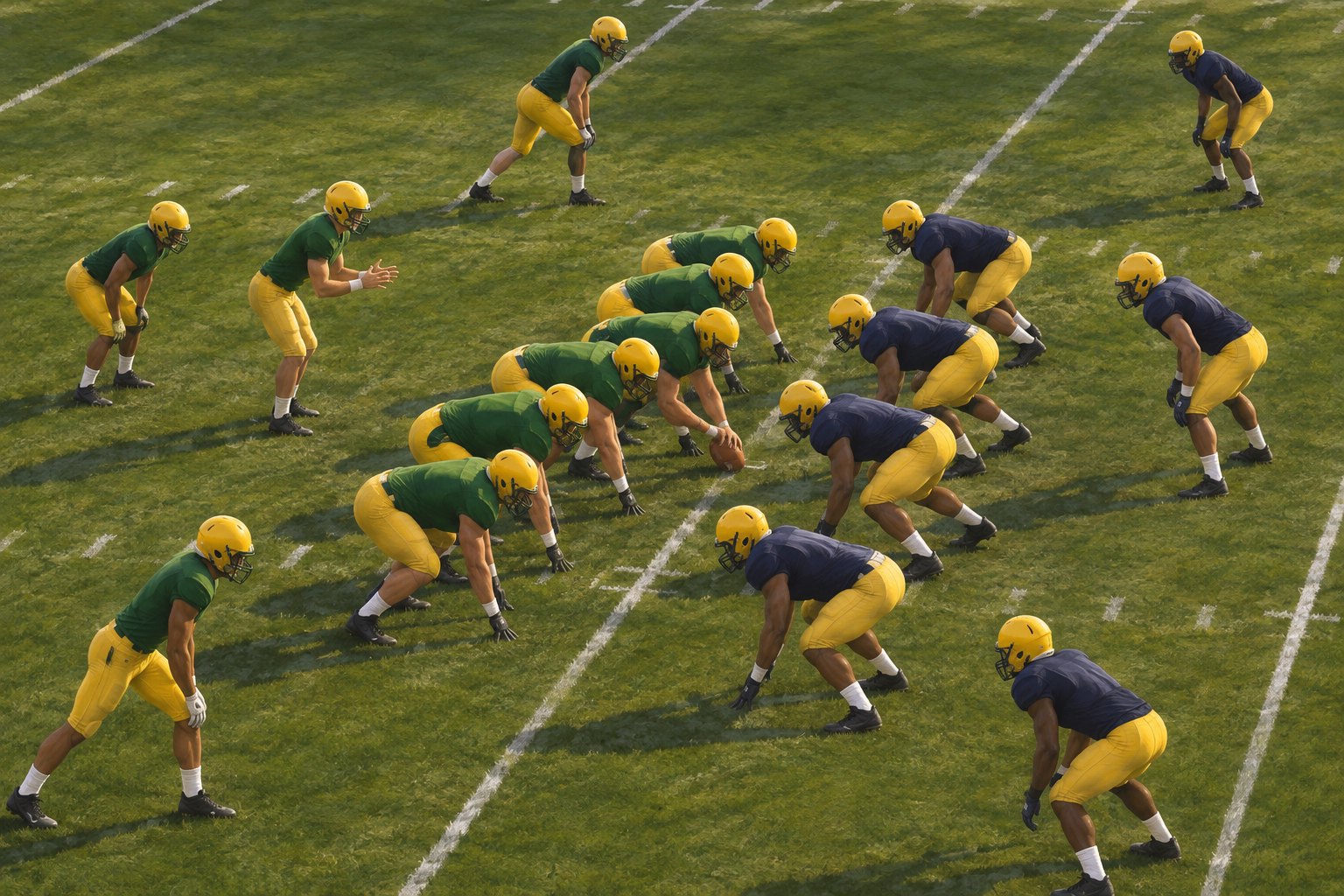
The illustration represents the spatial questions involved, rather than a documented Oregon–Michigan play. In actual footage, the challenge is to trace those relationships through motion. A player can influence a defender without touching the ball, making a tackle, or appearing in the final close-up.
That attention to supporting action has a useful parallel in character-focused movie criticism. Our analysis of Peter Banning’s family relationships in Hook approaches the central figure through his connections to others. Football demands a different kind of evidence, but watching beyond the most prominent person remains a productive habit.
Give Michigan and Oregon the Same Explanatory Standard
A team-centered viewing can make the opposition seem like scenery. Resist that temptation. Whenever a replay highlights an Oregon success, look for Michigan’s response. Whenever Michigan gains an advantage, examine the problem Oregon’s players had to solve.
Consider a defender approaching a ball carrier. His path may reflect the need to protect one direction while another defender covers a different space. Without knowing the assignment, a viewer should hesitate before labeling an indirect approach indecisive. Equally, uncertainty about assignments should not prevent clear descriptions of missed contact or lost position when the footage shows them.
The goal is balanced explanation, not equal praise. A persuasive account can be sharply critical while remaining precise about what supports its judgment. Describing both teams as active participants also helps identify whether an outcome reflects a repeatable advantage or a single execution error.
Replay Selection Shapes the Argument
Every selected clip directs attention. A close view can clarify contact at the line while hiding receivers farther downfield. A wider view can reveal spacing while making small movements harder to distinguish. Neither perspective is complete.
This is where football viewing and screen criticism genuinely meet: framing affects interpretation. Our discussion of visibility and perspective in You Can See Everything explores a related critical concern. Having access to an image does not automatically settle what that image means.
When a breakdown proposes a pattern, ask how many relevant examples support it and whether contrasting examples receive attention. One striking failure can explain a play. It cannot, by itself, establish how an offense or defense performed throughout a game. Repetition matters most when the situations being compared are genuinely similar.
A Practical Oregon–Michigan Rewatch
- Record the situation. Note the down, distance, and field position when they are visible.
- Watch at normal speed. Preserve the timing before using pauses to inspect details.
- Choose one player away from the ball. Follow that player from alignment through the end of the action.
- Write the observation first. Separate what visibly happened from the assignment or intention you infer.
- Test the explanation. Look for another comparable snap and consider what would contradict your first interpretation.
This process makes disagreement useful. Instead of arguing that a player simply looked good or bad, readers can identify the exact moment where their interpretations diverge. Sometimes another angle resolves the question. Sometimes the honest conclusion remains provisional.
The Deeper Value of Football Film Study
The most rewarding way to approach Oregon–Michigan Duck Tape is as an exercise in revising first impressions. Live viewing naturally follows the ball and the emotional swing of each result. Careful review can return attention to the preparation, positioning, and collective work that made that result possible.
My standard for worthwhile analysis is whether it leaves the viewer better equipped to watch the next play independently. The strongest explanation shows its evidence, recognizes the camera’s limits, and makes room for uncertainty. For this matchup, that means seeing Ducks and Wolverines as players solving changing problems together—and making each judgment only as confidently as the footage allows.
Original content by this site's editorial team. Published: November 23, 2026 at 01:51:18 PST (Los Angeles time)