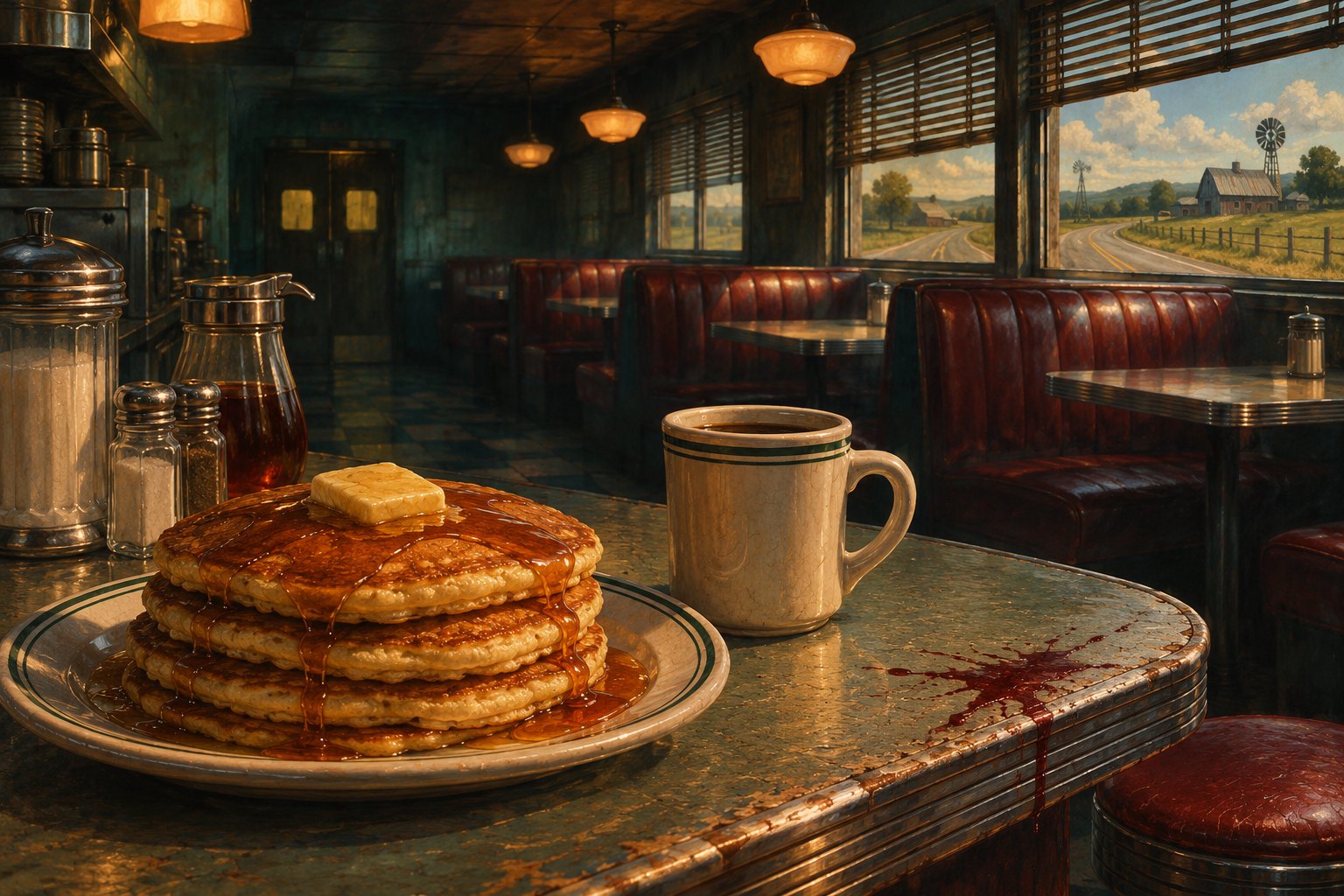
Best Pancakes in the County builds its crime-thriller premise around a useful contradiction: people who can threaten everyone in a restaurant still expect somebody to bring their food. Written and directed by Ken Sanzel, the film brings Nicolas Cage’s criminal S.O.B. into a confrontation involving hired killers, corrupt agents, and diner employees whose apparent vulnerability deserves a second look. Its most interesting question is who gets mistaken for background scenery—and what happens when that person fights back.
Spoilers follow for the opening and the employees’ concealed capabilities. This is a character-focused critical reading based on corroborated plot accounts and published dialogue, rather than a firsthand assessment of every performance or action sequence. The central setup and principal credits are confirmed in the film’s [Apple TV listing](https://tv.apple.com/us/movie/best-pancakes-in-the-county/umc.cmc.1i8lrzy95lq5k2xdhtmkdx5p5).
S.O.B.: A Criminal Who Makes Trust Impossible
The opening gives S.O.B. a particularly revealing introduction. Expecting millions in cash from a break-in, he finds a device connected to cryptocurrency instead. His partner’s reassurance—“It’s not like you’re going to kill me over this”—immediately proves disastrously misplaced. Glenn Kenny recounts the exchange and its lethal outcome in his [review for Roger Ebert’s publication](https://www.rogerebert.com/reviews/best-pancakes-in-the-county-nicolas-cage-movie-review-2026).
That line matters because the partner assumes there is still a shared understanding between them. He appeals to proportion: surely this disagreement does not justify murder. S.O.B. rejects the premise. From that point, any arrangement involving him carries an obvious problem. Negotiation requires some belief that the other person recognizes limits.
The character’s ownership of the diner adds another dimension. A business that should depend on repeat customers becomes an extension of personal control. Read symbolically, the setting suggests hospitality without obligation: S.O.B. can offer shelter, food, or an agreement while reserving the power to make each offer meaningless. His associates are dealing with someone for whom possession appears more reliable than loyalty.
Dolly and Cookie: The People Everyone Underestimates
Shelley Hennig plays waitress Dolly, while Justin Long plays cook Cookie. Their initial position makes them natural points of identification. Armed visitors occupy the room; the employees must continue navigating it. Food service becomes an involuntary performance of normality, requiring them to respond to customers whose demands have acquired potentially lethal consequences.
Published accounts establish that both workers have capabilities and motives beyond their jobs. Alex Maidy also singles out a sequence intercutting their fights with the intruders in his [JoBlo review](https://www.joblo.com/best-pancakes-in-the-county-review/). Those developments shift the employees from apparent bystanders into active participants.
For Dolly, the revealing distinction is between being seen and being understood. A waitress is highly visible when somebody wants something, yet easily ignored as an independent person. Her usefulness to the customers encourages them to classify her before considering what she knows. That gives the character a compelling interpretive function: the room’s assumptions about service work become weaknesses in its assessment of danger.
Cookie offers a related question. Does competence under pressure tell us who a person is, or merely what that person can do? A surprise fighting ability changes the odds of survival. It does not automatically explain loyalties, attachments, or the boundaries someone will refuse to cross.
Why the Breakfast Arguments Matter
The food talk is more than an excuse for the title. Agent Otto, played by Brandon Mychal Smith, questions the diner’s claim: “Best pancakes in the county? What, were they reviewed somewhere? Food Network or something?” Joe Leydon reproduces the exchange in his [Variety review](https://malaysia.news.yahoo.com/best-pancakes-county-review-nicolas-121623240.html).
There is an appealing absurdity in demanding evidence for breakfast superiority while accepting a room full of coercion. Otto applies consumer skepticism to the safest possible subject. The joke offers a recognizable human habit: concentrating on a manageable uncertainty when the larger situation is beyond control.
Elsewhere, orders become their own source of friction. Travis Hopson describes disputes involving a vegetable wrap, Dolly’s mistakes, and Cookie’s struggle to feed dangerous customers in his [Punch Drunk Critics review](https://punchdrunkcritics.com/2026/11/best-pancakes-68961/). These details give the premise a specific social texture. The gunmen bring extraordinary danger but retain ordinary expectations of service.
My reading is that this contradiction supplies the story’s strongest comic idea. Nobody wants to surrender the privileges of being a customer, even after destroying the conditions that make a restaurant function. The employees inherit responsibility for keeping everyone comfortable while receiving almost no consideration themselves.
A Standoff Needs More Than Hidden Identities
Two factions help organize the confrontation: corrupt FBI agents led by Lauren German’s Agent Margot and S.O.B.’s hired guns led by Ravi Patel’s Ryder. Ross McIndoe identifies that arrangement in his [Slant review](https://www.slantmagazine.com/film/best-pancakes-in-the-county-review-nicolas-cage-justin-long/). The competing groups turn the diner into a place where an affiliation can offer protection and invite attack simultaneously.
As a dramatic structure, this is promising. Each person must judge both the visible threat and the reliability of supposed allies. But a character can acquire another allegiance without becoming more interesting. A revelation earns its weight when it changes our understanding of an earlier choice: a hesitation becomes mercy, a mistake becomes concealment, or an apparent kindness acquires a cost.
That distinction also informs our discussion of restaurant conflict and moral responsibility in We Are Born Good. Understanding why someone enters a confrontation is only the beginning. The more demanding question concerns what they choose once escape becomes difficult.
The Deeper Reading: A Room Full of Claims to Authority
The title offers a useful way to interpret the whole premise. “Best” is a claim the diner makes about itself. A badge, a criminal reputation, and an employee’s job title likewise encourage assumptions before anyone has demonstrated what those labels deserve.
On this reading, the confrontation is a struggle over credibility. S.O.B. wants others to accept the force of his reputation. The agents carry institutional authority into private wrongdoing. Dolly and Cookie benefit when people mistake their work for the limits of their identity. Everyone is making—or exploiting—a claim about who matters.
Readers interested in that gap between presentation and character may also appreciate our analysis of status and self-presentation in American Psycho. Here, the diner gives that question an especially concrete form: who gets served, who gives orders, and whose judgment counts?
The most productive way to approach Best Pancakes in the County is to watch those relationships change. Concealed weapons and concealed histories can rearrange a thriller’s balance of power. The deeper test is whether a character’s choices reveal something that a label never could.
Original content by this site's editorial team. Published: November 23, 2026 at 02:28:10 PST (Los Angeles time)