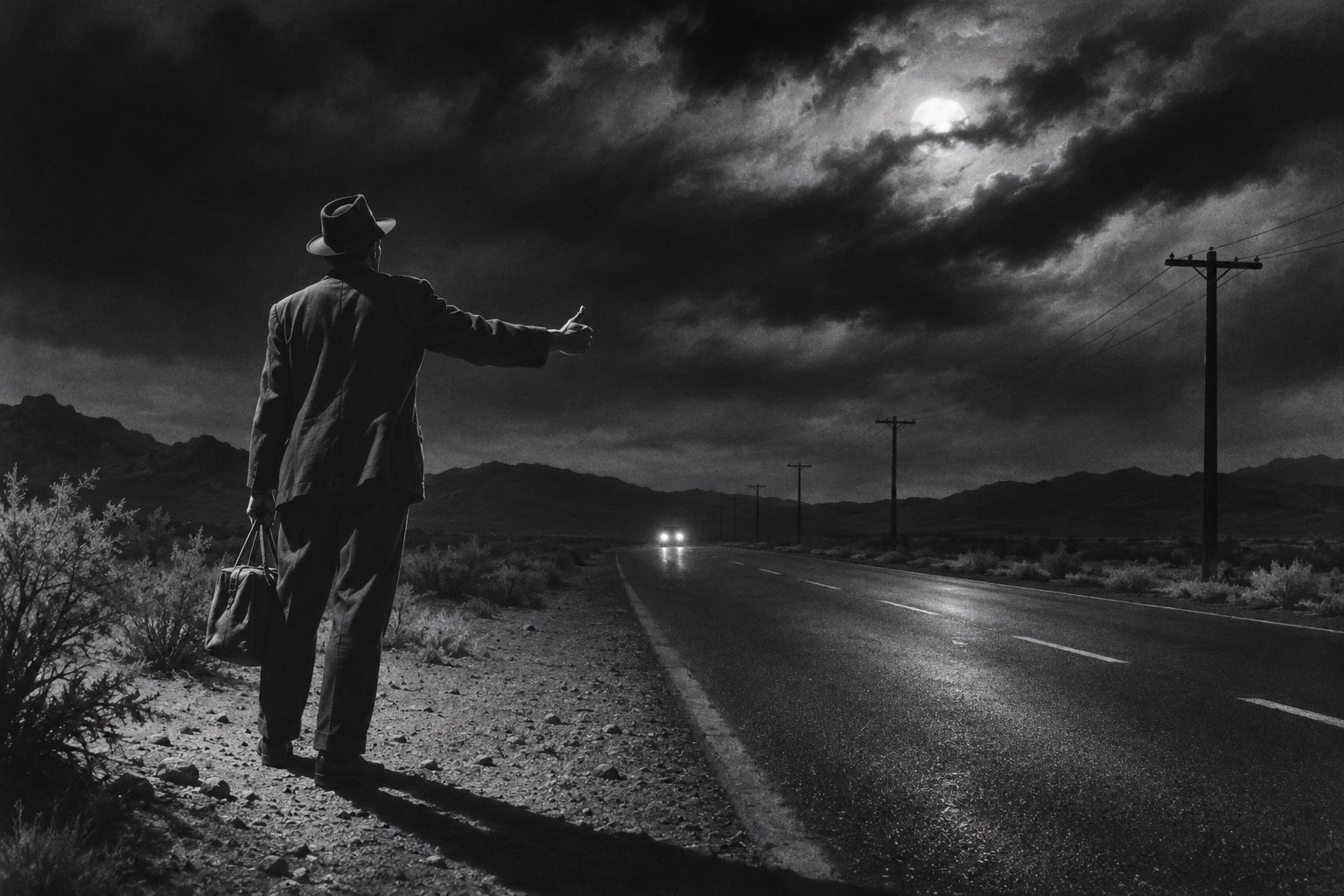
KPBS+ brings ten classic movies together for Noir-vember, offering several ways into film noir: compromised marriages, criminal schemes, frightened witnesses, and people who mistake desperation for permission. My starting recommendation is Detour, Edgar G. Ulmer’s 1945 thriller. Its central question makes an excellent companion to the entire collection: when someone describes every disastrous decision as bad luck, how much should we believe?
Beth Accomando’s KPBS selection spans Detour through Touch of Evil. Below is a quick guide to the ten titles, followed by a closer review of the smallest, meanest trap in the bunch.
The ten films in the KPBS+ Noir-vember selection
- Detour (1945): A hitchhiking pianist encounters death, blackmail, and an increasingly implausible escape route.
- Scarlet Street (1945): An unhappy man’s romantic illusions make him vulnerable to exploitation.
- The Strange Love of Martha Ivers (1946): Childhood violence shadows adult relationships and power.
- Pitfall (1948): An insurance investigation pulls a dissatisfied family man into danger.
- D.O.A. (1950): A poisoned man investigates his own impending death.
- Woman on the Run (1950): A woman searches for her husband after he witnesses a killing.
- Kansas City Confidential (1952): An innocent man pursues the criminals behind his predicament.
- The Hitch-Hiker (1953): Two travelers find themselves at a violent stranger’s mercy.
- The Big Combo (1955): A detective’s pursuit of a crime boss becomes an obsession.
- Touch of Evil (1958): A border-town investigation exposes police corruption.
For a first double feature, I would pair Detour with The Hitch-Hiker: both make accepting a stranger into a car terrifying. For a change of emotional temperature afterward, choose Woman on the Run, where investigating another person creates possibilities beyond betrayal. Check individual KPBS+ listings for current playback access.
Detour review: a man determined to sound innocent
Spoiler warning: The following discussion reveals major events and the ending of Detour.
Tom Neal plays Al Roberts, a nightclub pianist traveling west to reunite with Sue, played by Claudia Drake. Charles Haskell, played by Edmund MacDonald, gives him a ride. When Haskell dies, Al fears the police will blame him. He conceals the body and takes Haskell’s identity. Then he picks up Vera, played by Ann Savage, who recognizes the car and knows enough about Haskell to expose him.
That progression matters because Al keeps presenting action as inevitability. He does things, then describes himself as someone to whom things happen. His fear of accusation may be understandable; his solution manufactures precisely the suspicious circumstances he claims to dread.
Neal’s performance makes Al an uncomfortable companion. He is wounded and resentful, with little of the easy charm that might make us enjoy being deceived. I find that unpleasantness essential. The film makes sympathy an active judgment: we can recognize his terror without accepting his explanation.
His fatalistic refrain supplies the defense: “Whichever way you turn, Fate sticks out a foot to trip you.” It is memorable because it converts responsibility into a physical ambush. Fate becomes the assailant; Al becomes the pedestrian who happened to pass by.
Vera refuses to accept Al’s version
Vera’s arrival changes the balance of power. Until she challenges him, Al can imagine that possession of Haskell’s car and belongings makes his impersonation workable. Vera recognizes the gap between appearances and facts. She understands that his vulnerability is valuable.
Savage gives her speech an attacking rhythm. Vera does not wait for Al to finish constructing a defense before tearing into it. “You’re no gentleman, see?” sounds almost comically inadequate beside the danger surrounding them, yet it exposes another contest: each character wants the authority to define the other.
From Vera’s perspective, knowledge offers bargaining power. That does not make her blackmail defensible. It makes her more interesting than a decorative embodiment of temptation. She is thinking about what information can buy, and she keeps increasing the price.
Her proposed inheritance scheme pushes their arrangement beyond immediate concealment. Al resists impersonating Haskell before people who might know him. His objection is sensible, but it arrives after he has already embraced a smaller version of the same deception. He recognizes the absurdity of Vera’s plan more readily than the danger of his own.
Neither character can build a stable agreement because each needs something the other cannot safely provide. Vera wants compliance; Al wants release. Readers interested in relationships organized around unequal expectations may also appreciate our analysis of romantic rescue fantasies in Mad Love, although this partnership has become outright coercion.
The telephone turns escape into catastrophe
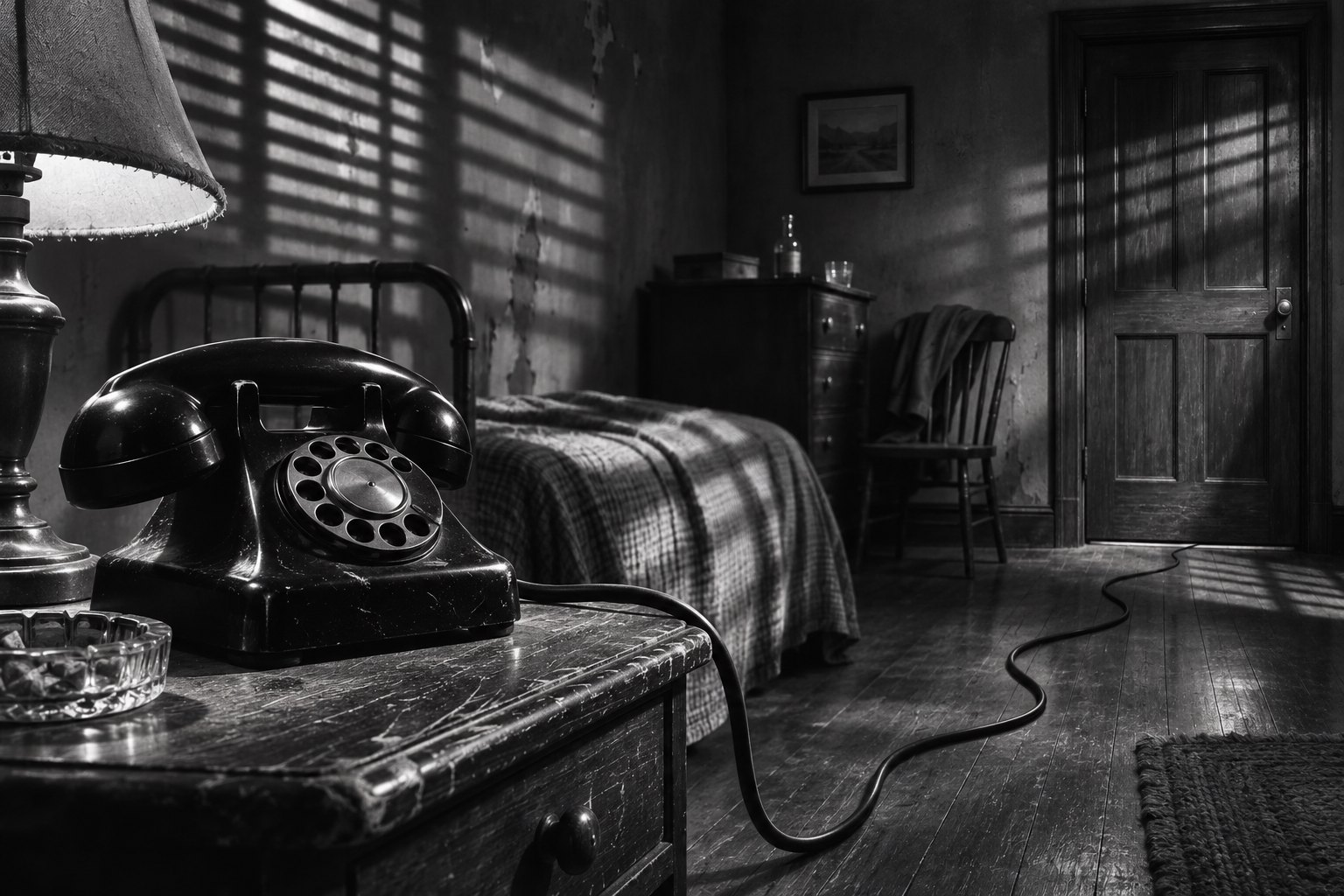
The confrontation in their rented room reduces the film’s geography to a door and a telephone cord. Vera threatens to call the police and locks herself away. Al pulls the cord in an attempt to stop the call. When he enters, he discovers that she has been strangled.
The mechanics are extraordinary enough to test belief. For me, that strain is part of the scene’s disturbing effect, although viewers who need convincing physical probability may find it a serious weakness. The event reaches us inside Al’s account, where even the most damaging action arrives with an explanation attached.
“Vera was dead, and I was her murderer,” he admits. Briefly, the language becomes direct. His subsequent concern with evidence makes that moment sharper: acknowledgment does not automatically produce accountability.
The telephone also completes a cruel visual idea. An object intended to connect people becomes the means by which Al tries to prevent communication. My reading is that the scene gives physical form to his larger problem: he wants to control what others can say about him, and that effort produces consequences he cannot control.
Why the rough edges strengthen the nightmare
Detour offers little visual comfort. Its cramped spaces and conspicuous rear projection can make travel feel strangely stationary. The characters move across America, yet the film rarely grants the expansive freedom associated with a road movie.
I would not pretend every rough edge is an intentional masterstroke. Some viewers will find the acting abrasive and the plotting excessively dependent on coincidence. But the compressed atmosphere gives those limitations expressive force. Al seems unable to get outside either his circumstances or the repetitive explanation running through his head.
That makes an illuminating contrast with the shared vulnerability and cooperation in Jaws. Here, needing another person supplies fresh opportunities for suspicion. Every temporary partnership arrives with an exit clause someone else controls.
The deeper trap: confusing explanation with innocence
The final police-car image closes around Al as he imagines punishment catching up with him. It can be read as the destination his narration has anticipated all along. What remains unsettled is whether fatalism explains his situation or protects him from examining it.
The film does not require us to prove that every part of his account is false. Its more uncomfortable achievement is showing how a person can arrange fear, coincidence, and genuine misfortune into a story that minimizes his own agency.
That is why Detour earns the opening slot in my Noir-vember viewing plan. Beyond the shadows and sharp dialogue, it makes us listen critically to someone asking for our sympathy. Carry that attention into the other nine films: watch the decisions, then listen to the explanations. The distance between them is where noir becomes most revealing.
Original content by this site's editorial team. Published: November 14, 2026 at 02:00:22 PST (Los Angeles time)