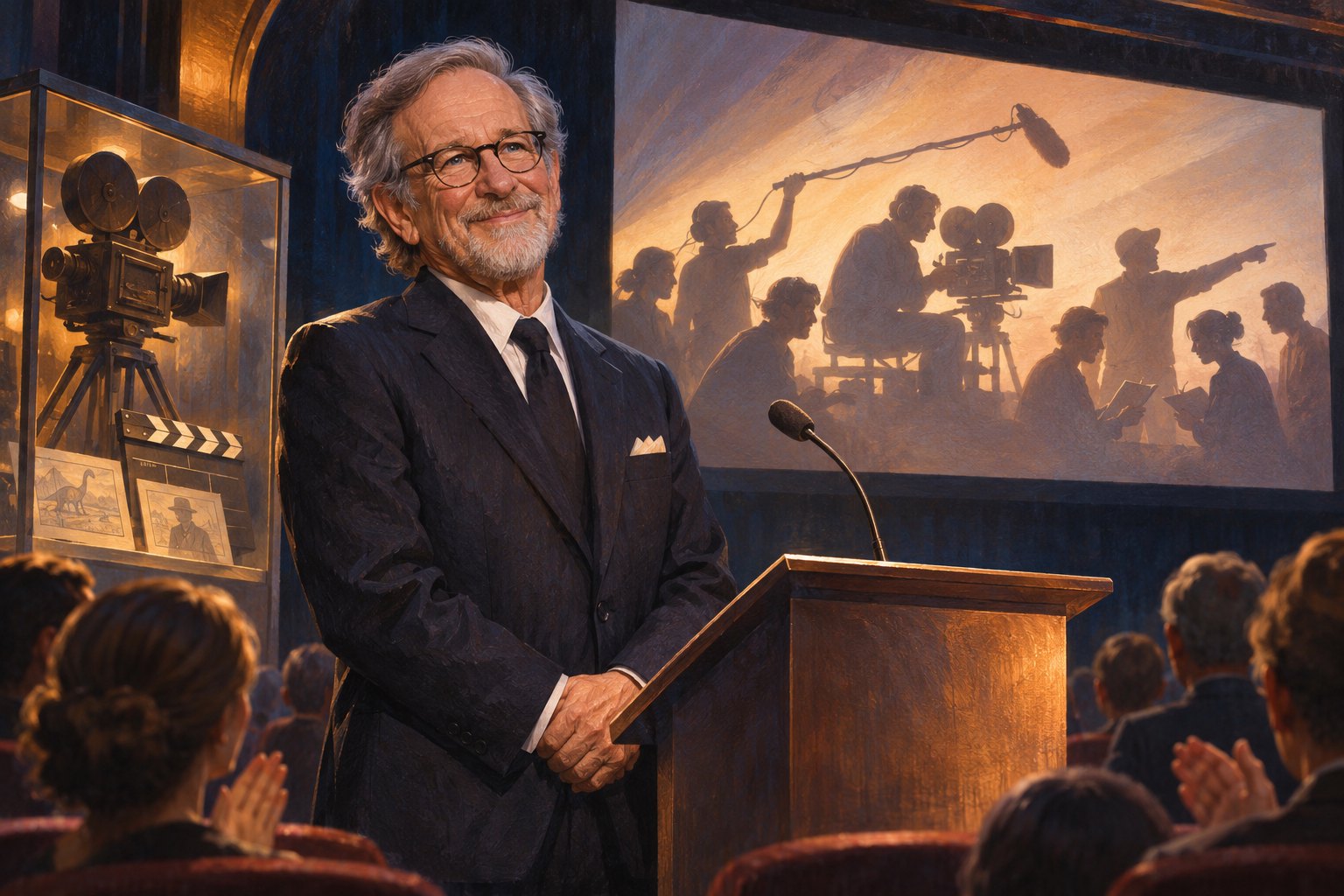
Steven Spielberg was honored at the Museum of Modern Art Film Benefit, and the remark highlighted in CNN’s coverage gives the occasion an unusually thoughtful center: “Standing up here alone feels wrong.” For a filmmaker whose name can dominate the conversation around a movie, that discomfort invites a worthwhile question. What becomes visible when we look beyond the person receiving the applause?
One answer lies inside Jaws. Spielberg’s shark thriller offers an especially revealing example of individual ability depending on other people. Its three central men bring different skills, prejudices, and fears aboard the same boat. Their struggle makes an illuminating companion to the sentiment in Spielberg’s remark, without turning a fictional adventure into an explanation of his speech.
Spoiler notice: The following critical reading discusses major scenes and the ending of Jaws.
A director’s honor invites a closer look at shared authorship
The museum’s recognition establishes the occasion; the connection to Jaws is an interpretation. Spielberg’s discomfort with standing alone suggests a useful approach to appreciating directing: look at how a movie brings separate contributions into a coherent experience. The honor itself is documented in [MoMA’s Film Benefit listing](https://www.moma.org/calendar/events/11620).
For Jaws, those contributions include the screenplay by Peter Benchley and Carl Gottlieb, cinematography by Bill Butler, editing by Verna Fields, and music by John Williams. These credits are recorded in [Amblin’s film overview](https://amblin.com/movie/jaws/). Naming them changes how we watch. Suspense emerges through the relationship between what the camera reveals, how long an image lasts, what we hear, and what a performer lets us recognize.
That relationship also informs our discussion of how film scoring serves character and storytelling. Music becomes dramatically meaningful through its placement within a scene. The same principle applies across a production: excellent individual work gains force through its connection to everything around it.
Brody’s strongest quality is his capacity for doubt
Police chief Martin Brody is an appealing center for Jaws because responsibility comes to him without the comforting certainty that he can manage it. On Amity Island, public safety collides with the community’s dependence on visitors. Brody understands the danger, yet his authority proves vulnerable to pressure from people who prefer a reassuring explanation.
From his perspective, the early beach scenes are exercises in divided attention. Ordinary movement becomes suspicious. Conversations interrupt observation. He must decide which disturbance matters while everyone else expects a normal summer day. Spielberg makes that burden legible by organizing our attention around Brody’s inability to watch everything.
Roy Scheider gives the character a particularly effective mixture of watchfulness and exhaustion. Brody’s fear does not feel like a decorative flaw waiting for a triumphant cure. It affects how he occupies space, approaches water, and responds to men who seem more comfortable with danger.
When he finally sees the shark close to the boat, “You’re gonna need a bigger boat” works as both comic release and a brutally practical assessment. The line shrinks the men’s confidence to the scale of their actual circumstances. Brody can survive because new evidence changes his thinking. He does not need to protect an image of himself as fearless.
Hooper knows the science, but knowledge needs a hearing
Matt Hooper, played by Richard Dreyfuss, brings a different frustration into the story. He can recognize evidence that others dismiss, but being correct does not automatically make him persuasive. His professional knowledge meets institutional resistance on land and personal hostility at sea.
That distinction keeps Hooper from becoming a convenient dispenser of answers. His expertise matters, but his confidence can also sharpen an argument that already needs calming. He is a person trying to be heard, with impatience and pride attached to his competence.
Against Quint, Hooper’s equipment and education become symbols in a contest over whose experience deserves respect. The conflict is entertaining because neither man is simply pretending to know his subject. They possess different kinds of real knowledge. The problem is their tendency to treat acknowledgment of the other man’s abilities as a loss of status.
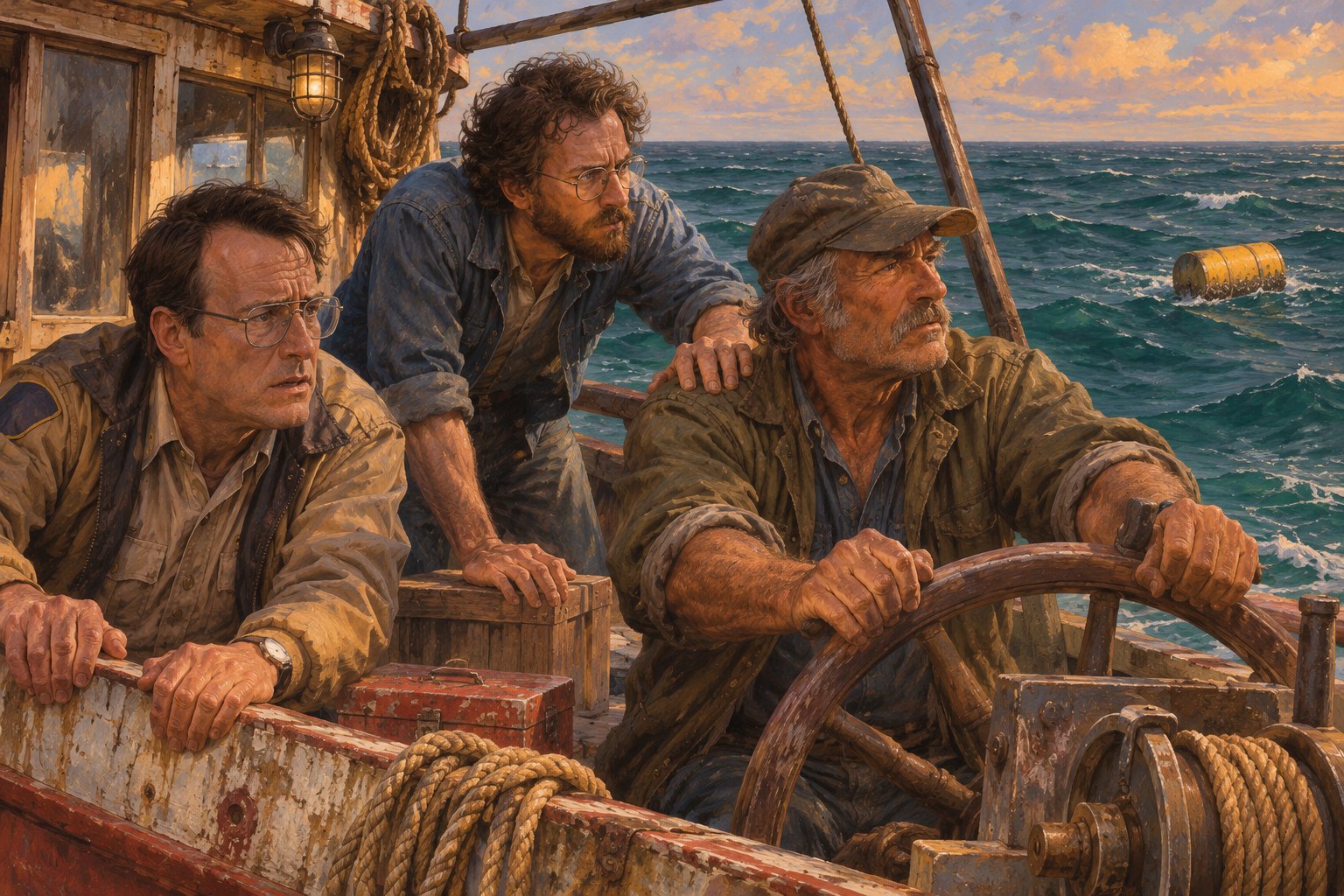
Quint’s confidence becomes the boat’s second danger
Robert Shaw’s Quint initially offers the reassurance Brody lacks. He speaks as someone who has already measured the threat and decided what defeating it will cost. His presence promises practical mastery, making it easy to understand why frightened people might place their trust in him.
The Indianapolis speech complicates that promise. Quint’s account of surviving the sinking and its aftermath gives his fixation a terrible emotional foundation. The scene asks us to listen to the pain beneath his abrasive performance of toughness. For a time, the competition between the men gives way to shared attention.
Yet understanding Quint does not make every subsequent decision defensible. When he destroys the radio, his insistence on controlling the hunt deprives the others of a route to help. Experience has hardened into a refusal to accept limits. The man who appears best equipped to command becomes dangerous precisely because he cannot bear to yield.
In my reading, this is the film’s sharpest distinction between courage and domination. Courage can admit dependence. Domination treats dependence as humiliation. Quint’s tragedy develops from the way his knowledge and suffering become inseparable from his need to remain in charge.
The ending complicates the solitary hero
Brody eventually faces the shark without another man beside him on the sinking boat. That image might seem to settle the film in favor of individual heroism. He must act, and no reassuring authority can take over.
But his last stand depends on the expedition’s accumulated resources. Hooper’s compressed-air cylinder and Quint’s rifle become part of Brody’s improvised solution. The ending does not erase the others simply because the decisive action belongs to him. His achievement grows out of an unstable partnership whose materials and lessons remain available after its apparent collapse.
Hooper’s return also matters. The final movement gives Brody companionship again, replacing the isolated confrontation with two survivors making their way toward shore. The emotional destination is relief shared with another person.
That is why character remains essential to the spectacle. As our examination of why memorable survivors strengthen a horror film argues, danger gains weight through the people trying to live beyond it.
What Spielberg’s recognition helps us see
Jaws remains, in my judgment, an extraordinarily satisfying thriller because its character conflicts actively shape its action. Fear, expertise, and pride determine what happens aboard the boat. The suspense has human causes as well as a monstrous one.
Viewed alongside Spielberg’s MoMA honor, the film offers a deeper way to think about accomplishment. A recognizable individual can deserve recognition while carrying the work of others into every moment of success. Brody’s final act belongs to him, but its possibility belongs to more than one person. Spielberg’s remark makes that distinction worth keeping in view when the applause begins.
Original content by this site's editorial team. Published: November 14, 2026 at 00:05:30 PST (Los Angeles time)