
A Sesame Street movie is in the works at Netflix, according to The Hollywood Reporter. That is an appealing prospect for families, but the creative question reaches beyond seeing familiar faces in a feature: can a movie make room for the way a young child experiences a problem, a friendship, or an unfamiliar place?
The most promising version would give its characters something emotionally meaningful to do with the additional time. A longer adventure can deepen a relationship, allow a misunderstanding to develop, and make an act of kindness feel earned. It can also bury those pleasures beneath hurried plotting. For this project, the difference could determine whether the neighborhood feels welcoming or merely recognizable.
This is spoiler-free commentary on a developing project, not a review of a completed film. The reported news establishes that a movie is in the works; it does not provide the basis for evaluating performances, recounting scenes, or quoting dialogue. The discussion below concerns the storytelling possibilities, without presenting them as the announced plot.
What the movie news tells viewers—and what it cannot
For anyone searching for the new Sesame Street movie, the immediate answer is straightforward: Netflix is the platform associated with the reported project. The development headline alone does not establish when families will be able to watch it, which characters will lead the story, or what shape that story will take.
Those distinctions matter because recognition creates expectations quickly. A familiar title can prompt audiences to imagine a cast, a musical style, or a particular kind of adventure before those details have been established. None of those assumptions should become a substitute for an actual announcement.
There is still something useful to discuss now: what the feature format could contribute. More running time is valuable when an early choice has consequences that a character eventually understands. Without that progression, a movie risks feeling like a collection of encounters with a destination attached.
A child’s concern should be large enough to carry the story
My strongest hope is that the movie trusts an ordinary emotional concern. Wanting to join a game, fearing a mistake, or struggling to explain a feeling can provide substantial dramatic stakes when the audience understands why the experience matters to the character.
That does not require a small visual world. A film can travel widely while staying close to one character’s understanding. The crucial question is whether a new location changes what that character notices, fears, or chooses. A beautiful setting becomes dramatically useful when it complicates a relationship or offers a new way to solve a problem.
From a character’s perspective, the audience should be able to follow three things: what I want, what I misunderstand, and what I am willing to try next. Keeping that chain legible would let younger viewers participate in the story instead of simply watching events arrive.
Our discussion of preserving character motivation when an adaptation changes form addresses a related challenge. Whatever the source material, emotional continuity gives individual moments their cumulative force.
An ensemble needs different ways of seeing the same problem
A neighborhood movie offers a particularly useful dramatic resource: several people can care about the same situation for different reasons. One may want to act immediately. Another may need reassurance. Someone else may have noticed a practical detail everyone overlooked. These are possibilities for ensemble writing, not descriptions of the upcoming film.
The important choice is whether those differences affect the action. If every character agrees instantly, cooperation becomes decorative. If a disagreement changes the plan, listening becomes something the audience can see working.
A satisfying ensemble also distributes agency. The central character can make the decisive choice without supplying every useful idea. A quieter participant should be able to contribute something that changes the outcome. Otherwise, a story that celebrates community may still function as a demonstration of one exceptional individual doing everything.
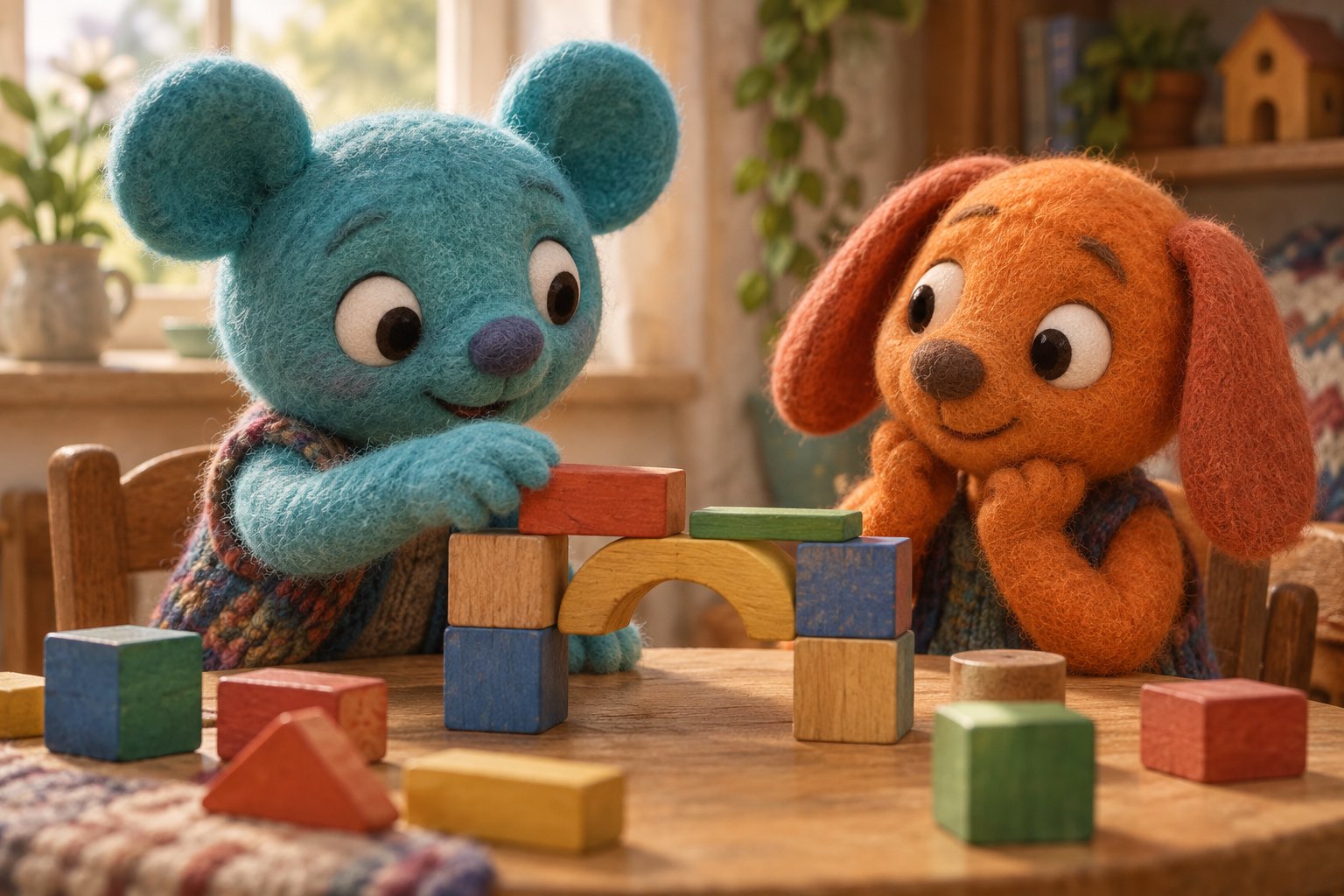
The filmmaking can support that distinction. A reaction shot lets us register that someone feels excluded. A pause gives another character time to notice. Returning to the first character after an apology allows us to see whether the apology helped. These small decisions can carry more emotional information than an explanatory speech.
Comedy should reveal a personality
For my taste, the best family-film humor grows from a recognizable intention that goes slightly wrong. Someone tries too hard to help, misunderstands an instruction, or approaches a simple task with elaborate confidence. The joke belongs to the character because another personality would have handled the situation differently.
That creates opportunities for repetition with development. A recurring comic habit can first cause trouble, then become useful once the character learns when to apply it. The eventual payoff rewards attention while showing change through behavior.
The same principle applies to dialogue. Memorable lines need a situation, a speaker, and an emotional reason to last. Until actual dialogue is available, assigning quotations to this movie would be misleading. The meaningful question is whether its eventual words emerge from relationships strongly enough that audiences want to repeat them.
Visual energy needs room for a response
A feature offers opportunities for expressive framing, movement, design, and scale. But visual energy works best when viewers can identify what deserves their attention. A busy frame can be funny; constant busyness can make a crucial look or gesture difficult to read.
Our commentary on looking beyond visual spectacle to character and performance offers a useful standard here. An image earns its place through the experience it creates, including what it lets us understand about someone.
For this movie, I would watch the transitions between excitement and recovery. After a surprise, does a character get a moment to process it? After an argument, does the next scene acknowledge the discomfort? Those intervals make consequences readable and give an audience time to care.
The deeper opportunity: belonging as something characters practice
The richest possibility in a Sesame Street feature is a story in which belonging develops through action. Someone makes space. Someone asks a better question. Someone revises an assumption after hearing an answer. Community becomes credible through these choices.
That would also give the ending something substantial to resolve. Reaching a destination or completing a task can supply closure, but a changed relationship supplies meaning. The final encounter should let us recognize a difference in how the characters treat one another.
My standard for Netflix’s movie would therefore be simple: does its adventure leave its characters better able to understand each other? If the finished film earns that change through humor, mistakes, and patient observation, the feature format will have given the neighborhood something worth the trip.
Original content by this site's editorial team. Published: September 24, 2026 at 22:08:54 PDT (Los Angeles time)